A Behavioral Model of User Onboarding
Why onboarding succeeds when motivation, capability, and context align in the user’s current moment.
Design for behavior change with the Persuasive Patterns card decks
Apply psychological principles to influence decisions, increase engagement, and optimize user experience.
Get your deck!Onboarding is often treated as a sequence.
A user arrives, signs up, completes a set of steps, and is considered onboarded. When that process breaks, the usual response is to adjust the flow: rewrite the checklist, shorten the tutorial, reduce a few fields, improve the sequence.
Sometimes that helps.
But most onboarding does not fail because the flow is slightly wrong. It fails because the product asks for an action that does not match the user’s situation in that moment.
A user arriving with urgency behaves differently from one who is exploring. A beginner needs something different from an expert. A user with five minutes cannot follow the same path as someone sitting down for an hour.
More importantly, these conditions do not stay fixed. They change from moment to moment. Context changes.
That is why onboarding is not just a flow problem. It is a behavioral problem.
In practice, I have found that adapting the experience to different user contexts leads to better outcomes than trying to design the perfect prompt, as emphasized in B=MAP. And it is not enough to rely only on “opportunity” as defined in COM-B (physical, environmental, or social conditions). To design user onboarding experiences, I’ve found that a more useful concept is context: what the user can realistically do in a specific moment.
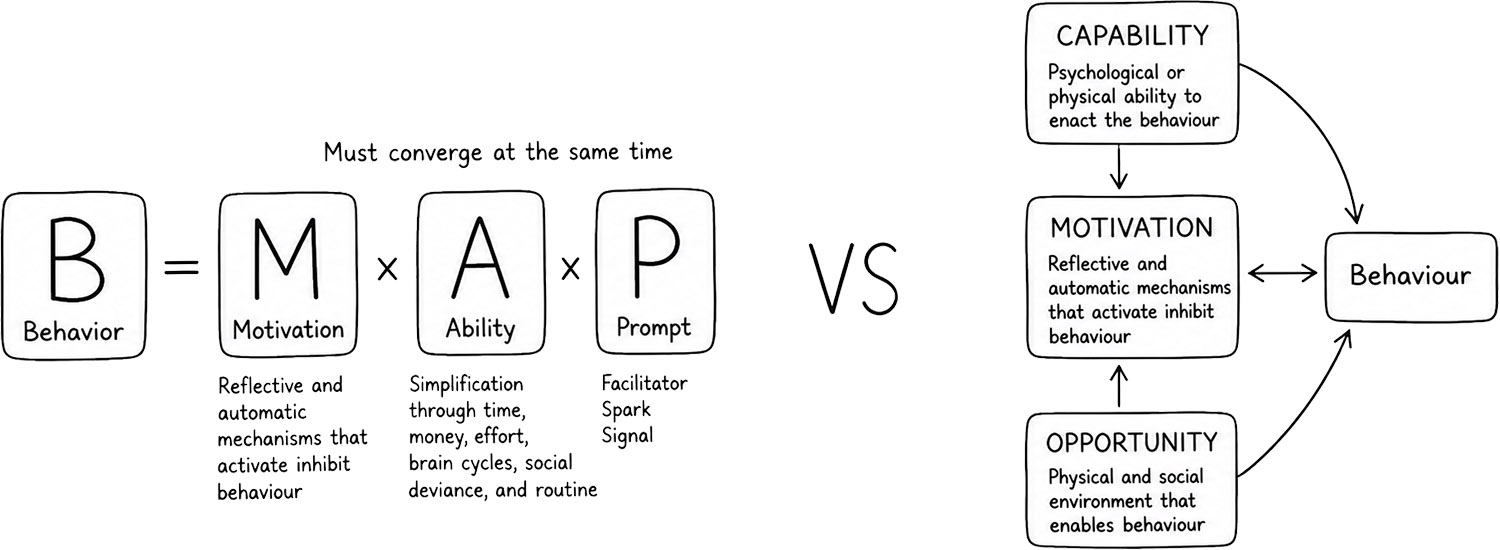
I have used models like B=MAP and COM-B for years to think about user behavior and customer adoption. Both are useful, but neither fully captures the realities of onboarding. The missing piece is not just whether action is possible in general, but whether it fits the user’s situation right now.
The framework in this article builds on the strengths of both models, but treats context as time-bound: a window in which action can happen now. Prompts and other interventions still matter, but they function as ways of helping the user act within that window.
This model is not derived from academic research or peer-reviewed theory. It comes from practice—hundreds of onboarding and product design projects across different products and use cases. It is the framework I have found most useful for understanding why onboarding succeeds or fails in real situations.
Across the onboarding lifecycle, the same pattern appears repeatedly. Before the product, users arrive with different levels of intent. In the first moment of real value, timing determines whether effort turns into progress. Beyond day one, users must re-enter in new situations with new constraints. And repeated use becomes habit only when those situations become stable enough for action to happen again and again.
These are not separate challenges. They are different expressions of the same underlying problem:
At any moment, action depends on three things being aligned: motivation, capability, and context.
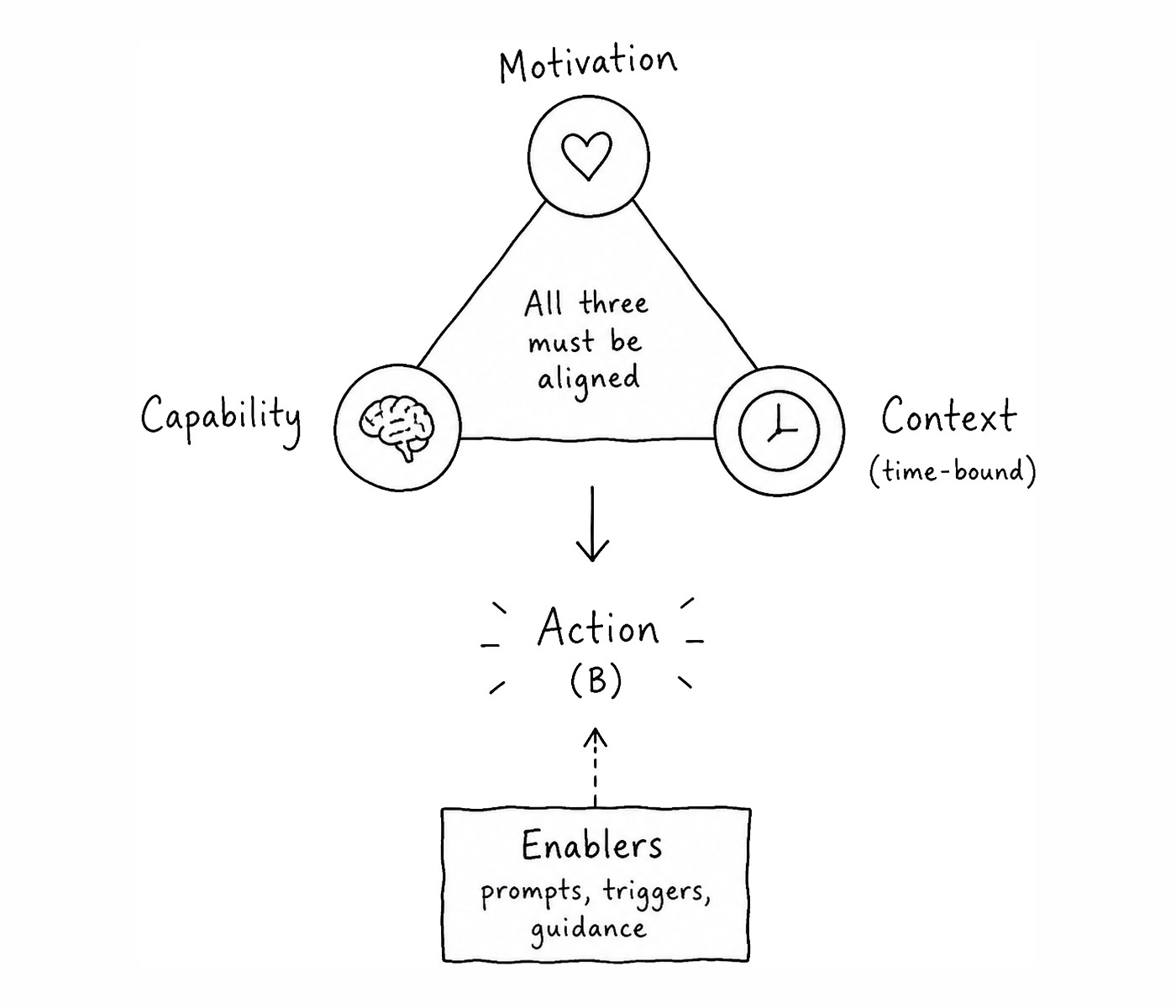
A useful way to think about onboarding is as a function of three variables:
Success of onboarding = Motivation × Capability × Context
Each user, at any point in time, sits within a specific combination of these three conditions.
Onboarding succeeds when the next action fits that combination. It fails when it does not.
The multiplication matters.
If any one variable is too low, action does not happen:
- A motivated user still fails without capability
- A capable user still does not act in the wrong context
- A user in the right context still disengages if motivation is low
You cannot motivate your way out of missing capability. You cannot simplify your way out of absent motivation. You cannot educate your way out of a moment where the user has no time or attention to act.
Improving onboarding is not about maximizing one variable. It is about aligning all three.
And in practice, onboarding does not fail in general. It fails in specific moments.
Between friends, I call this practical and pragmatic model the “MCC Model”.
Action happens in windows of opportunity
Context is not just a background condition. It defines whether action can happen now, and for how long.
At any point, the user has a limited window in which action is possible.
That window may be:
- a few seconds between tasks
- a few minutes of focused attention
- a longer session with time to invest
These windows open, narrow, and close. When they close, the opportunity to act often disappears with them.
Motivation may still exist and capability may still be sufficient, but if the window is gone, action does not happen.
This leads to a more precise way to think about onboarding:
Onboarding succeeds when the required action fits within the user’s current action window.
And fails when it does not.
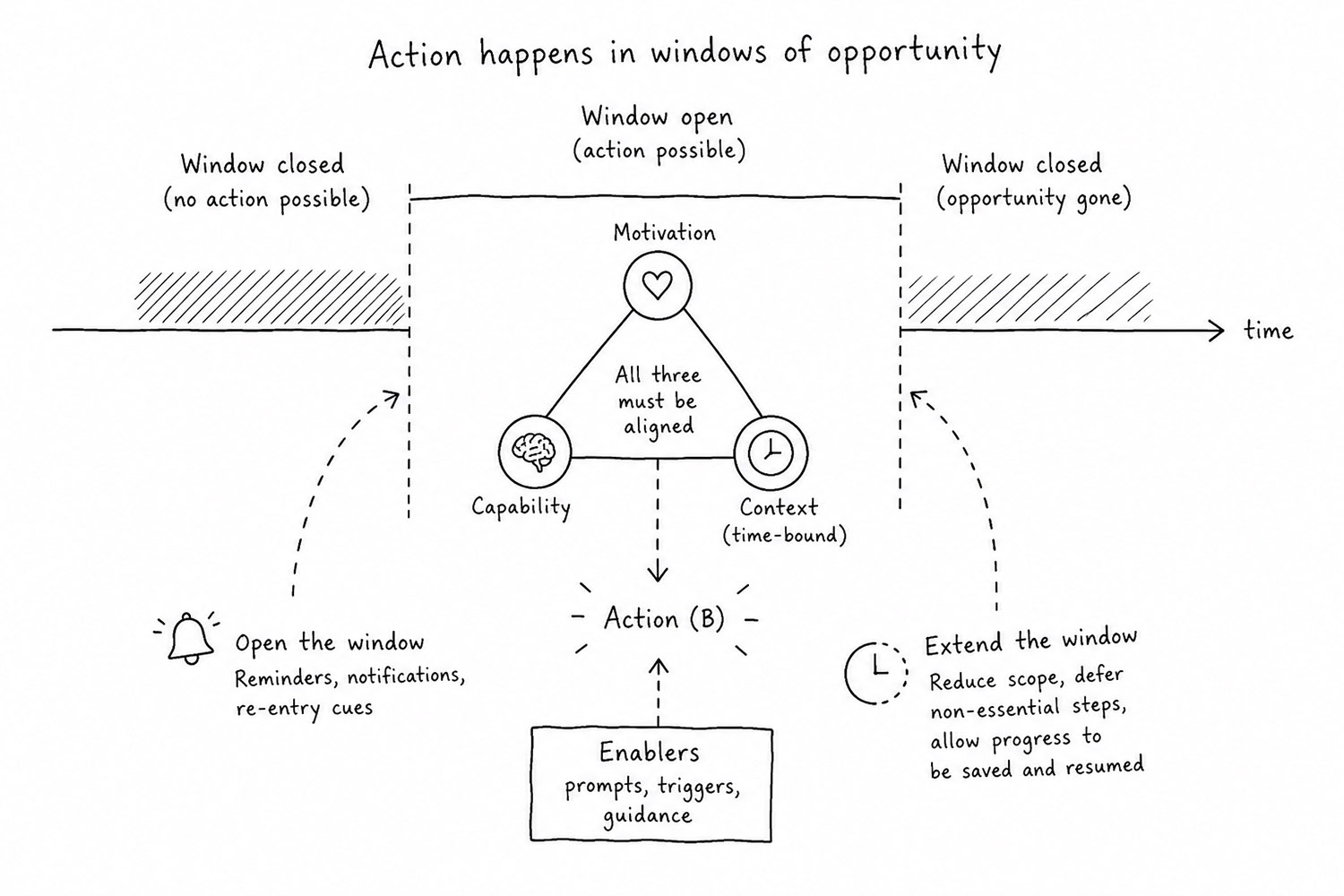
This is why the first moment of real value matters so much. It must arrive before motivation fades, before attention shifts, and before the current window closes. It also explains why onboarding continues beyond day one. Users return in new windows, with different levels of attention, different priorities, and often a different ability to act.
And it explains why habits are hard to build as repeated use depends on stable, recurring windows. If no reliable moment exists for the behavior to happen again, repetition does not form.
What appears across onboarding as separate problems is often the same problem viewed at different points in time: the next action does not fit the moment.
The limits of one-size onboarding
Most onboarding flows are designed for an average user, but in practice, that user rarely exists. Users arrive with different levels of motivation, different capabilities, and different available moments. Yet a single onboarding path usually assumes a certain amount of time and attention available and an ability to proceed.
When those assumptions are wrong, the flow fails.
These are not edge cases, but what happens when one path is designed for one combination of motivation, capability, and context, then applied to everyone. When onboarding fails, the cause is usually not “the flow” in the abstract. It is a mismatch between what the product expects and what the user’s current moment allows.
- If motivation is too low, users choose not to begin
- If capability is too low, users cannot proceed
- If context is insufficient, users do not proceed now, and often never return
The goal of the designer is not to design a perfect sequence, but more to design a system that works across different moments (across windows of opportunity) and adapts when the active constraint changes.
Defining windows of opportunity
Let’s examine the three variables in greater detail: Motivation × Capability × Context
Motivation: why the user is here
Motivation is the user’s reason for using the product, and how strongly they feel it.
Users do not arrive with the same kind of motivation. Some are trying to solve an immediate problem. Others are evaluating options. Some are browsing with weak intent. Some were invited by others. Some are switching from an existing tool. Some arrive already persuaded, but with expectations that may or may not be met.
| Motivation Type | Description | Risk | Design focus |
|---|---|---|---|
| Urgent | Immediate problem to solve | Impatience | Speed to value |
| Intentional | Clear goal, evaluating options | Overthinking | Clarity and proof |
| Curious | Browsing, weak intent | Drop-off | Low-commitment entry |
| Invited | Brought in by others | Confusion | Context and relevance |
| Switching | Leaving another tool | Skepticism | Migration and reassurance |
| Warmed | Pre-existing belief | Expectation mismatch | Deliver value quickly |
Motivation determines how much effort a user is willing to invest. But it does not guarantee action.
To act on motivation, onboarding must reduce uncertainty and make the value of acting now clear. This includes:
- clarifying what the user will get
- showing proof that it works
- setting expectations about what happens next
- reducing perceived risk and hesitation
These are not separate elements. They are how motivation becomes strong enough to support action within a limited window.
Motivation creates intention. It does not ensure action.
Capability: what the user can do
Capability is the user’s ability to take the required action. It includes domain knowledge, familiarity with similar tools, understanding of your product, and confidence in using it.
When capability is too low, users stall not because they lack interest, but because they do not know what to do or how to proceed.
To act on capability, onboarding must make the next step clear and achievable in the current moment. This includes:
- showing a clear next action
- providing guidance and examples
- using defaults to reduce effort
- structuring tasks so they can be completed step by step
Capability is not fixed, but built across moments. As it grows, what fits within the same window changes. Early on, only small, guided actions are possible. Later, larger and more complex actions fit into the same amount of time.
This creates a progression:
- assisted action
- independent action
- repeated action
Each action should fit the user’s current capability and slightly increase it for the next moment.
Context: whether action can happen now
Motivation explains why the user is here. Capability explains what the user can do. Context determines whether action happens now.
Context includes:
- time available
- attention available
- environment
- interruptions
- competing priorities
Even when motivation and capability are sufficient, action fails if it does not fit into the current moment. To act on context, onboarding must adapt the size and timing of the action to the window that exists. Example of design strategies might be:
- reducing the scope of what is asked
- splitting work into smaller steps
- allowing progress to be saved and resumed
- asking for action at the right time
- creating new opportunities to return when no window exists
Time available is an important part of context as it helps determine the size of the action:
| Context Condition | What it means | What fits in the window |
|---|---|---|
| Seconds available | No time for setup | One immediate action |
| 2–5 minutes | Limited but intentional | Single-step progress |
| 10–30 minutes | Willing to invest effort | Guided setup or partial workflow |
| Interrupted attention | Likely to be paused | Resumable, low-risk steps |
| Mobile / on the go | Reduced input and focus | Minimal interaction |
| Focused session | Deep work possible | Full workflows |
A single onboarding path cannot work equally well across these conditions.
In this way, a user is a sequence of moments. Their motivation, capability, and context changes over time. What looks like drop-off is often a mismatch between what the product expects and what the current moment allows. At any point, one variable is usually limiting action.
The useful question is not “Where do users drop off?” but:
What is preventing action in this moment?
Diagnosing onboarding failures
A user who does not start may lack motivation, or may simply not have the time in that moment. A user who abandons a flow may be confused, or may be interrupted.
To improve onboarding, the goal is not just to observe behavior, but to identify what is preventing action in that specific moment.
The model provides a way to do that by mapping observable behavior to the most likely limiting variable.
| What you observe | Likely constraint | What is actually happening | What to change |
|---|---|---|---|
| Users do not start | Motivation ↓ | The value does not justify the effort to begin | Clarify value, reduce perceived effort |
| Users drop before first meaningful action | Capability ↓ | The required action is unclear or unfamiliar | Guide the first step, reduce ambiguity |
| Users abandon mid-flow | Context ↓ | The action does not fit into the available window | Reduce scope, split into smaller steps |
| Users complete setup but do not return | Context ↓ | No new window is created for return | Create re-entry points and prompts |
| Users explore but do not commit | Motivation ↓ | The value remains uncertain relative to effort | Strengthen proof, clarify outcomes |
| Users hesitate before key actions | Capability ↓ | They are unsure how the action works or what will happen | Add examples and clearer outcomes |
| Users say “I’ll do this later” but don’t | Context ↓ | The window closes and is not recreated | Add reminders, preserve state, reduce restart cost |
| Users use once but do not build a habit | Context ↓ | No stable window exists for repeat behavior | Create consistent usage moments |
The observable behavior is only the surface. The active constraint explains the cause.
In practice, multiple constraints may be present, but one is usually dominant in that moment. Identifying it changes how the problem is approached.
Once the constraint is clear, onboarding improves by changing that variable within the current window, not by redesigning the entire flow.
Enablers: acting on the moment
Motivation, capability, and context define whether action is possible. But possibility alone does not guarantee behavior.
A user may intend to act, understand what to do, and have enough time available, yet still not move. Attention shifts. Something interrupts. The moment passes without action being taken. This gap between possible and actual behavior is where onboarding often breaks down.
Designing for alignment is necessary, but might not be sufficient. Onboarding must also ensure that when the conditions are right, action actually happens before the window closes. This requires mechanisms that operate in time, within the moment itself.
Enablers are the mechanisms that turn a viable moment into an actual action.
They do not replace motivation, capability, or context. They operate on them in real time, increasing the likelihood that the user acts before the opportunity disappears.
In practice, enablers take different forms depending on which variable is limiting:
- To increase motivation: clarify value, show proof, reduce risk, reinforce trust
- To increase capability: guide the next step, provide examples, reduce complexity
- To adapt to context: reduce scope, enable resumption, adjust timing, create return moments
These interventions are how onboarding design can trigger user behavior within each moment. They serve three roles.
- They open a window. When no moment for action currently exists, onboarding must create one. This often happens outside the product interface via reminders, notifications, re-entry cues, and prompts tied to relevant events. The goal is not simply to bring the user back, but to do so at a time when action is more likely to be possible.
- They extend a window. When a window exists but is limited, onboarding must make it large enough for meaningful progress. This involves reducing what is required in that moment by deferring non-essential steps, breaking tasks into smaller parts, allowing partial completion, or minimizing setup before value. Extending a window does not require more time. It requires adjusting the size of the action to fit the available time.
- They complete within a window. When the user is ready to act, the priority is to ensure that action completes before the window closes. At this point, friction has the highest cost. Ways to reduce friction in this case could include a clear and visible next step, guidance at the point of action, feedback that confirms progress, and reassurance about outcomes. The goal is to reduce hesitation and make continuation the easiest option.
These roles are not separate stages. They are different ways of acting on the same moment, depending on what is missing.
Across onboarding, the task is consistent: ensure that when a window opens, it leads to action.
Designing across the onboarding lifecycle
The model applies across the full onboarding lifecycle, but the dominant constraint shifts over time.
Before the product, the primary challenge is motivation. Users must arrive with a reason to act and a belief that the effort is justified.
At the first moment of value, capability and context become critical. The user must be able to act immediately, within the available window, and see progress quickly.
Beyond day one, context becomes the main constraint. Users return in new situations, often with less attention and competing priorities. Onboarding must support re-entry and reduce the effort required to continue.
As usage repeats, habit formation depends on stability in context. Action must fit into a recurring window that can be relied on over time.
Each stage reflects the same model, but with different variables limiting action.
Designing onboarding means identifying which constraint dominates at each stage and adapting accordingly.
Onboarding as a system
To design a successful onboarding experience, it is too simple to think of onbaording as a sequence of steps that users complete once. You will benefit more from thinking about onboarding in terms of a system that operates across moments.
Within that system:
- motivation must be sustained or renewed
- capability must be built gradually
- context must be adapted to changing conditions
- action must be enabled within each available window
Failure at any point is not a general breakdown, but a mismatch in a specific moment. In this way, the central question of onboarding is not: “What steps should users complete?”, but more:
What is the next action, and does it fit the user’s motivation, capability, and context in this moment?
Because action does not happen in general.
It happens in moments.
And onboarding works only when each moment leads to action.
- Fogg Behavior Model by BJ Fogg
- The Behaviour Change Wheel: A New Method for Characterising and Designing Behaviour Change Interventions by Susan Michie, Maartje M van Stralen, Robert West
- Osterwalder, A., Pigneur, Y., Bernarda, G., & Smith, A. (2014). Value Proposition Design: How to Create Products and Services Customers Want. Wiley.
- Fitzpatrick, R. (2013). The Mom Test: How to Talk to Customers & Learn If Your Business is a Good Idea When Everyone is Lying to You.
- Fogg, B. J. (2009). A behavior model for persuasive design. Proceedings of the 4th International Conference on Persuasive Technology. https://doi.org/10.1145/1541948.1541999
- Michie, S., van Stralen, M. M., & West, R. (2011). The behaviour change wheel: A new method for characterising and designing behaviour change interventions. Implementation Science, 6(1), 42. https://doi.org/10.1186/1748-5908-6-42
- Lally, P., van Jaarsveld, C. H., Potts, H. W., & Wardle, J. (2010). How are habits formed: Modelling habit formation in the real world. European Journal of Social Psychology, 40(6), 998–1009. https://doi.org/10.1002/ejsp.674
- Wood, W., & Neal, D. T. (2007). A new look at habits and the habit-goal interface. Psychological Review, 114(4), 843–863. https://doi.org/10.1037/0033-295X.114.4.843
- Sweller, J. (1988). Cognitive load during problem solving: Effects on learning. Cognitive Science, 12(2), 257–285. https://doi.org/10.1207/s15516709cog1202_4
- Mark, G., Gudith, D., & Klocke, U. (2008). The cost of interrupted work: More speed and stress. Proceedings of the SIGCHI Conference on Human Factors in Computing Systems. https://doi.org/10.1145/1357054.1357072
- Simon, H. A. (1971). Designing organizations for an information-rich world. In M. Greenberger (Ed.), Computers, communications, and the public interest (pp. 37–72). Johns Hopkins Press.
- Deci, E. L., & Ryan, R. M. (1985). Intrinsic motivation and self-determination in human behavior. Plenum.
- Nielsen, J. (1993). Usability engineering. Academic Press.