Workshop Exercises: Ideate
Bad-to-Brilliant
Create silly, impractical, and unethical ideas to turn them around for good

Why: Foster a relaxed, inclusive environment that boosts creativity and confidence
When: Effective in situations where traditional brainstorming has become stagnant
Free participants from the usual constraints of practicality and ethics, allowing for unrestrained creative thought by initially encouraging ‘bad’ or unconventional ideas. The process of brainstorming deliberately bad ideas help bring out participants’ creative abilities. It challenges them to think in unconventional ways, which can lead to unique and innovative insights.
Transforming ‘bad’ ideas into viable, ethical solutions, requires participants to think critically and innovatively. By flipping impractical or unethical ideas into positive solutions, participants become more aware of ethical considerations in design and behavioral psychology.
The exercise is designed to create a relaxed environment where participants feel comfortable sharing ideas without fear of judgment. This setting is crucial for lowering inhibitions and encouraging free-flowing creativity. By shifting the focus to generating the ‘bad’ ideas, all participants, including those who are typically reserved, will find it easier to contribute. This inclusivity boosts individual confidence and reinforces the value of every team member’s input. By entertaining the most absurd ideas, participants are compelled to challenge their usual assumptions and biases, paving the way for more profound and insightful discussions that can lead to groundbreaking ideas. As a facilitator, you should provoke participants into thinking of ideas that are not just bad but outrageously so. This extreme level of creativity can lead to discovering unique perspectives and solutions that might not be apparent in a conventional brainstorming setting. By exploring what would never work, participants can more clearly see what might work splendidly. Sometimes, pushing ideas to their most extreme form can reveal surprisingly appropriate and innovative solutions, potentially leading to unique business models or strategies.
Instructions for running this play
Before the exercise. Prepare a clearly defined design challenge or problem statement for the group to work on.
- Set the stage. Encourage participants to brainstorm the most outlandish, impractical ideas without concern for practicality or ethics.
- Establish the challenge. Clearly present the design challenge to guide the brainstorming.
- List bad ideas. Conduct a 15 minute Silent Storm session for participants to list their wildest ideas related to the challenge on separate sticky notes.
- Share. Participants share their ‘bad’ ideas, fostering a humorous and open environment.
- Flip. Challenge participants to transform these ideas into practical, ethical solutions. Write each flipped idea on individual sticky notes and post them on a large surface.
- Identify best flips. Use Dot Voting to select the most practical and ethical ideas.
- Refine. In groups, refine the top 3 ideas, enhancing them collaboratively.
- Presentation and feedback. Present the original ‘bad’ ideas and their transformed versions, followed by a feedback session.
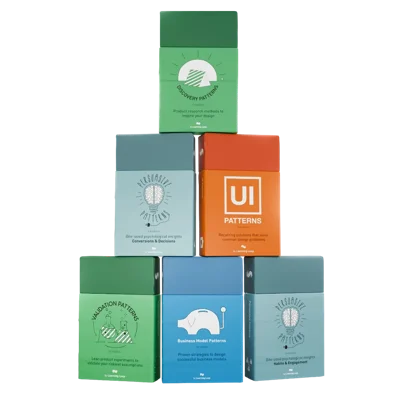
Every card deck includes workshop patterns, so your team can put the methods to work in your next session.
Running behavioral design workshops? The Persuasive Patterns Workshop Playbook (PDF) shows you how to design and run them.
Browse the card decks