User Onboarding Beyond Day One
From First Win to Ongoing Adoption
Turn insights into action with the Persuasive Patterns card decks
Master the science behind user motivation and create products that drive behavior.
Get your deck!User onboarding does not end at activation. But it changes form.
The first time a user experiences value is critical. It is the moment where the product proves itself. The moment it clicks. The point at which expectation becomes grounded in experience.
But that moment, while decisive, is not durable on its own.
Belief formed in a single interaction is still provisional. It has not yet been reinforced by repetition, nor integrated into the user’s routine. Without continued exposure to value, it weakens. What felt clear in the moment becomes less certain over time.
The real challenge in user onboarding, therefore, is not simply getting users to that first meaningful result. It is sustaining the trajectory that begins there. It is helping users return, re-engage, and extend that initial experience until the product becomes part of how they think and work.
This is where onboarding moves beyond the first session and where it begins to compound.
From First Win to Second Visit
The first session in a product is often carefully constructed. It is shaped to reduce friction, guide attention, and deliver a clear initial result. It is, in most cases, the most intentionally designed part of the experience.
The second session rarely receives the same level of consideration. Yet, it is one of the most consequential moments in the entire lifecycle as this is where intention meets reality.
The user has stepped away. Time has passed. Other priorities have intervened. What remains is not the full clarity of the first experience, but a partial memory of it. When they return, they are no longer new, but they are not yet fluent.
They occupy an in-between state.
User onboarding needs to be designed for this state explicitly. Not by restarting the experience as if nothing has happened, and not by assuming a level of understanding the user has not yet achieved, but by reconnecting them to what previously mattered.
The goal is continuity.
Picking Up the Thread
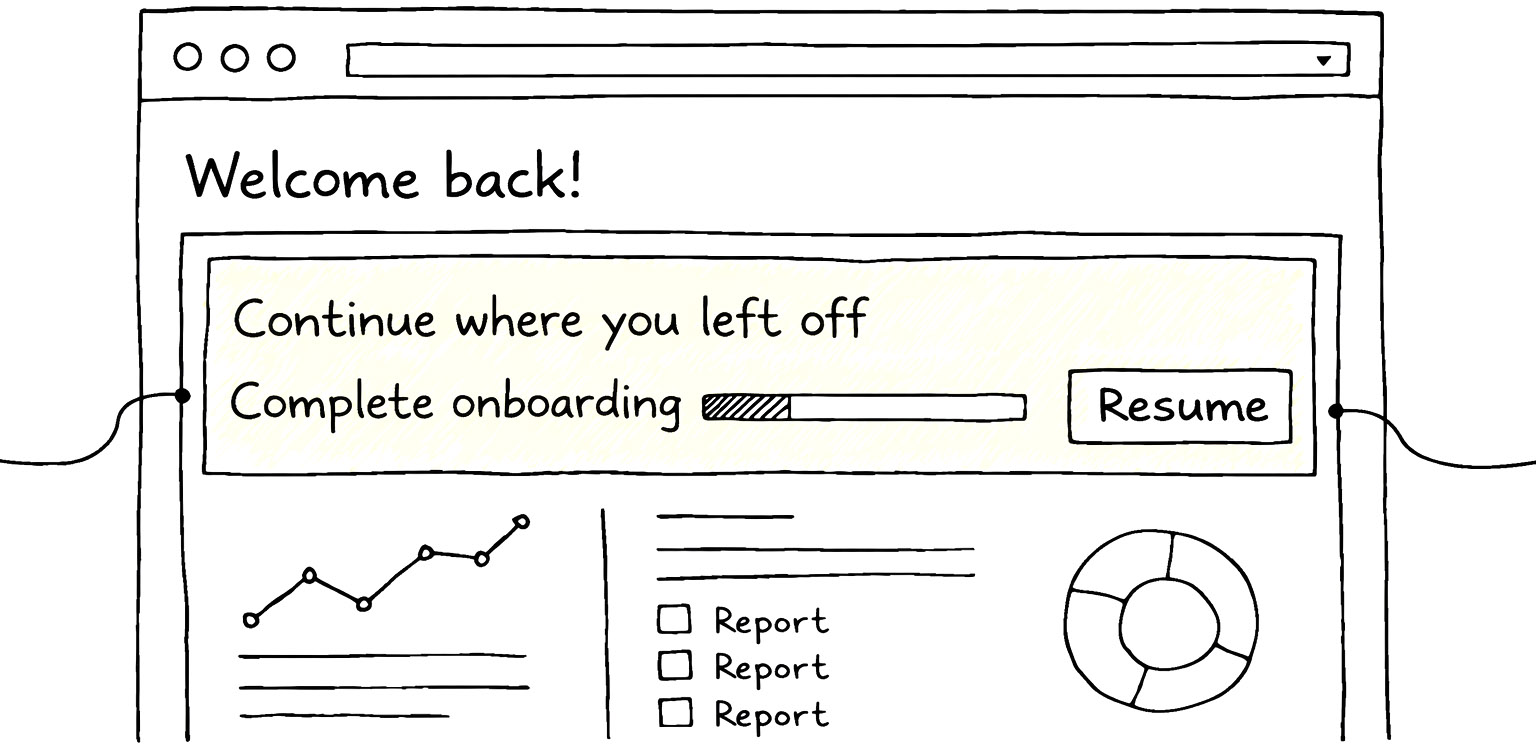
A returning user should not have to reconstruct their own context. They should be able to resume.
It doesn’t have to be a complex matter. Rather, it is often a matter of restoring the last point of interaction, surfacing relevant work, and making the next step visible without friction. What matters is that the product acknowledges prior effort and uses it as a starting point.
The objective is not to reintroduce the system, but to re-establish motion.
When this is done well, the second session feels lighter than the first. The user spends less time orienting and more time progressing and the user’s interaction shifts from exploration to continuation.
This shift is subtle, but important as it is where familiarity begins to form. And familiarity is a precursor to habit.
Sustaining Motivation
Initial engagement is often driven by curiosity or intent. Continued engagement depends on reinforcement.
Starting a new behavior requires effort, but maintaining it requires evidence that the effort is worthwhile. Without that evidence, motivation declines. This pattern is consistent across domains, and product use is no exception.
User onboarding should account for this dynamic. It should not assume that a single positive experience is sufficient, but rather create a sequence of reinforcing signals that confirm the value of continued use.
These signals do not need to be large.
- A completed action.
- A visible outcome.
- A clear indication of progress.
Each of these contributes to a growing sense that the product is not only useful, but reliably so. Over time, these small confirmations accumulate into confidence.
And confidence reduces the cognitive effort required to return.
Making Progress Visible
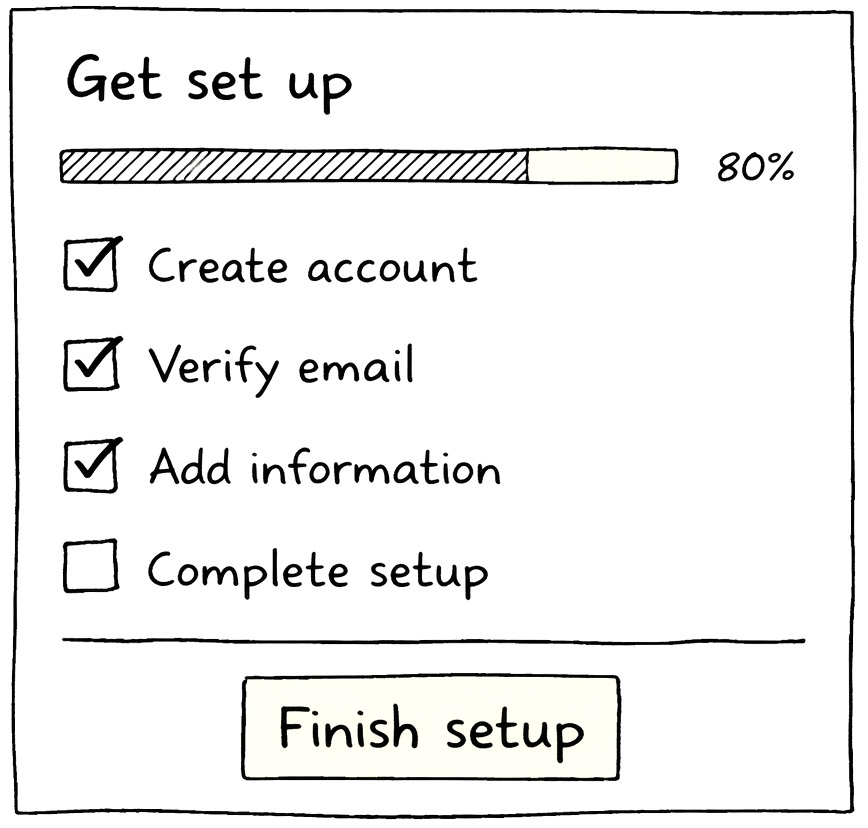
Users are more likely to continue when they can see that they are already advancing.
Progress, when left implicit, is often underestimated. When made visible, it becomes a motivator and can help transform effort into movement. This is where structured progression becomes useful—not as a rigid sequence, but as a representation of advancement. Breaking larger outcomes into smaller, coherent steps allows users to understand where they are and what remains.
The purpose is not to create a checklist for its own sake, but more to make progress legible. When users can see that they are approaching something meaningful, the experience feels bounded and achievable. This reduces hesitation, particularly in the early stages where uncertainty remains high.
Clarity of progress lowers the perceived cost of continuation.
Guiding Behavior Inside the Product
When users enter a new system, they look for cues that indicate how to proceed. These cues are rarely explicit instructions. More often, they are inferred from the structure and presentation of the interface.
User onboarding should provide these signals intentionally.
It should make clear which actions are expected, which outcomes are meaningful, and how success is recognized. This can be achieved through hierarchy, emphasis, and sequencing within the interface itself.
Examples of successful outcomes are particularly effective.
They provide a reference point that reduces ambiguity. Instead of asking users to infer what “good” looks like, the product demonstrates it. This shifts the experience from interpretation to imitation, which is cognitively less demanding.
In this way, the product becomes easier to learn without requiring additional explanation.
Being Present When It Matters
Even in well-structured systems, moments of hesitation are inevitable. Users encounter uncertainty, gaps in understanding, or situations that do not match their expectations. When this happens, the absence of support can interrupt progress.
User onboarding should extend beyond the initial flow to address these moments. It is not about constant intervention, but about being available when needed and stepping back when not. Contextual guidance, timely prompts, and accessible support mechanisms help users move forward without disrupting their sense of autonomy.
The challenge lies in maintaining the right balance.
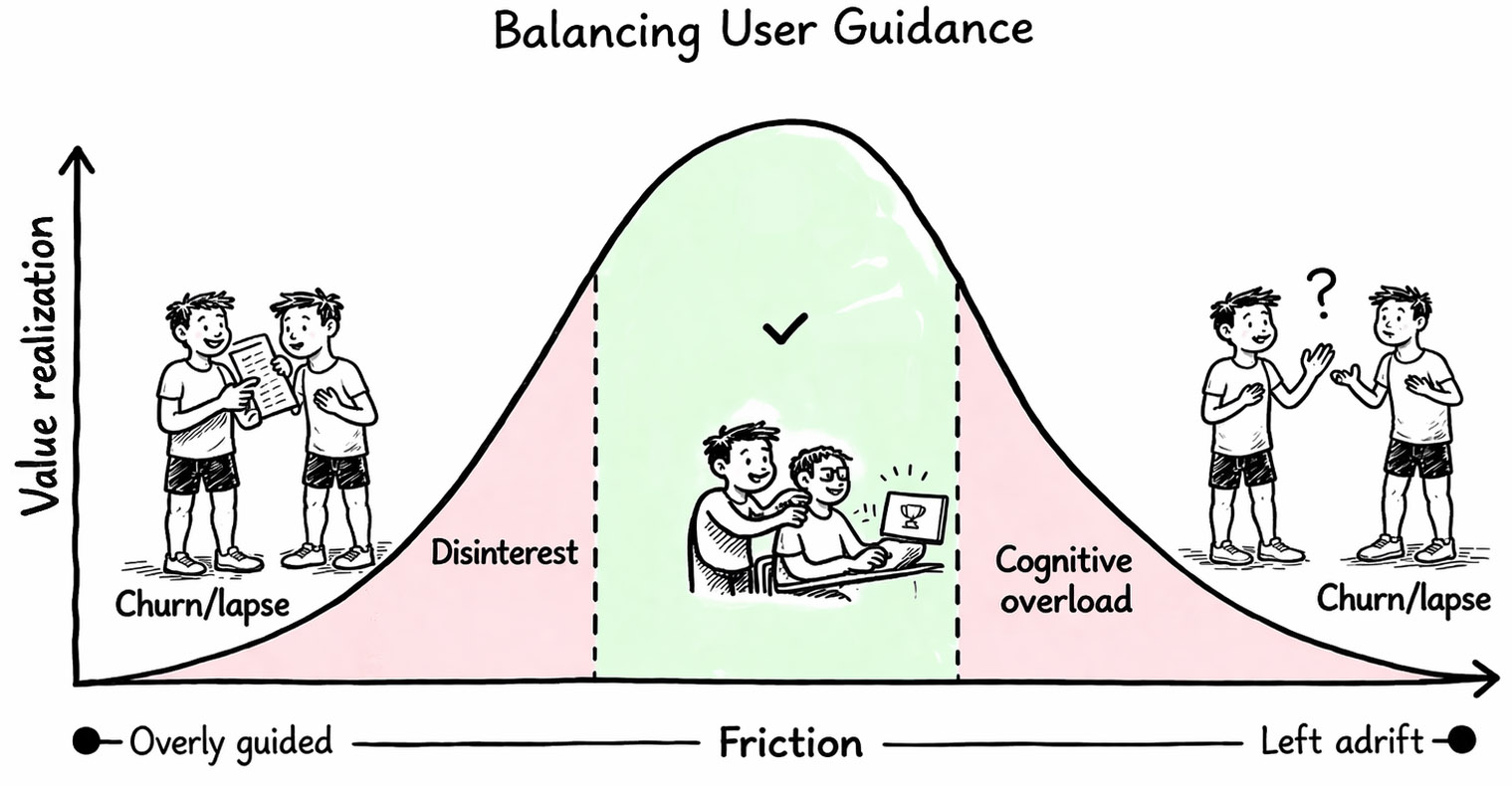
This balance can be understood through what Krys Higgins describes as the optimal onboarding zone, grounded in the Yerkes–Dodson law. Performance does not increase linearly with support or pressure. It follows a curve.
At one end, users are overly guided. Every step is explained, every action anticipated. The experience becomes heavy. Users disengage, not because it is difficult, but because it feels unnecessary. This is where disinterest sets in.
At the other end, users are left adrift. Guidance is absent when it is needed most. Cognitive load increases. Uncertainty compounds. This is where confusion turns into abandonment.
Between these extremes lies a narrow range where users are able to progress. Enough structure to reduce uncertainty. Enough freedom to maintain agency.
This is the zone where value is realized.
Effective onboarding operates within this range. It does not aim to eliminate friction entirely, nor to maximize guidance. Instead, it treats both as variables to be adjusted over time.
This is less about directing behavior and more about enabling practice.
Users should be able to engage with the product early, to try, adjust, and progress through doing rather than observing. Guidance should not precede every action, but follow moments of friction. It should appear in response to need, not in anticipation of it.
When this balance is achieved, support feels natural. It aligns with the user’s intent rather than competing with it.
This presence serves a dual function. It supports the user in the moment, helping them maintain momentum without breaking their flow. At the same time, it reveals where the experience may be unclear or incomplete. Each point of hesitation becomes a signal. An indication of where the product can better align with the user’s expectations.
In this sense, ongoing onboarding is not only a system of guidance. It is a system of learning for for both the user and the product.
Re-engaging Lapsed Users
Not all users will continue uninterrupted. Some will disengage, whether due to competing priorities, incomplete understanding, or insufficient reinforcement of value. This is a normal part of product use.
The question is not how to prevent all drop-off, but how to make return possible. A lapsed user should not feel as though they are starting over. Instead, the product should reconnect them to what they did before, what they achieved, and what remains.
Re-engagement is a matter of restoring continuity. External prompts can support this, but their effectiveness depends on what happens next. If the return experience does not quickly re-establish clarity and value, the opportunity is lost.
What matters is that each return is meaningful.
Repeated visits do not create retention on their own. Users need to see progress. Each session should lead to something completed or advanced. Re-engagement should therefore guide users toward a specific next step, not just bring them back.
Lifecycle communication helps bridge these moments. Messages tied to real activity, such as unfinished work, recent progress, or periods of inactivity, can prompt return in a way that feels relevant rather than generic. Over time, these prompts should become less necessary. The goal is for users to return on their own, driven by the value they have already experienced.
Social context can reinforce this further. When users involve others, their commitment strengthens, and return becomes more natural.
Re-engagement is a continuation of onboarding, ensuring that users do not just come back, but continue forward.
Expanding Into Deeper Workflows
Activation is not the finish line. It is the point where the user becomes capable of more.
A successful first experience does more than prove value. It changes the user. Tasks that initially felt uncertain begin to feel manageable, and what once required effort starts to feel routine. With that shift, onboarding has to evolve as well.
The question is no longer whether the product works, but how far it can be taken.
At this stage, onboarding is no longer about introducing the system. It is about keeping users in the right zone as they grow. That zone is defined by three things working together:
- Challenge
- Guidance
- Time
Challenge: Staying in the Flow Channel
Mihaly Csikszentmihalyi describes the Flow Channel as the space where challenge and ability are in balance. When a task exceeds the user’s skill, it creates anxiety. When it falls below it, the experience becomes repetitive and dull. Between those extremes lies a narrow range where engagement is sustained.
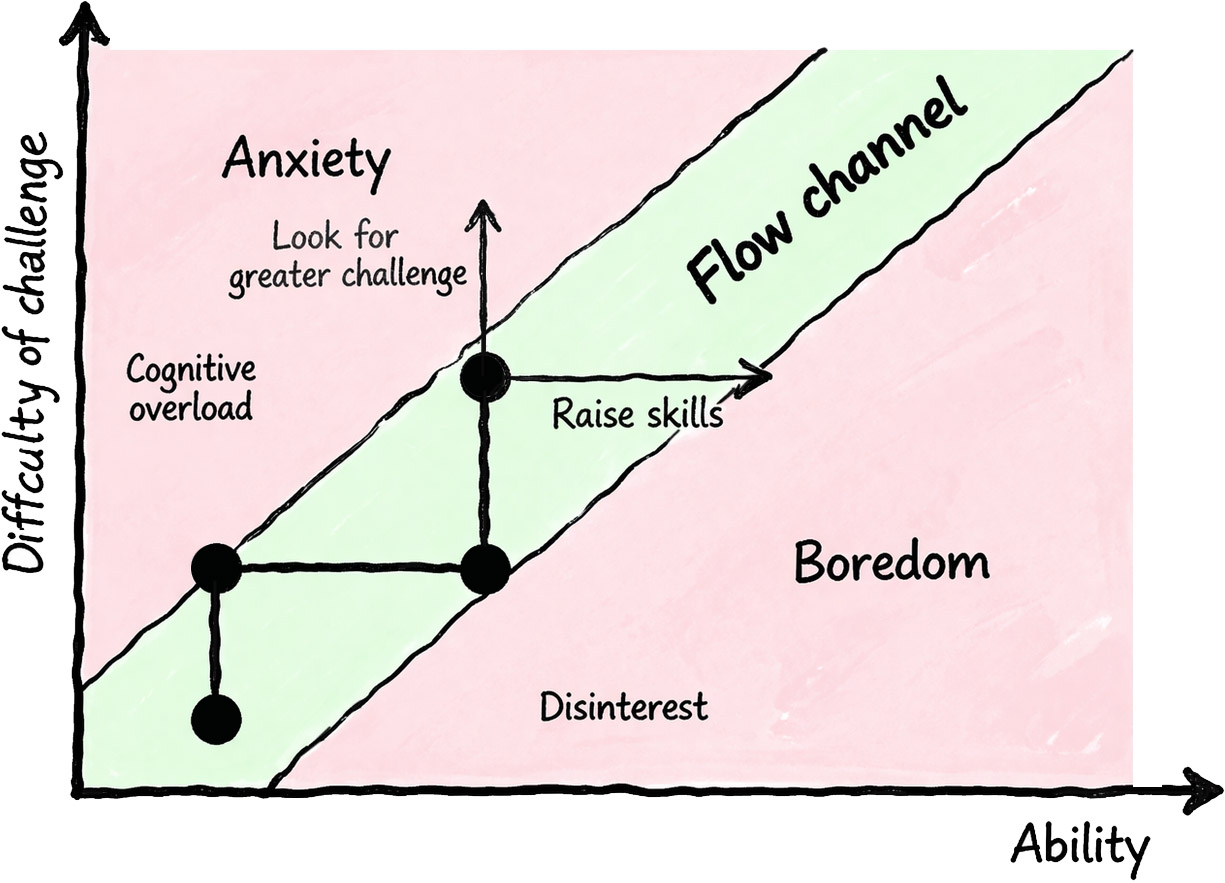
User onboarding beyond activation operates within this same space.
As users gain experience, their tolerance for complexity increases. What was once challenging becomes familiar. If the product does not evolve alongside that growth, the experience flattens. Progress slows. Interest fades.
At the same time, introducing too much complexity too early has the opposite effect. The experience becomes heavy. Cognitive load rises. Confidence drops.
The task, then, is not to simplify or to add complexity, but to calibrate.
Each step forward should introduce an appropriate challenge. Something that stretches the user slightly, but remains within reach. This is what keeps users engaged. Not ease, but progress.
Guidance: Staying in the Optimal Zone
Challenge alone is not enough.
The same balance applies to guidance.
Earlier, we saw how too much support can feel intrusive, while too little leaves users without direction. That tension does not disappear after activation. It becomes more pronounced as the product grows more capable.
Too much guidance interrupts flow and limits autonomy. Too little forces users to rely on trial and error at precisely the moment where complexity is increasing.
Onboarding, at this stage, operates along a second axis: Guidance (too intrusive vs too absent)
If challenge defines what users are asked to do, guidance defines how supported they feel while doing it.
The optimal experience sits between the two. Tasks should feel slightly demanding, but achievable. Support should be available, but not imposed. Users should feel in control, without being left to figure everything out on their own.
When either side falls out of balance, users drift out of the optimal zone.
Progression: Keeping Both in Balance
As users continue, progression starts to take on a different character.
Early wins feel like achievements. Later, the same actions feel routine. That shift is not a problem. It is a signal. It means the user is ready for more.
Progression, then, is not about adding features. It is about extending capability in a way that feels continuous. A familiar action becomes more powerful. A simple workflow gains another layer. The product expands without forcing the user to reorient.
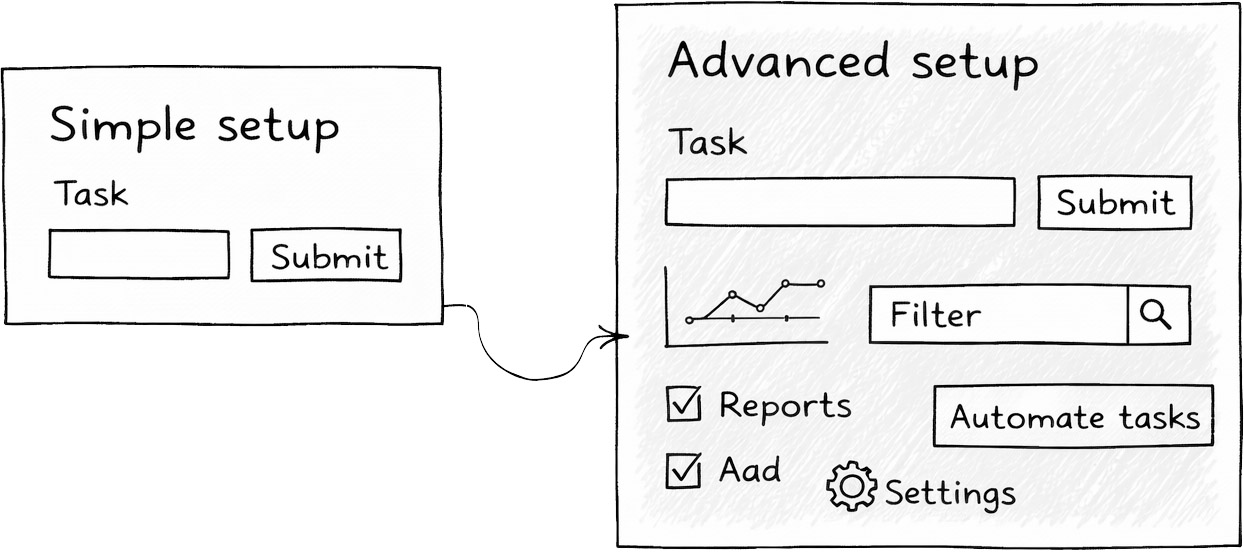
Timing determines whether this works:
- Introduce complexity too early, and it feels like friction.
- Introduce guidance too early, and it feels intrusive.
- Wait too long, and the experience loses momentum.
Onboarding at this stage is not a fixed flow. It is an ongoing adjustment. A continuous rebalancing of challenge and guidance as the user’s ability changes. When that balance holds, the experience remains engaging. Users stay in motion.
Connecting the Stages
That balance does not exist in isolation, but is shaped by everything that came before and everything that follows.
Onboarding is often described as a sequence. Step one leads to step two, which leads to step three. If each step performs well, the outcome is expected to follow. This is cause-and-effect thinking. It works for isolated interactions. A clearer tooltip improves comprehension. A shorter form increases completion. These are local optimizations that are predictable and measurable.
But onboarding beyond day one does not behave like that. It behaves like a system.
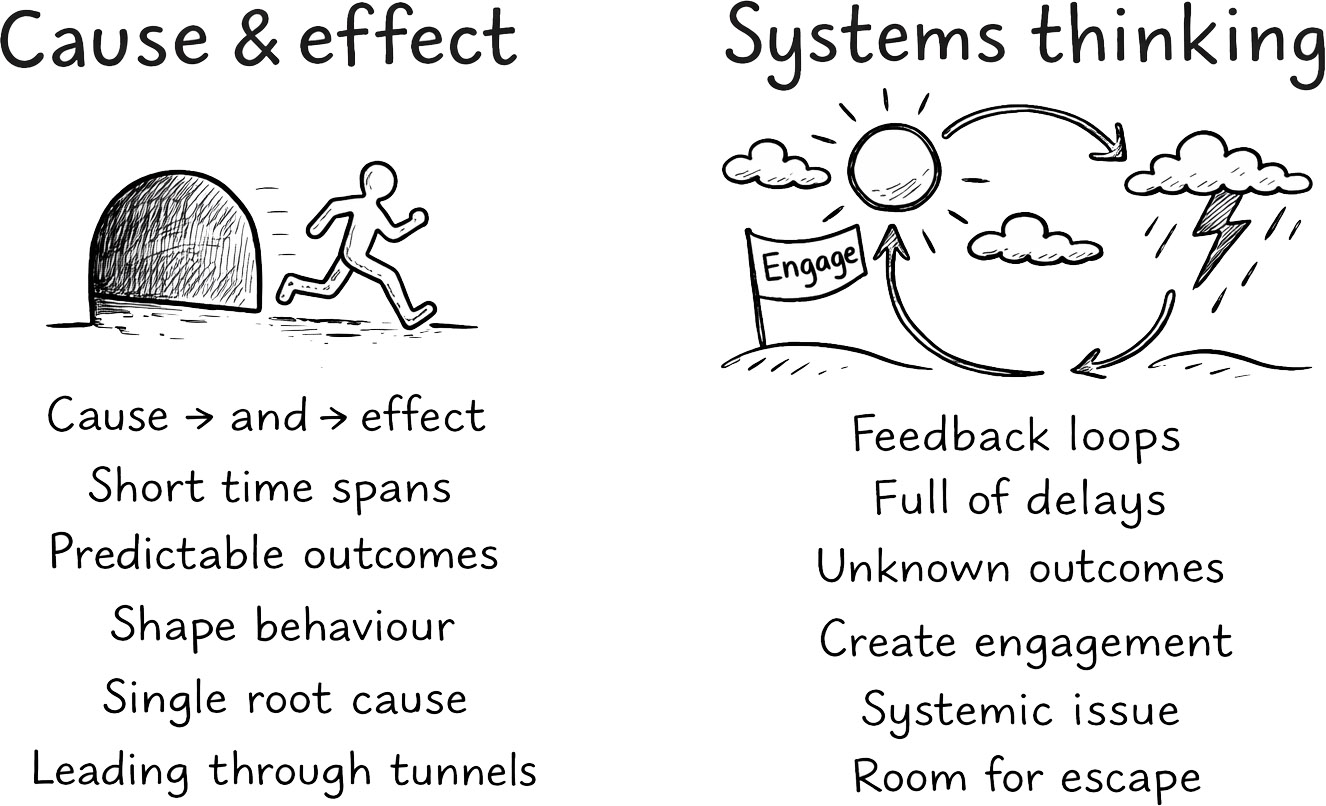
A user’s experience unfolds over time. Each interaction influences the next, but also reshapes what came before. A strong second visit reinforces the memory of the first. A confusing return weakens it. Progress builds confidence, which in turn changes how future challenges are perceived.
This is more a set of feedback loops than a chain of connected steps.
Outcomes are determined not by any single moment, but by how those moments interact. Improvements in one part of the experience can be amplified or canceled out elsewhere. A strong onboarding flow cannot compensate for a lack of meaningful value. A well-timed message cannot recover a weak return experience.
What matters is alignment.
Each stage should support the others. The first experience should make return more likely. The second should reinforce progress. Later interactions should expand capability without introducing unnecessary friction. When this alignment is in place, the system begins to reinforce itself.
Progress leads to confidence. Confidence leads to deeper use. Deeper use leads to more value. And that value increases the likelihood of return.
The opposite path is just as real. Friction leads to hesitation. Hesitation reduces engagement. Reduced engagement limits exposure to value.
The difference between these paths is not a single decision, but more how the system behaves over time. When onboarding is designed this way, it no longer feels like a sequence of steps. When this user is at this stage, there is no sense of restarting, only continuation.
The user is not moving through a flow, but within a system that either sustains momentum or gradually loses it.
It Never Ends
User onboarding is often framed as a beginning. In practice, it is an ongoing system that supports progress over time. It carries the user from first value to repeated use, from simple actions to more capable workflows, and from individual use to shared systems.
The moment it clicks is where it starts.
What follows determines whether it lasts.
- The Optimal User Onboarding Zone by Krys Higgins
- Persuasive Design Ten Years Later by Anders Toxboe
- Onboarding Tutorials vs. Contextual Help by Page Laubheimer
- The Ultimate Guide to Product Onboarding by Appcues
- Yerkes-Dodson Law of Arousal and Performance by Charlotte Nickerson