AI-Assisted Coding Is Fast, But Structure Still Moves Slow.
You Still Need Both
AI-assisted coding collapsed the distance between idea and implementation.
Prompts become interfaces. Interfaces become code. Code ships.
That speed helps. It removes friction, improves discovery, and lets more people build. But it also changes where thinking happens.
We reach something that looks finished earlier. And once something looks finished, we stop questioning the structure underneath it.
The conversation shifts. From system shape to surface detail. From architecture to adjustment.
This is not an AI problem. It is a sequencing problem.
Friction didn’t go away, but just moved
In the past, friction lived at the start. Alignment before building. Structure before implementation.
AI moves friction downstream.
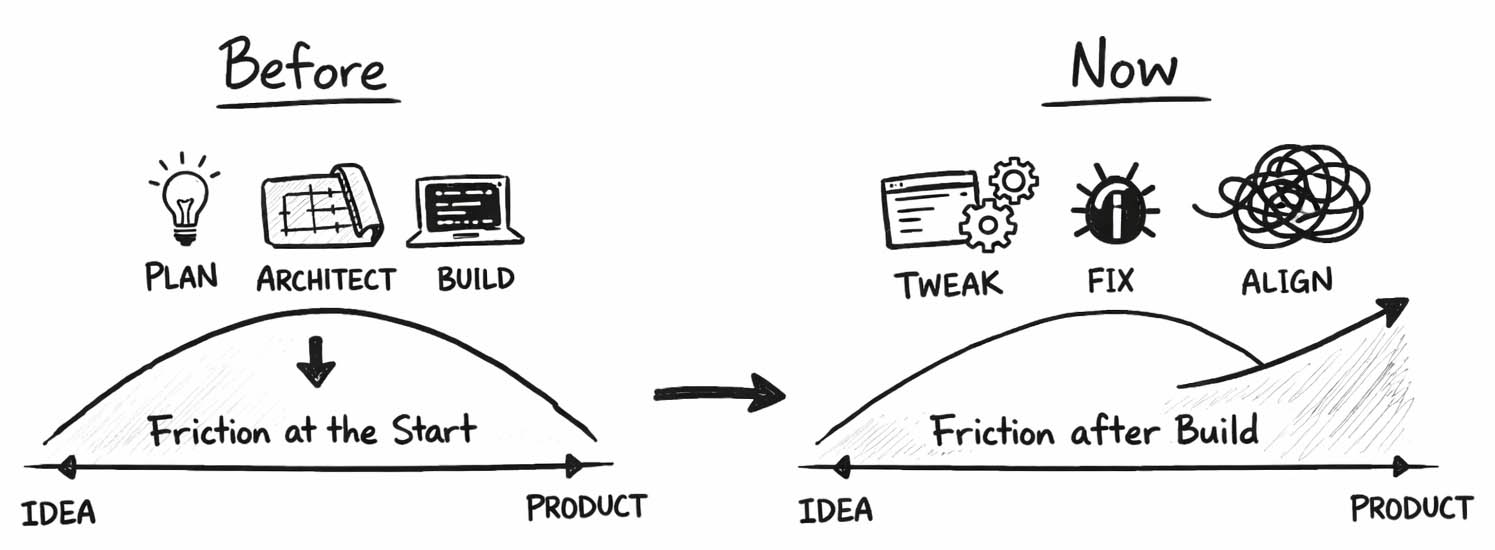
You can now produce something functional immediately. A flow. A UI. A working integration. Something that behaves like production.
But structural decisions still happen. They just happen implicitly:
- naming
- boundaries
- responsibilities
- interaction models
They get decided while building instead of before.
Speed increases. Deliberate thinking decreases.
And what used to be architecture becomes a side effect of production.
This is how fragmentation starts
Large teams fragment when decisions are made in parallel without shared structure. The result is familiar: siloed journeys, inconsistent experiences, systems that don’t quite align.
That pattern is well described here: https://learningloop.io/blog/fragmented-experiences
AI introduces the same dynamic in a different form.
Instead of teams creating fragments, tools and individuals do:
- one generates UI
- another drafts flows
- another writes logic
- another defines data
Each piece works. Together, they drift.
Because coherence does not come from correctness. It comes from structure.
When prototypes start acting like production
AI changes what a prototype looks like. Prototypes used to signal “unfinished,” Rough, abstract, open to interpretation and open for discussion. Now it looks real, is interactive, and often fully funtional. It seems close to being shippable.
That changes our behavior. We tend to refine the prototype rather of rethinking whether we are structurally on the right path. Rather than debating, testing, and questioning – we adjust. In this way, momentum tends to replace intent.
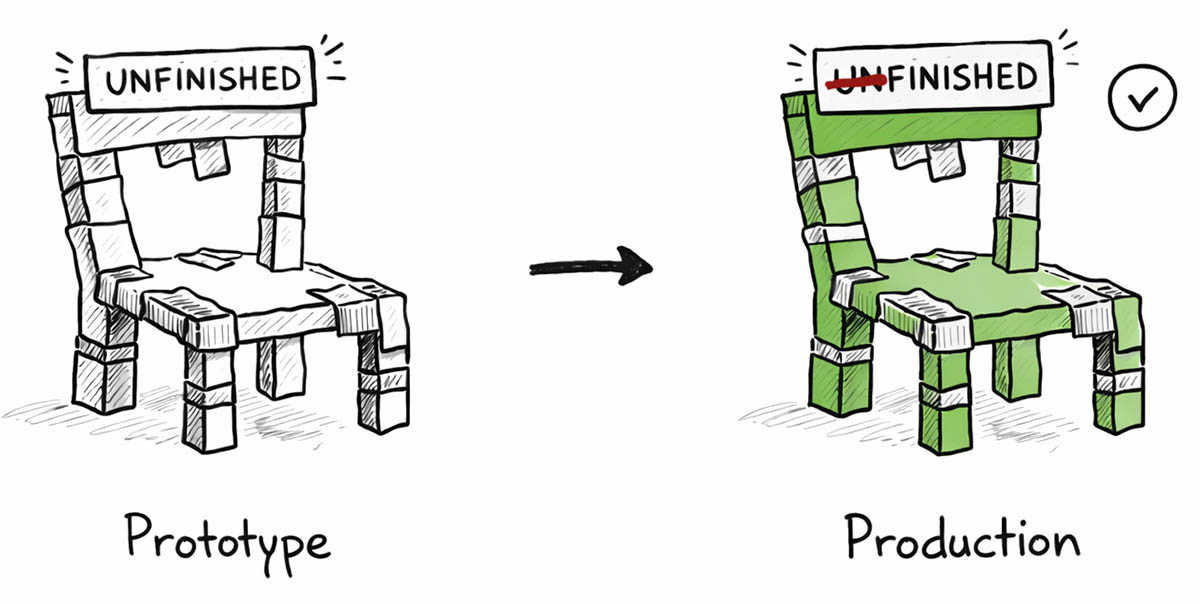
With such an engagement in refining prototypes until they are ready to be launched, we are no longer inviting for structural conversations. We stop them before we got started. The structure and mental model behind our prototypes now rarely gets revisited.
Vibe coding works until it doesn’t
Building by feel is effective for discovery. We Prompt. We Generate. We Adjust. We Repeat. It lowers the cost of trying ideas and gives autonomy to people who previously depended on others to build. But when this approach moves into production, systems grow through local optimizations.
Small decisions accumulate:
- patterns form accidentally
- flows diverge
- assumptions stay implicit
The issues are not visual, but structural. Users feel them as friction or fractional and incoherent user experiences. Teams feel them as rework. Time saved building returns as time spent aligning.
Structure-first is just ordering
Some teams respond by moving back to abstraction before implementation.
Text before UI. Mental models before screens. Skeleton before skin.
Not because earlier methods were better. Because they forced the right questions early.
Working without visual fidelity shifts the conversation:
- What is this system?
- Where does responsibility live?
- What must stay consistent?
- What tradeoffs are we making?
AI makes it easy to skip this step as it produces plausible outputs instantly. But plausibility is not coherence.
The craft didn’t disappear, but became optional
Discovery, architecture, and UX always relied on invisible decisions:
- choosing the right level of fidelity
- framing the problem before showing solutions
- deciding what must be resolved before building
AI makes it easier to bypass those moments.
Anyone can now generate something that looks complete. Fewer people shape how it should be evaluated, challenged, and integrated.
Someone still has to decide:
- what fidelity is appropriate
- what must be defined first
- what consistency means across outputs
That is design. That is architecture.
Whether acknowledged or not.
AI distributed design
The real shift is not that AI writes code, but the fact that more people now shape systems. PMs define flows. Designers influence logic. Engineers rely on generated scaffolding. Founders build end-to-end.
Design and architecture become ambient. Embedded in prompts, defaults, and generated outputs.
But distributed responsibility increases the need for coherence.
Without shared structure, systems drift. The same pattern is seen when multiple teams work on the same fragmented product. Only faster.
This is a coordination problem
It is easy to frame this as a tension between traditional design and AI-first building. In practice, both are necessary, but AI expands who can build and accelerates exploration and delivery.
But it also increases the number of partial decisions entering the system. Without coordination, those decisions accumulate into inconsistency.
Coherence requires:
- shared mental models
- explicit patterns
- defined constraints
- sequencing from abstraction to implementation
The fundamentals did not change. The tempo did.
So who is designing now?
If everyone can build, who owns structure? Specialists? Distributed teams? Systems and guardrails? Prompts and templates? There is no single answer.
But ignoring the question leads to the same outcome: fragmented experiences assembled from individually rational parts.
AI accelerates production. It does not replace the need for coherence.
Speed isn’t the risk
AI makes it easier to build, test, and ship.
But it also makes it easier to skip the moment where structure is made explicit.
That is where drift begins.
Not in code quality. Not in polish. In the accumulation of decisions that were never surfaced, aligned, or intentionally designed.
Speed is not the risk.
Losing the structure behind what we ship is.
- Why Large Product Teams Create Fragmented Experiences by Anders Toxboe
- ASCII-Driven Development by calufa
- On Generative Features by Stephen Anderson
- Empowered by Marty Cagan
- Team Topologies by Matthew Skelton, Manuel Pais
- Continuous Discovery Habits by Teresa Torres
- Designing AI Systems That Actually Work (Video) by Various speakers