The Product Trio as We Know It Is Dead
As AI makes it easier to build and test solutions, the trio can spend more of its time figuring out which customer problems are worth solving
At SimplerQMS, we have two product teams. Each has a product trio and four engineers working in two pairs. As AI has sped up development, our engineers have been spending more time talking to customers and stakeholders. They can come back with a working version while we’re still figuring out what we need to learn from it.
That first version usually needs several rounds of feedback. The trio has input. Stakeholders bring constraints the pair may not have known about. Customers show us where their actual workflow differs from what we assumed. Once a pair has something working, the team still needs time to work through what it learns and decide what to try next. Both pairs can reach that point in the same week.
My first instinct was to give engineering pairs room to produce the first version and concentrate design time on the highest-impact problems. That made sense for the build, but I’d left the feedback rounds unplanned. We still needed to agree on which decisions needed input from product or design, who would gather evidence from customers, and who would own the revisions.
One engineer in the trio was a good answer to a different problem
Teresa Torres describes the product trio as the core group that leads discovery and decides what to build, with input from the wider team. Engineering is represented, typically by a tech lead, and Torres allows for flexibility in who fills that role. The separation I’m questioning is in how the work is organized. Even when the tech lead sits alongside the other engineers, a standing trio can end up making the product decisions that the rest of engineering is expected to carry out.
When the engineers doing the work are also talking to customers, prototyping options, and learning from the results, one engineering representative is a poor substitute for giving those pairs meaningful decisions of their own. A pair can discover that the solution we had in mind addresses the wrong part of the workflow. I want them to be able to act on that discovery within an agreed brief.
I’d have the trio lead discovery in the problem space. That means talking to customers, observing how they work, and comparing opportunities. How often does a problem come up? Who does it affect? What would improve for customers and for the business if we solved it? That’s the work behind choosing an outcome and explaining why it deserves the team’s attention.
The pair would lead discovery into how to achieve that outcome. They’d investigate the causes in more detail, try possible solutions with customers, and own the work through feedback and revision. The split is about who takes the lead. Engineers can bring customer observations that change which opportunity the trio prioritizes. The designer or PM can join a test when their judgment will affect the next decision. And when the pair finds evidence that the original problem was framed too narrowly, the pair and trio revisit the brief together.
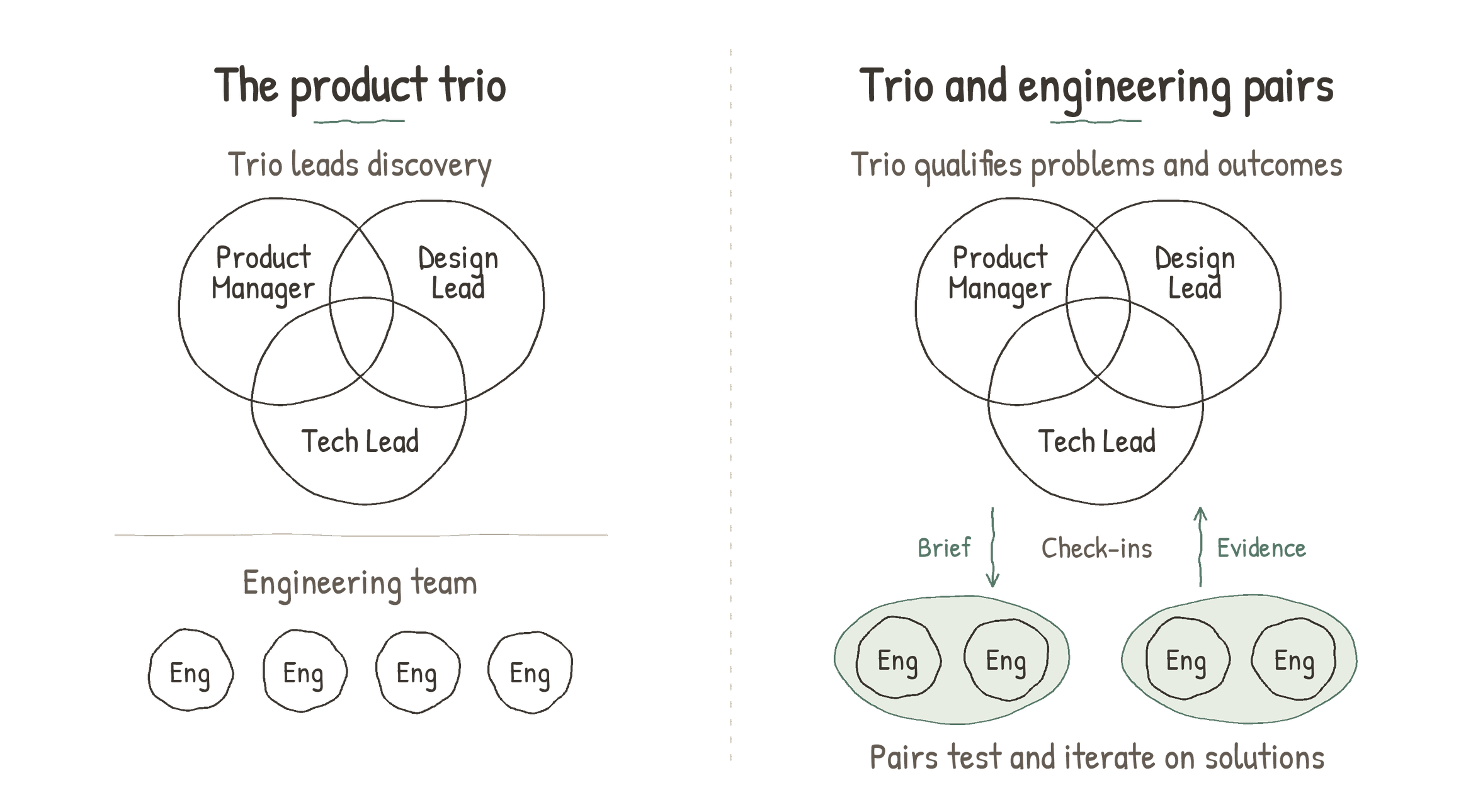
The trio leads problem discovery. The engineering pairs lead solution discovery and bring evidence back that can change the brief.
Brief the outcome. Have the pair brief you back.
Stephen Bungay’s The Art of Action offers a practical way to do this. Set out the intent, the reasons behind it, and the freedoms and constraints. Ask the people doing the work to come back with their understanding and how they intend to act. That backbrief gives both sides a chance to surface assumptions before the work gets too far.
Take a hypothetical example from our domain. In talking with customers about slow approvals, the trio might find that some documents sit idle when they’re first sent for review, while others stall after being returned for revision. Suppose workflow data and conversations with document owners suggest that returned documents account for the delays customers find most disruptive. The trio could then brief the pair to reduce the time between a document being returned and its owner resuming work, within existing permission rules and with approval history preserved.
The pair might brief us back like this:
We’ll look at when owners notice a returned document and watch what they do next. If they see it too late, we’ll look at the notification. If they see it and still hesitate, we’ll test whether the reason for the return and the next action are clear. We’d like the designer in the first observation and a decision on which direction to pursue once we’ve seen how people handle it.
The check-in is where we look at what the pair found and how its proposed action serves the intent. If owners see the return and understand what to do but are waiting for a reviewer to clarify conflicting comments, the pair can bring that evidence back. Together we can decide whether to investigate the reviewer’s workflow or keep the original focus. After release, we look at whether owners actually resume work sooner. Bungay’s distinction matters here. The alignment gap is between the plan and the actions people take. The effects gap is between those actions and the outcome they produce. A pair can execute an agreed plan and still find that the outcome barely moves.
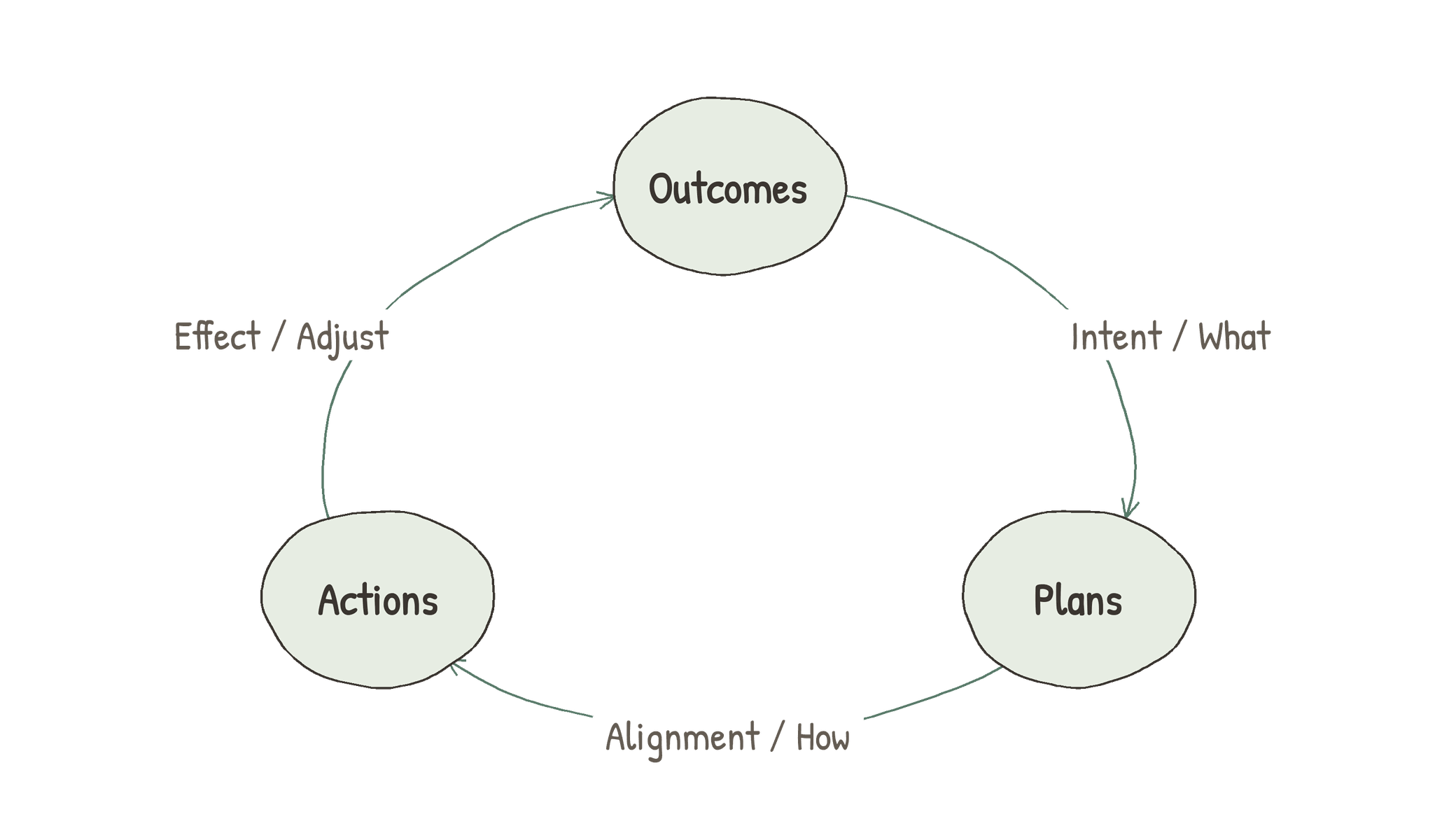
Adapted from Stephen Bungay’s *The Art of Action*. The loop connects intended outcomes, plans, and actions.
What do teams actually trust agents to do?
Three published projects give a sense of the range. Dropbox gave agents defined implementation and testing tasks, with a written plan and engineer review before accepting the work. Shopify organized its mobile rebuild in engineering pairs that steered agents, including overnight. The agents worked with reference implementations, architecture guidance, and fast automated checks. People still validated and approved what shipped. Anthropic says the team building its source-control system reviewed every change request, focusing on the intent of the change without reading every line.
Who writes the code, who checks it, and who can ship it are separate decisions. I’d give an agent considerable latitude to build a disposable prototype with sample data. For a routine change in a familiar part of the product, I’d expect scoped access, automated checks, and a named human reviewer. A change to approval permissions calls for closer inspection of the affected logic and the evidence required by our existing risk-based validation process. In each case, trusting the model API with a task also means deciding what data it can see, what tools it can use, and where its authority ends.
The context needs to be accessible to the team as well as the agent. I’d keep the current brief, the relevant observations, examples of the workflow, the decisions we’ve made, and the checks we expect together. Give the agent access to the parts it needs in an approved environment. When a customer session changes our understanding, the pair updates the shared record. Otherwise the next person or agent can keep executing a plan the team has already abandoned.
There’s also a difference between choosing a level of review and quietly doing less because the queue is full. Faros’s Q3 engineering telemetry found pressure accumulating in QA and review as AI use deepened. I’d watch where time is actually spent waiting. If both pairs are waiting for a decision, reserve time for the decision. If verification is backing up, make changes smaller, strengthen the checks, or start fewer things at once.
What’s left for the PM, the designer, and the engineer?
The PM leads the trio’s work of comparing opportunities, choosing an outcome worth pursuing, and making the trade-offs clear. That includes deciding what to drop when two plausible ideas compete for the same customer, design, or rollout capacity.
The designer’s contribution becomes especially visible when the team is unsure how people do their work or what a change will teach them to expect elsewhere in the product. An engineering pair can apply a familiar filter pattern and own the result. A change to who acts next after a document is returned may need the designer to observe users, help interpret what happens, and decide with the pair whether the interaction fits the wider product. I want each pair to agree up front when it needs design input and who owns the iterations between reviews. If both pairs need several rounds of design input in the same week, the PM and I have a priority decision to make.
Engineers take on more of the investigation and solution design while remaining responsible for how the software behaves in production. That raises an uncomfortable question about junior engineers. If agents do many of the tasks people used to learn on, when does a junior learn to spot a bad assumption, diagnose a failure, or see what a passing test leaves uncovered? I’d give newer engineers real changes to explain and debug in a pair, with explicit feedback on their reasoning. A small randomized study found that fully delegating coding work could come at the cost of learning the library involved. That’s enough to make me take apprenticeship seriously.
The rest of the company sets part of the pace
When I spoke with Martin Ibsen on Produktland, this was the part I kept coming back to. Engineering can be ready before the rest of the company is ready. Sales needs to explain why the change matters. Customer Success and support need to help people use it. A customer in a regulated industry may need to update their own procedures. And people who already know the product have a limit to how much change they want in their working day.
Does that make marketing the differentiator? I think it makes distribution and adoption more important to the product decision. If several companies can build a similar feature, reaching the right customer with a promise they understand matters. So does getting that customer to use it in a real workflow and return to it. Sometimes the right decision is to test another variation with a few customers and release less.
That’s what I want to change about the trio. I want the people closest to the work to have enough context and authority to act. I want the trio to spend more of its time with customers qualifying opportunities and deciding which outcomes to pursue. What the pairs learn while testing solutions should inform those choices. When both pairs can have another working version ready tomorrow, the question I want us to answer together is which one deserves another round of the team’s time, the company’s attention, and the customer’s effort.
Teresa Torres’s work on product trios and Stephen Bungay’s The Art of Action informed the model I’ve proposed here. It builds on my earlier piece about dual-track development and shared understanding.
- Ask Teresa: Does the Engineer in the Product Trio Need to be the Tech Lead? by Teresa Torres
- The Art of Action: Chapter recaps by Stephen Bungay
- How AI-assisted development helped us build the new Dropbox experience by Pravi Garg, Sourabh Yerfule, and Gennadiy Civil
- How we rebuilt the Shopify app in 12 weeks by Remi Vanhee
- Redesigning source control at Anthropic by Anthropic Engineering
- SimplerQMS Validation: Fully Validated eQMS for Life Sciences by SimplerQMS
- The Speed Trap: AI Engineering Report Q3 2026 by Faros AI
- Shen, J. H., & Tamkin, A. (2026). How AI impacts skill formation. arXiv.