Planetary Product Sense: Giving Nature a Voice
How planetary personas can help product teams consider other species, balancing empathy with scientific knowledge and the complexity of ecosystems.
Talk transcript of Lene Nielsen – recorded on 16 Sep 2026 Product Design
Play to load YouTube, which may use cookies and collect information about your visit. Watch on YouTube
Product teams spend a lot of time listening to people. We interview customers, map their journeys, and build personas to help us understand lives beyond our own. But what happens when a product affects a stakeholder who cannot join an interview, answer a survey, or complain to customer support?
A cod in the Baltic Sea has no seat at a product review. Neither does a wolf, a pig, or the moss in an ecosystem altered by human activity.
Planetary personas bring other species into design conversations by presenting their circumstances and needs through a focused, relatable perspective. In this talk, Lene Nielsen, an associate professor at IT University of Copenhagen, explores whether conversational AI can make those perspectives easier to engage with—and eventually help teams make different design decisions.
Her work raises a challenge for product sense: whose experience have we learned to understand, and whose have we left out?
Taking personas beyond the human user
Lene starts with an idea familiar to anyone who has worked with personas. A persona helps a team focus on someone specific rather than an abstract audience. It provides context for decisions and encourages designers to consider a life different from their own.
Together with colleagues, she began asking whether the same approach could help designers understand other species. Could a first-person narrative create enough empathy to bring an animal’s needs into the conversation?
This work connects with animal-computer interaction, a research field concerned with how animals encounter technology. Automated feeders and robotic milking systems are examples Lene uses to remind us that animals already interact with products. The question of how to understand their experience is practical as well as philosophical.
Looking across existing non-human personas, her team found two broad approaches. Some emphasized factual information. Others gave their subjects human-like voices and characteristics, sometimes approaching the storytelling of an animated film.
Each approach offered something useful. Each also left something missing.
Empathy gets attention; facts support decisions
To explore that tension, the team ran a workshop with 30 designers. They created two frog personas: one primarily factual, the other more empathetic and anthropomorphic.
Lene reports that the more anthropomorphic version helped designers include frogs in their design decisions. The factual version supplied relevant information for making those decisions.
That distinction matters. A subject can become emotionally engaging without giving a team enough information to act responsibly. Equally, a technically accurate description can remain so distant that nobody brings it into the discussion.
For Lene, the opportunity lies between those extremes: enough personality to make another species present in the room, with enough factual substance to support useful questions.
Her team’s planetary-persona chatbots include a slider that lets people choose a more empathetic or more factual response style. Rather than assume one voice will suit every situation, the interface makes the balance something to explore.
From a one-page persona to a conversation
The project began with Lene experimenting with a chatbot representing a viper. With funding from the university, it expanded into a platform with several planetary personas, including a wolf, an industrial pig, and moss.
A conversation changes how someone can explore a persona. Instead of reading the information chosen for a single page, they can ask follow-up questions and investigate something that the original description did not cover.
Lene describes live testing in a nature-education setting, where schoolchildren questioned the characters, challenged them, and tried to expose them as AI. A dinosaur character kept responding politely from within its imagined world.
Those encounters show how people engage with the interface. They also leave the central research question open: does that engagement help someone understand another species, and can that understanding improve a design decision?
At the time of the talk, Lene describes the system as working well for sharing information. Bringing it into a product design process is the next challenge.
A cod’s perspective on a complicated ecosystem
The Baltic cod gives Lene a way to explain why both individual perspectives and ecosystem thinking matter.
In her example, the fish’s circumstances involve many interacting pressures: fishing, pollution, fertilizer runoff, algae growth, climate change, predators, and parasites. Human interests and political decisions also shape the system.
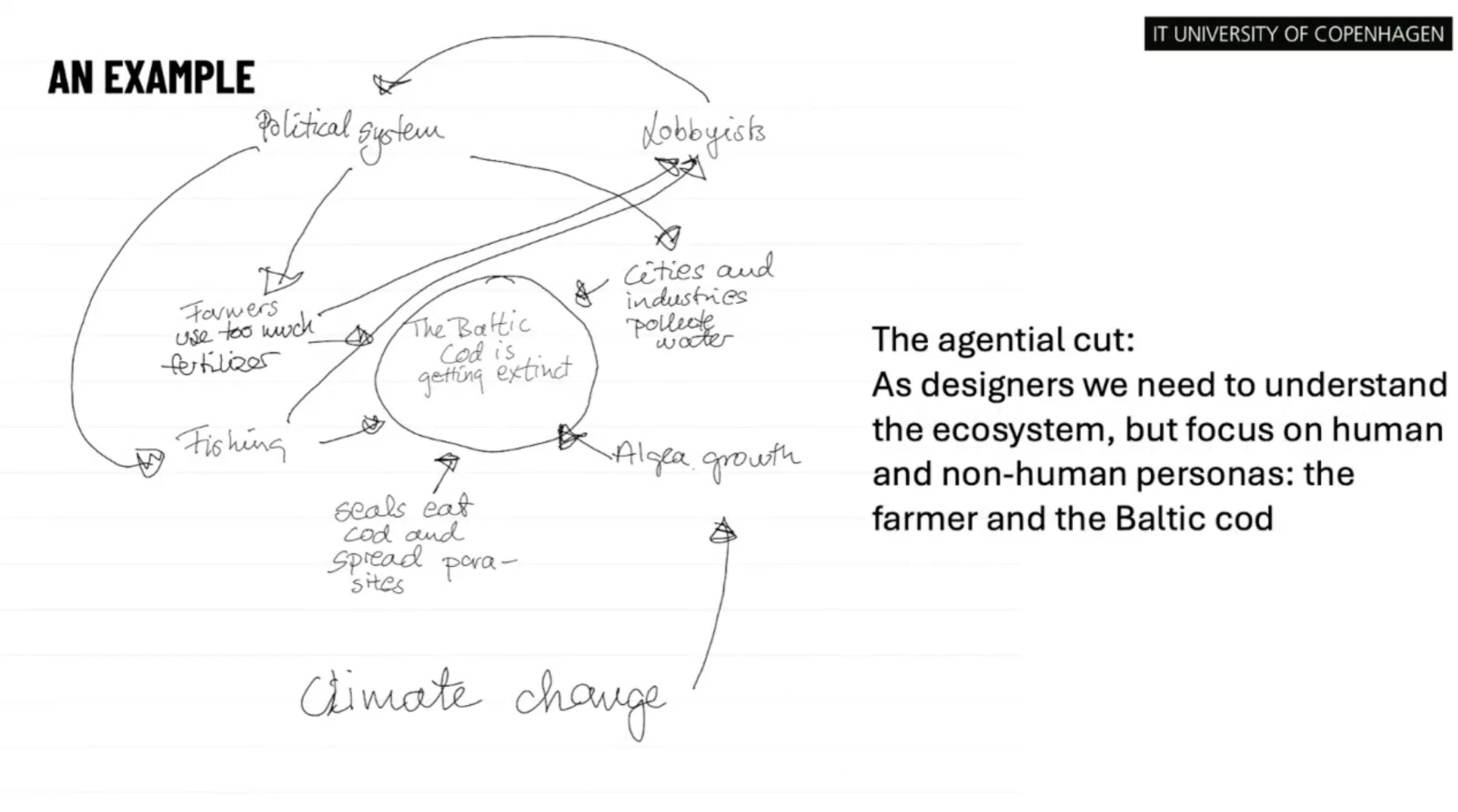
A team may find it relatively easy to imagine the perspective of a farmer or a lobbyist. Understanding the situation from the cod’s position is harder.
Yet a persona cannot stand in for the entire ecosystem. Lene discusses the need to understand the wider network while also focusing on particular phenomena within it. A focused perspective makes complexity more approachable, but designers still need to reconnect that perspective to the relationships around it.
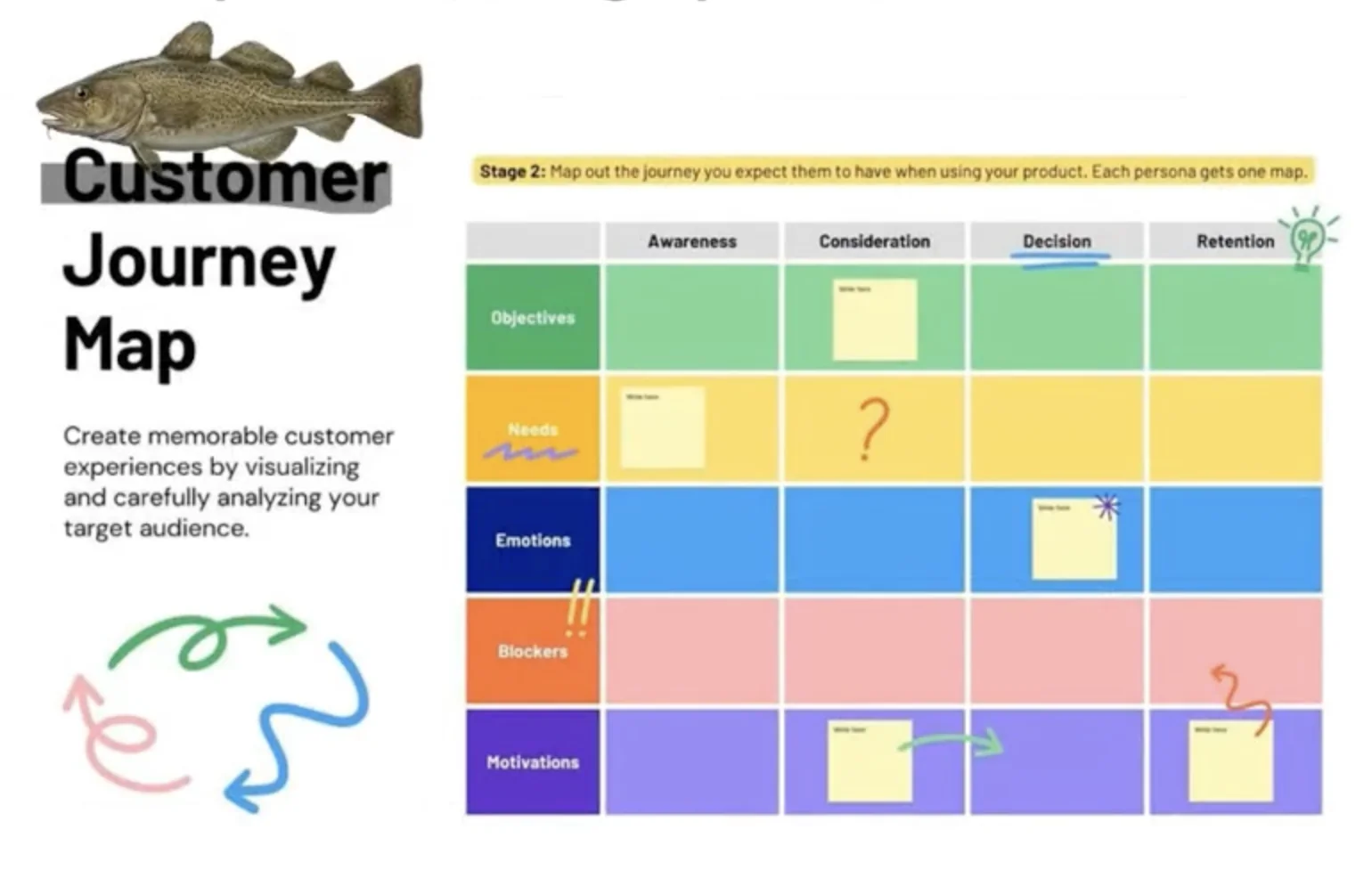
That leads to one of the talk’s most useful questions: what would a cod journey map look like?
We already use customer journey maps to understand experiences over time. Exploring a journey from another species’ perspective could change which events and consequences a team notices. Lene presents this as a question for further work, with the design method still to be developed.
Giving nature a voice also introduces human choices
During the discussion, an audience member asks how the team avoids putting its own biases into the personas. The chatbot’s subject cannot review the representation and correct the researchers.
Lene acknowledges her own starting assumption: she wants planetary personas to function in a way similar to human personas. She also wants empathy without taking anthropomorphism so far that the character becomes a cartoon. Those preferences influence the design, and she is clear that they need testing.
The factual grounding has limits too. In live testing, the team found that the documents supporting some personas contained too little information, causing repetitive answers. Lene’s experience is that a chatbot grounded in scientific material needs a substantial knowledge base.
The conversation surfaces further questions. Does one persona flatten meaningful differences between animals and their environments? Does it create a stereotype? What do people actually learn from interacting with it?
Lene does not claim these questions are settled. Testing people’s impressions and understanding remains part of the work ahead.
The next step is a real design decision
When someone asks whether the personas have already been used to create products, Lene’s answer is no. She is looking for teams willing to explore that application.
An audience member working with wind turbines suggests considering birds and bats in the design process. It is a possible direction for a collaboration, rather than a completed case study.
For teams interested in trying the idea, the talk suggests several questions worth bringing into an existing discovery process:
- Which species are affected by our product or the system it operates within?
- What evidence would we need to represent their circumstances credibly?
- Where might an engaging narrative introduce assumptions that the evidence does not support?
- Which decision could change if we considered that species’ perspective?
- How would we assess whether the exercise improved our understanding?
These are starting points for an experiment, rather than a validated framework. The distinction is central to Lene’s invitation: she is asking product teams to help discover how this approach could work in practice.
Expanding what product sense includes
Lene closes by reminding the room that products can harm nature. If our understanding of a good product ends with the people who buy or use it, we may overlook consequences for other living things.
Planetary personas offer a way to make those consequences easier to discuss. Their value will depend on the quality of the knowledge behind them, the assumptions built into their voices, and whether teams can connect the conversation to actual design choices.
The challenge is to widen the circle of perspectives that inform our judgment—and then find out whether that changes what we build.
This article is adapted from Lene Nielsen’s talk and audience discussion at the Learning Loop Product Sense meetup in Copenhagen on September 16, 2026.