Designing for Enough
A Better Way to Build Persuasive Experiences
Turn insights into action with the Persuasive Patterns card decks
Master the science behind user motivation and create products that drive behavior.
Get your deck!A framework for designing persuasive experiences around agency, appropriate challenges, meaningful progress, and a clear sense of when the user has done enough.
Persuasive design often starts with a gap.
- There is where someone is now,
- and there is where they could be.
They have exercised twice, but planned to exercise three times. They have completed four lessons, but could complete five. They have saved €500, but want to save €1,000.
That gap creates motivation. Much of behavioral design is about making it visible: goals, progress bars, streaks, levels, feedback, reminders, social comparison.
In that sense, behavioral designers are designers of gaps.
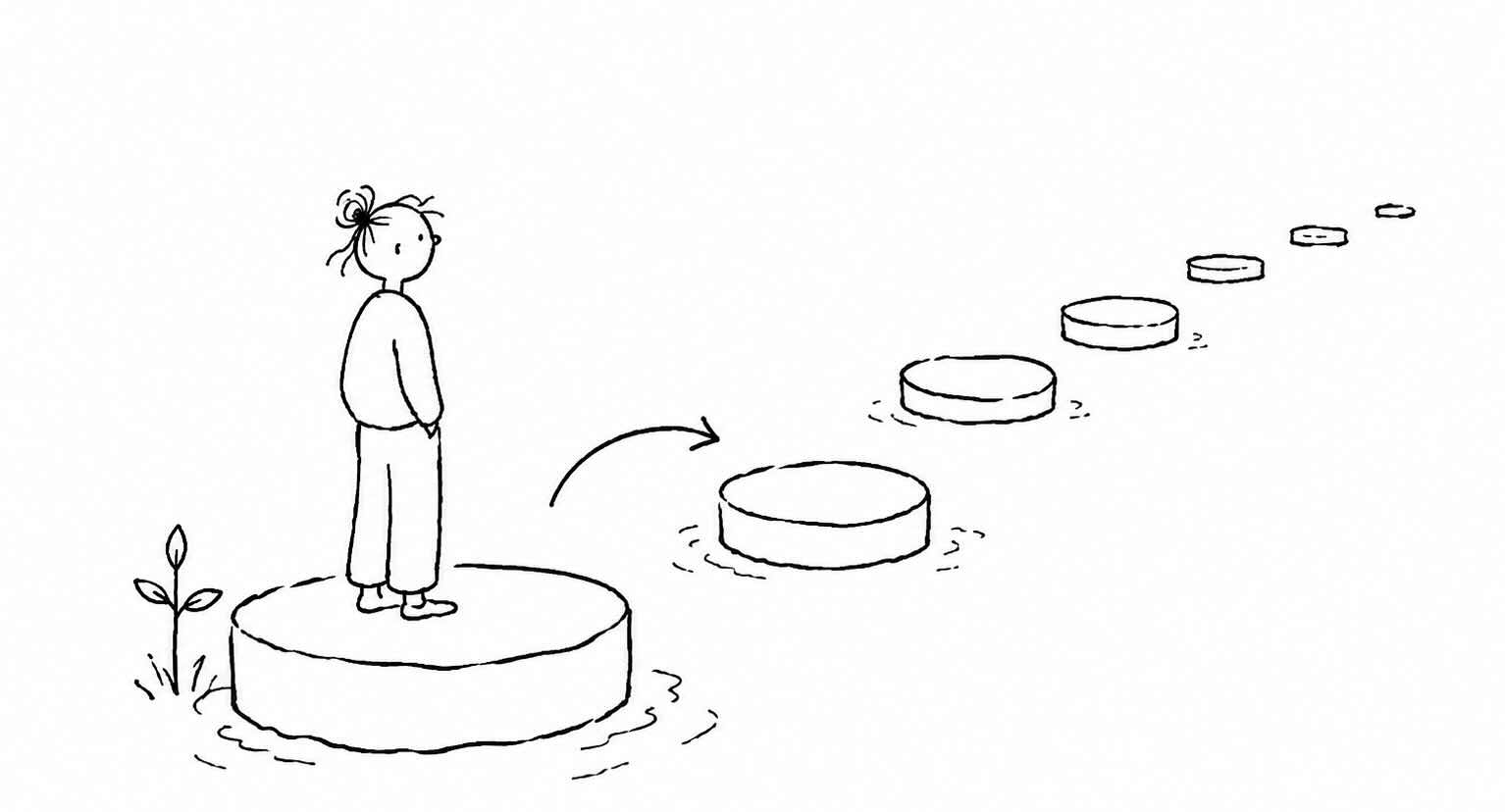
But there is an important distinction between helping someone close a gap and building an experience that depends on keeping the gap open. From an ethical point of view I would argue that:
- Good behavioral design helps people close gaps they have chosen.
- Bad behavioral design keeps moving the gap so they never feel permitted to stop.
It’s about how we think about how we present “what is enough” to the user.
Three ways of thinking about enough
The first is familiar:
1: “If I get this one thing, I’ll be satisfied.”
Reach the target. Get the promotion. Lose the weight. Gain the followers. Finish the course.
Here, enough is attached to an external outcome. We expect reaching it to resolve the tension between where we are and where we want to be.
But our desire for more rarely disappears for long, which leads to the second realization:
2: “No matter how much I achieve, it’s never enough.”
There is always another goal, another level, another metric to improve. Digital products are particularly good at exposing this. Finish one thing and another appears. Reach one milestone and the next is introduced. Read one article and there is an infinite feed waiting beneath it.
For a behavioral designer, this presents a tempting opportunity: if wanting persists, we can always give it somewhere else to go. But perhaps we are asking the wrong question.
Instead of asking how to make people want more, we should ask: ”Why do we keep making external outcomes responsible for producing the feeling of enough in the first place?”
That brings us to the third level:
3: Wanting more is useful, provided we design what it is directed towards.
The goal isn’t to eliminate wanting. It is to give it structure.
Turn wanting into something people can act on
Consider these two perspectives:
- Wanting creates a gap and a goal gives the gap direction.
- Control gives us agency and providing an appropriate challenge to the user makes closing the gap engaging.
Or in other words, consider the difference between “get 10,000 followers” and “publish something useful this week.”
The first may be motivating, but success depends heavily on other people, algorithms and circumstances. The second turns the ambition into something the person can actually do.
The aspiration doesn’t need to become smaller, but the definition of success should move closer to the person’s control.
In behavioral design, the destination is often confused with the next useful behavior.
- We show users the weight they need to lose rather than the workout they chose to complete today.
- We emphasize fluency rather than today’s conversation practice.
- We show follower counts rather than whether someone published the work they intended to publish.
The best goals sit at the intersection of agency and appropriate challenge.
Design the next challenge, not the final destination
This is where Csikszentmihalyi’s idea of flow becomes useful.
Flow is associated with conditions such as clear goals, feedback and a productive balance between challenge and skill. If something is too easy, engagement suffers. If it feels far beyond our ability, we may experience anxiety or give up.
Wanting more does not, by itself, cause flow, but wanting creates the gap from which a meaningful challenge can emerge.
Once we stop expecting achievement to extinguish desire, the question changes from:
“How do I finally arrive?”
to:
“What challenge is worth engaging with next?”
For a behavioral designer, that’s a very different objective.
Instead of endlessly increasing the target, we can help someone find the next challenge that is difficult enough to matter, achievable enough to create agency, and clear enough for them to see progress.
The absence of a final destination doesn’t make striving pointless. It changes how we should design the journey.
Design for stopping, too
There is one more component that persuasive design often overlooks. Often, behavioral designers spend considerable effort designing triggers for starting behavior.
- What makes someone open the app?
- What makes them begin a lesson?
- What gets them to take the next action?
But if wanting continually regenerates, we also need to design stopping rules – otherwise the user is left waiting for an internal feeling of satisfaction that may never arrive.
- A learning product can say: “You completed today’s practice.”
- A fitness product can say: “You’ve done the workout you planned.”
- A productivity tool can say: “You’ve dealt with everything that needs your attention today.”
These messages allow two things to be true simultaneously:
“I still want to improve” and “I have done enough for today.”
That might be one of the most important forms of agency we can design.
A practical test for persuasive experiences
When designing a behavior-changing experience, ask five questions:
-
What gap are we making visible? Is it a gap the user actually cares about, or one the product benefits from creating?
-
Who chose the destination? Are we supporting an intention the person already has, or manufacturing dissatisfaction to drive engagement?
-
Can the user control success? Translate distant outcomes into actions they can meaningfully influence.
-
Is the next challenge appropriate? Don’t simply ask for more. Match challenge to growing capability and make progress visible.
-
Where is enough? Give the person a credible point of completion. If every achievement immediately produces another obligation, reconsider what you are designing.
Persuasive design doesn’t need to make people want more. People already want more.
Our responsibility is to help them want with direction, act with agency, engage with challenges worth pursuing—and know when they have done enough.
- Stop Confusing Your Dreams with Your Goals by Jasmine Eyal and Nir Eyal
- Flow: The Psychology of Optimal Experience by Mihaly Csikszentmihalyi
- Appropriate Challenges design pattern by Anders Toxboe
- Self-Determination Theory by Richard M. Ryan and Edward L. Deci
- Autonomy and Competence in Technology Adoption Questionnaire by Dorian Peters, Rafael A. Calvo, and Richard M. Ryan
- Persuasive Patterns by Anders Toxboe