Workshop Exercises: Decide
Who / What / When Matrix
Unite a group with tasks they've crafted and committed to

Why: Solve task ambiguity and missed deadlines by ensuring all team members understand their roles, tasks, and deadlines
When: When assigning responsibilities is crucial for momentum
Instructions for running this play
- Setup. On a large surface create a matrix with three columns labeled WHO, WHAT, and WHEN.
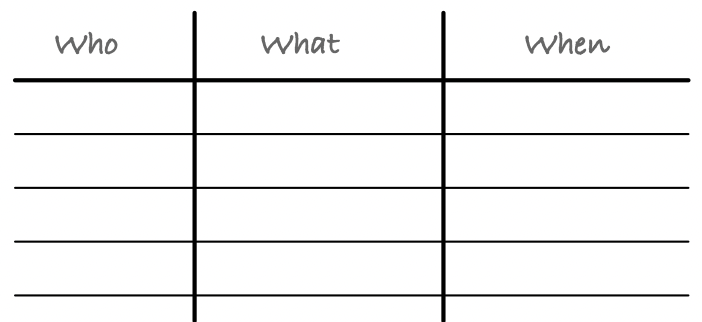
- Assign Roles. Instead of starting with tasks (the ‘What’), begin by listing all the participant names under the ‘Who’ column. Each person present is a potential action taker.
- Define Actions. Ask each participant to declare concrete next steps they can commit to. Write these commitments under the ‘What’ column. Allow participants to define multiple actions if they feel strongly about certain tasks.
- Set Deadlines. For each task, ask the responsible person to provide a specific time of completion. Write these deadlines under the ‘When’ column. This creates an accountability structure.
- Delegate further. If there’s a lot to do and few commitments, encourage those who’ve not taken up an action to either define new tasks or assist others. This step helps to distribute tasks and increases overall engagement.
Tips to perfect this play
Master and adapt the play to fit your context and needs.
Tip: Get public commitment
People are more likely to commit to actions when they are declared in front of a group.
Tip: Specific deadlines work
Encourage specific deadlines rather than vague timelines like "next week" to ensure a concrete commitment.
Tip: Reinforce commitments
Request participants to email you their commitments and send their list of tasks and deadlines to the entire group. This reinforces the commitments made.
Tip: Add WHY and HOW
Extend the matrix to include "Why" and "How", encouraging further clarity in task objectives and methods.

Every card deck includes workshop patterns, so your team can put the methods to work in your next session.
Running behavioral design workshops? The Persuasive Patterns Workshop Playbook (PDF) shows you how to design and run them.
Browse the card decksRelated plays
- Who/What/When Matrix by Dave Gray
- Who, What, When by Charles Burdett