Not Every KPI Should Be Maximized
Designing KPIs with a definition of “enough”
Design for behavior change with the Persuasive Patterns card decks
Apply psychological principles to influence decisions, increase engagement, and optimize user experience.
Get your deck!Most product KPIs point in one direction: increase engagement, increase retention, increase frequency, increase completion, increase interactions. This makes sense. A KPI is supposed to give a team direction, and an arrow pointing up is easy to understand. If the metric moves, we can see that something changed, compare experiments, and decide whether our work had an effect.
The problem is that a directional KPI contains an assumption that is rarely made explicit: if some is good, more must be better. If getting someone to practice three times a week is good, four must be better. If ten interactions are valuable, twenty must be more valuable. If retention improves from 40% to 50%, then 60% must be the next objective. Unless we define otherwise, there is no point at which the product can say that the behavior is happening sufficiently well.
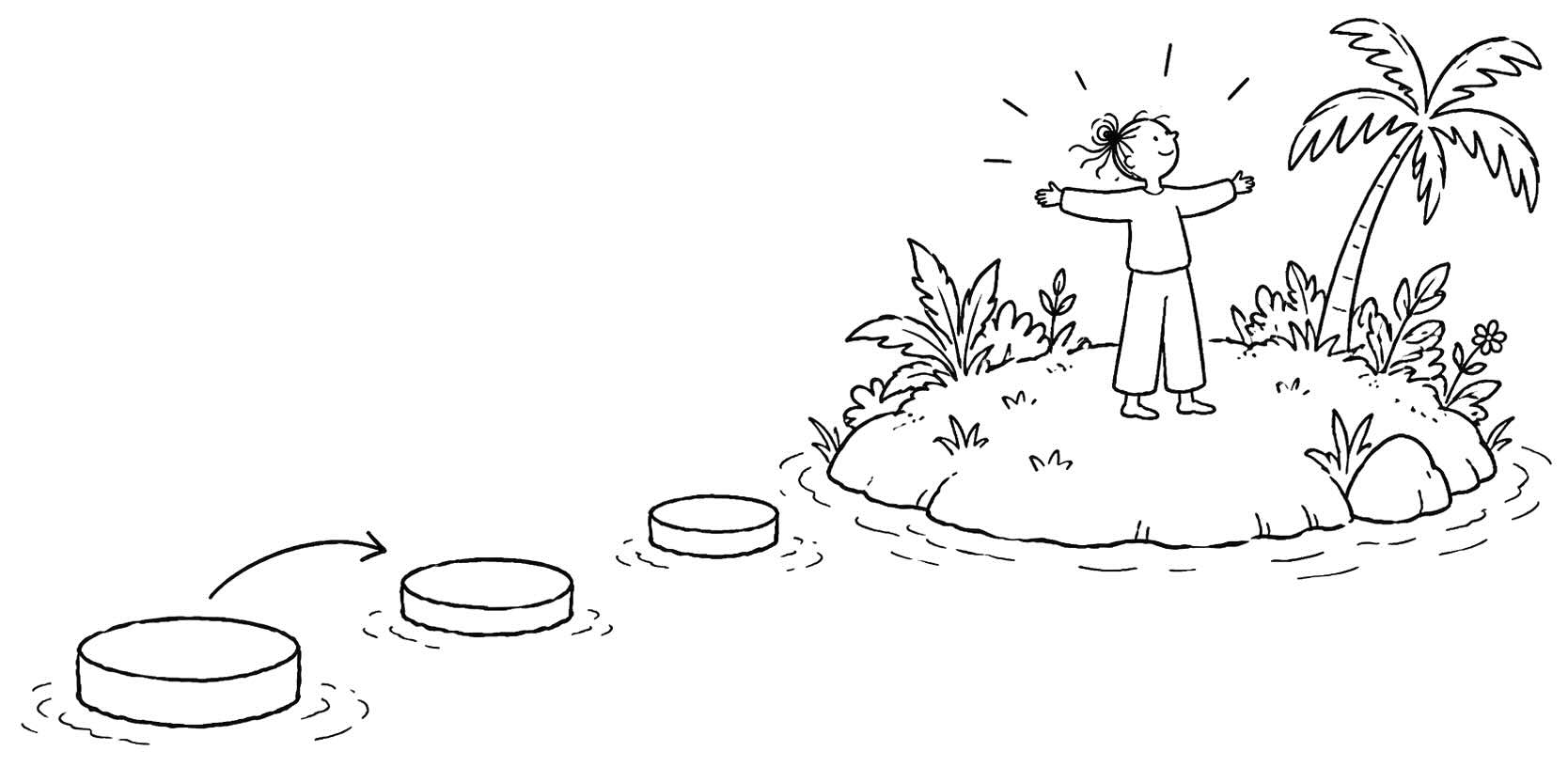
This creates a particular problem for behavioral designers. If persuasive design has no definition of “enough,” every successful behavior becomes an invitation to optimize for more.
The problem might start before we design the experience
Behavioral designers are often asked to move an existing metric. Get more people through onboarding. Make users return more frequently. Increase the number of lessons completed. Encourage more people to contribute. Our job then becomes finding the barriers, motivations, prompts and feedback mechanisms that can change that behavior.
But if the metric itself rewards more indefinitely, we may be solving the wrong problem very effectively.
Imagine a learning product where people who practice three times a week generally make the progress they came for. Helping someone move from no practice to three sessions may create substantial value. Getting the same person from three sessions to six might increase the engagement metric just as clearly, but that does not necessarily mean we have doubled the value we created.
At some point, we need to change the question from “Can we increase this behavior?” to “Would increasing this behavior still materially improve the outcome?”
That distinction matters because the behavioral designer is not necessarily responsible for over-optimization. A team that has been given “increase weekly engagement” as a goal is behaving rationally when it keeps trying to increase weekly engagement. If we want different behavior from our product teams, we also need to design better definitions of success.
Measure what the behavior is supposed to change
One way to do this is to distinguish between an activity and the state we hope that activity creates.
Consider a product intended to help people form meaningful relations. We could measure the number of messages sent, conversations started or times someone returns to the product. These are useful signals because they are observable and easy to quantify, but more messages do not necessarily mean a more meaningful relation. If we optimize them indefinitely, we risk becoming very good at producing communication without knowing whether the communication is achieving anything.
Instead, we could ask what we would expect to observe if a meaningful relation were actually forming. Is the interaction reciprocal rather than one-sided? Does initiative become shared between the participants? Does the connection persist without repeated prompts from the product? Does it eventually result in something meaningful beyond simply creating more activity inside the system?
None of these measures can tell us with certainty that a relationship is meaningful. Some outcomes will always benefit from asking people directly. But they give us behavioral evidence that the relationship itself has changed rather than simply measuring the amount of interaction used to get there.
This suggests a different principle for behavioral KPIs: measure progress toward the state you want to create, not simply the amount of behavior used to create it.
From maximizing behavior to helping more people reach enough
Once we know what state we are trying to create, we can begin defining what “enough” looks like.
Instead of setting a goal to “increase meaningful interactions per user,” a relationship product might aim to help a certain percentage of people who are seeking connection establish at least one reciprocal relationship within a given period. Once that state has been reached, making those same people generate twice as many interactions is no longer automatically twice as successful.
This changes the optimization problem. Rather than asking how we can push already-successful users further and further along the same metric, we can ask how we help more people reach the point where the product is creating sufficient value.
In other words, optimize for how many people reach enough, not how far beyond enough your most engaged users can be pushed.
The same logic applies elsewhere. A productivity product does not necessarily need people to complete as many tasks as possible; it needs them to get the important things done. A fitness product does not necessarily need to maximize workouts; it needs to help people establish an appropriate and sustainable level of activity. A learning product does not need to maximize time spent learning if the user has already achieved the intended level of mastery.
Sometimes a successful product might even make itself less necessary. If two people establish a relationship that continues without product prompts, lower engagement could represent a better outcome. If someone learns what they came to learn and leaves, fewer sessions may be evidence of success rather than failure.
Not every KPI should have an arrow pointing upward
This means that KPIs can have different shapes. Some metrics genuinely benefit from being maximized. Others have a threshold beyond which additional behavior creates progressively less value. And some have an optimal range where both too little and too much can make the experience worse.
Notifications are an obvious example. Too few and users might miss something useful; too many and the product becomes a distraction. Challenge works similarly: too little can become boring, while too much can become overwhelming. The objective is not always to move as far as possible in one direction. Sometimes it is to get into the useful range and stay there.
Defining “enough” also protects the wider experience from local optimization. One team can maximize activation, another frequency, another notifications and another retention. Every team can improve its own metric while collectively creating a product that demands more and more of the user. Enough gives us a way to ask whether another improvement to one metric is still the best use of our attention.
A practical test for behavioral KPIs
When defining or reviewing a KPI for a persuasive experience, I would ask five questions:
- What user outcome is this behavior supposed to create? If the answer is another product metric, keep asking why.
- What observable behavior would indicate that the outcome is actually occurring? Look beyond volume for evidence that something meaningful has changed.
- At what point is that outcome sufficiently achieved? Decide whether the KPI should be maximized, reach a threshold, or remain within an optimal range.
- Does more behavior beyond that point still materially improve the outcome? If the answer is no, don’t keep rewarding it simply because it can still increase.
- What might get worse while we optimize? Define guardrails so that improving one number does not make the overall experience worse.
“Good enough” in this sense is not an argument for settling for mediocre products. It is a way of allocating attention toward the places where further effort still creates meaningful value instead of continually improving whatever happens to be easiest to measure.
A mature behavioral designer doesn’t just know how to move a metric. They know when the metric has moved enough.
- When Is Good Enough Actually Good Enough? by Jasmine Eyal and Nir Eyal
- Stop Confusing Your Dreams with Your Goals by Jasmine Eyal and Nir Eyal
- Designing for Enough: A Better Way to Build Persuasive Experiences by Anders Toxboe
- Rodden, K., Hutchinson, H., & Fu, X. (2010). Measuring the user experience on a large scale: User-centered metrics for web applications. Proceedings of the SIGCHI Conference on Human Factors in Computing Systems, 2395-2398.
- Kohavi, R., Tang, D., & Xu, Y. (2020). Trustworthy online controlled experiments: A practical guide to A/B testing. Cambridge University Press.
- Patterns of Trustworthy Experimentation: During-Experiment Stage by Microsoft Research
- Csikszentmihalyi, M. (1990). Flow: The psychology of optimal experience. Harper & Row.
- Appropriate Challenges design pattern by Anders Toxboe
- Self-Determination Theory by Richard M. Ryan and Edward L. Deci
- Autonomy and Competence in Technology Adoption Questionnaire by Dorian Peters, Rafael A. Calvo, and Richard M. Ryan
- Persuasive Patterns by Anders Toxboe