Product Management, Leadership
Value Proposition
The benefit a specific customer can expect from your offer, and why it is worth choosing
Value Proposition at a glance
- Type
- Strategic concept
A value proposition explains the benefit an offer provides to a specific customer and why that benefit makes it worth choosing over the alternatives. It connects what the customer needs to accomplish with what your product or service helps them do.
That connection guides product decisions as well as communication. If your proposition is about reducing appointment coordination, a simpler rescheduling flow may matter more than another reporting dashboard. You have a reason to choose one improvement over another.
A clear proposition is still a claim. Customers need to care about the benefit, understand the offer and experience enough value to justify adopting it. Writing a convincing sentence establishes none of those things by itself.
What belongs in a value proposition?
A useful working proposition answers four questions:
- Who is it for? Specify a customer in a recognizable situation.
- What matters to them? Name an outcome, difficulty or unmet need.
- What does the offer help them achieve? Connect its capabilities to that outcome.
- Why choose it? Explain the relevant advantage over what they would otherwise do.
The alternative may be another product, a spreadsheet, extra staff or simply living with the problem. An advantage matters only when the customer values it enough to accept the cost and effort of changing.
Keep the distinction between a feature and its benefit visible. “Clients can change their own booking” describes a capability. “Staff spend less time rearranging appointments” describes the intended benefit. The second depends on the first working in the customer’s real situation; it should not become an unconditional promise before you have supporting evidence.
Your working document can contain the customer, benefit, alternative and evidence in detail. A public headline may communicate only the most important part. The proposition is the thinking behind that message, not a requirement to put every detail into one sentence.
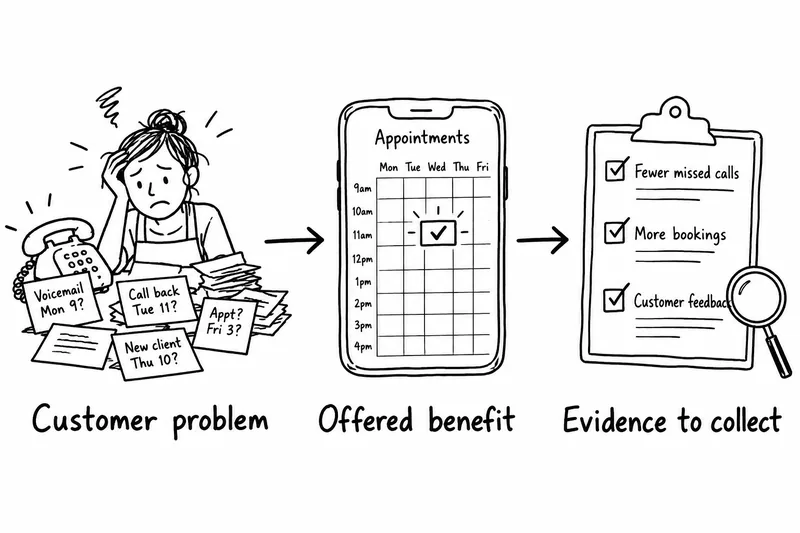
A worked example: appointment scheduling for independent salons
Consider a hypothetical scheduling service for independent salons. Everything in this example is illustrative; it describes proposed research and tests, not results from a real company.
The team starts with a broad claim: “The all-in-one platform for smarter appointments.” This leaves several decisions unresolved. Which salon? Which appointment problem? What would make its current arrangement worth replacing?
They narrow their initial audience to owner-operated salons where staff handle bookings and changes by phone while serving clients. Their proposed benefit is less interruption from routine coordination.
| Part | Working hypothesis |
|---|---|
| Customer and situation | An independent salon whose staff manage appointment changes by phone |
| Customer’s task | Keep a reliable appointment schedule while attending to clients |
| Current difficulty | Staff must interrupt other work to arrange changes and update the calendar |
| Proposed capability | Clients book and reschedule online, with updates in one shared calendar |
| Intended benefit | Less staff time coordinating routine appointments |
| Relevant alternatives | Phone calls, a paper diary, a general calendar or another booking service |
The team can now draft a proposition:
Let clients book and reschedule online, with changes reflected in one shared calendar, so staff can spend less time coordinating appointments.
This gives the team something specific to challenge. Do clients actually need help choosing services? Do salon staff need to approve changes? Does maintaining the new calendar add more work than it removes?
Those questions may change the proposition. If complex appointments still require a conversation, the service could focus on straightforward repeat bookings instead of promising to eliminate coordination.
The useful output is a decision about who to help and what to improve, together with the evidence still needed. A polished sentence is only one representation of that decision.
How the Value Proposition Canvas works
The Value Proposition Canvas is a tool for examining how an offer fits a particular customer’s jobs, pains and gains. Strategyzer’s official canvas separates the Customer Profile, describing the customer, from the Value Map, describing how your offer is intended to help. The proposition is the value you aim to provide; the canvas helps make its assumptions visible.
The two sides contain six components. Here is a first pass for the hypothetical salon service. Every entry is a hypothesis until supported by research or testing.
| Side and component | What to describe | Illustrative salon example |
|---|---|---|
| Customer Profile: Customer jobs | What the customer is trying to accomplish | Keep the appointment schedule reliable while giving clients attention |
| Customer Profile: Pains | Difficulties, costs or risks around that task | Phone interruptions and repeated work updating appointment changes |
| Customer Profile: Gains | Outcomes and benefits the customer values | A predictable day and confidence that staff are using the current schedule |
| Value Map: Products and services | The offering you propose | An online booking and rescheduling service with a shared staff calendar |
| Value Map: Pain relievers | How the offering addresses specific pains | Client self-service could remove some calls; synchronized changes could avoid repeated entry |
| Value Map: Gain creators | How the offering produces desired gains | Clear booking status and a common calendar could help staff prepare for the day |
Read across the relationship, not just down the boxes. Does self-service reduce the interruptions staff actually find costly? Does the shared calendar provide confidence, or create a second schedule to maintain? These are testable links between the offer and the customer’s situation.
Start with one customer segment. Research its jobs, pains and gains before selecting the most important ones to address. Then make deliberate choices about the offer. A full canvas does not require a feature for every pain or gain, and matching sticky notes is not evidence of fit.
Use our Value Proposition Mapping exercise to facilitate that work with your team. It provides a workshop structure for connecting customer needs with an offer. The table above uses Strategyzer’s canonical six component names, while the exercise uses an adapted workshop framing. Keep the customer-side needs and the offer-side response distinct whichever worksheet you use. When the mapping is coherent, the Value Proposition Statement exercise helps turn the choices into a clear working statement.
Value proposition vs slogan, positioning and USP
These ideas are related, but they do different jobs. For the same hypothetical scheduling service:
| Concept | Its purpose | Illustrative expression |
|---|---|---|
| Value proposition | Explain the customer benefit and reason to choose the offer | Let clients book and reschedule online, with changes in one calendar, so staff spend less time coordinating appointments |
| Slogan or tagline | Create a short, memorable expression | Make room for a better day |
| Positioning | Establish who the product is for, the alternatives and the market context in which its value makes sense | Appointment scheduling for independent salons that manage changes by phone |
| Unique selling proposition (USP) | Emphasize a particular distinguishing selling point | A claim about a rescheduling capability competitors lack—only if a competitive check supports it |
The positioning line is shorthand for a strategic choice, not a complete positioning exercise. April Dunford’s positioning guide explains how competitive alternatives, differentiated capabilities, customer value, target customers and market category inform one another.
You can have a meaningful value proposition without claiming to be the only provider of a feature. Customers might choose a combination of convenience, service and fit with their existing work. If you claim exclusivity or superiority, verify it against the alternatives customers actually consider.
How to develop a value proposition
Start with the customer’s situation
Choose one initial customer group and investigate recent examples of the task you want to improve. In a Customer Interview, ask what happened, what they did and what the consequences were.
For the salon example, “Walk me through the last appointment you had to move” is more informative than “Would you like easier scheduling?” Ask to see the current workflow when appropriate. Record the workaround and the reasons it survives: familiarity, flexibility and personal contact may matter alongside speed.
Separate observations from interpretations. A staff member describing three interruptions is an observation about that occasion. “All salons urgently need automation” is a much broader inference.
Choose the outcome to address
Use the canvas to compare possible benefits against what you have learned. For the salon, the customer-side question is whether coordination causes a worthwhile problem. The offer-side question is whether self-service changes and a shared calendar help with it. Keep those questions separate so that enthusiasm for a feature does not become supposed evidence of a need.
Choose the benefit that matters enough to investigate further. Record what you are leaving out: a service focused on routine rescheduling might initially leave complex consultations on the phone. That boundary makes the offer easier to design and its promise easier to test.
Write a claim you can examine
Draft a plain-language version stating the customer, the outcome and how the offer helps. The Value Proposition Statement exercise can help a group align its wording after doing the underlying research.
Then underline each claim that needs evidence. “Less coordination” needs a definition. For this example, the team could measure staff minutes spent arranging routine bookings and changes per completed appointment. They should also watch for new burdens, such as resolving calendar errors. A faster process that produces unreliable bookings does not deliver the intended value.
How to test a value proposition
Test the assumptions separately enough to understand what a result means. Alex Osterwalder’s guidance on testing value propositions distinguishes assumptions about the customer from assumptions about how the proposed offer creates value.
For the scheduling service, a practical investigation could look like this:
| Question | Evidence to seek | What it would not establish |
|---|---|---|
| Does coordination cause a significant problem? | Recent examples, observed interruptions and time spent on current workarounds | That this particular service solves it |
| Do customers understand the proposed benefit? | Their own explanation of the offer after seeing the message | That they will adopt or pay for it |
| Does the service reduce coordination work? | A limited pilot comparing routine coordination work before and during use | That the result applies to every salon |
| Is the benefit worth the switching cost? | Willingness to set up a real calendar, involve staff and consider a paid continuation | That customers will stay indefinitely |
Before a pilot, agree on a meaningful improvement and the conditions that would make the result unacceptable. For example, the team might require lower coordination time without more booking errors. Set the threshold with the participating salon’s economics and workflow in mind; there is no universal percentage that proves a proposition.
Record what else changed. Different booking volumes, unusual staff absence or extra help from the product team can affect the result. Include setup and support work when assessing whether the service is worthwhile.
A message test can reveal unclear wording. A pilot can reveal whether the benefit occurs. A payment can provide evidence about willingness to pay. None replaces the others. Use the Product Experimentation overview to choose a test for the uncertainty you actually have.
How the Value Proposition Canvas connects to the Business Model Canvas
The Value Proposition Canvas zooms into two blocks of the Business Model Canvas: Customer Segments and Value Propositions. The Customer Profile expands a chosen customer segment; the Value Map expands the offer aimed at it. Alex Osterwalder describes this relationship in his original explanation of the canvas.
The remaining Business Model Canvas blocks concern Channels, Customer Relationships, Revenue Streams, Key Resources, Key Activities, Key Partnerships and Cost Structure. Together, the nine-block canvas examines how the business creates, delivers and captures value. A useful customer benefit is one part of that system.
For the salon service, the smaller canvas examines whether self-service booking addresses a worthwhile coordination problem. The larger canvas asks how salons discover the service, who helps them set it up, which calendar integrations and support activities are necessary, and how revenue covers those costs. A benefit can matter to customers and still be expensive to deliver.
Use our Business Model Canvas glossary article for the wider model, and the value proposition playbook to compare ways a business might create value. Return to both canvases when evidence changes: targeting larger salons, for instance, could change the benefit, sales process, implementation work and price together.
When users and buyers differ, investigate both. Staff may value fewer interruptions while the owner cares about reliable bookings and implementation cost. One benefit statement need not carry the entire buying decision.
BMI Lab’s definition: customer value and the offering
In Understanding business models through BMI patterns, BMI Lab distinguishes the value proposition from the products and services that deliver it. The proposition concerns the customer value created by meeting needs, enabling gains or addressing problems. The products and services give that value a form the business can deliver.
For our hypothetical salon, the online booking service and shared calendar are the offering. Less time spent coordinating appointments is the intended customer value. A manually delivered service might produce some of the same benefit through a different offering. Comparing those possibilities helps the team avoid assuming that a particular feature is the only way to help.
BMI Lab places the proposition and offering within WHAT, one of four business-model dimensions in that article:
- WHO: the customers and their needs.
- WHAT: the customer value and the products or services offered.
- HOW: the activities, resources and partners used to deliver the offering.
- WHY: the commercial logic, including how the company captures value.
Use these questions to check the wider model alongside Strategyzer’s canvases. The frameworks organize the discussion differently. In the salon example, a subscription could be part of WHY, while software, integrations and support help answer HOW. Neither proves that the customer experiences the intended reduction in coordination work.
Limitations and common mistakes
- Treating agreement as demand. Someone liking the idea does not show that the problem deserves budget or that they will change their routine.
- Combining incompatible audiences. A salon with a dedicated receptionist may value something different from a solo practitioner. Investigate the difference rather than averaging their answers into “businesses.”
- Promising an outcome the product cannot control. Appointment software can support coordination; it cannot guarantee a full calendar or a successful business.
- Keeping the proposition fixed after learning. If customers adopt for a different benefit, review the evidence and revise the offer, audience or message.
A clear proposition also does not establish Product/Market Fit. It states a reason customers might choose you. Sustained use, purchasing and other market evidence are needed to assess whether that reason holds up.
Common questions about value propositions
How long should a value proposition be?
Use enough detail for the decision at hand. A headline may be brief; an internal working proposition should preserve the customer, expected benefit, relevant alternative and evidence. Shorter wording helps only when it remains clear and credible.
Should a product have more than one value proposition?
It can, when it serves meaningfully different customers or situations. Keep each proposition connected to a specific audience and evidence. Changing adjectives for different campaigns does not necessarily create a different proposition.
What is the next useful step?
Write your current proposition, mark its least-supported assumption and choose one investigation that could change your decision. If the uncertainty concerns the customer, start with research. If it concerns the promised benefit, test the mechanism that is supposed to deliver it.
Visual examples
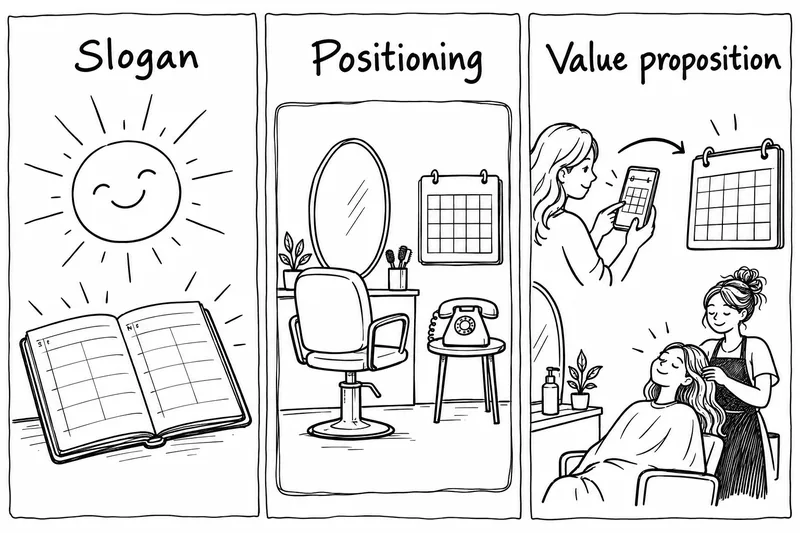
Three ways to describe a hypothetical salon scheduling service: a slogan, a positioning choice and a proposed value proposition. The promise of less coordination is an assumption to test, not a proven result.
You might also be interested in reading up on:
- The Value Proposition Canvas by Strategyzer
- Value proposition: the key to winning customers and driving business growth by Strategyzer
- The Customer Value Map v.0.8 - now called The Value Proposition Canvas by Alex Osterwalder
- The Business Model Canvas by Strategyzer
- Understanding business models through BMI patterns by BMI Lab
- Test your value proposition: supercharge Lean Startup and CustDev principles by Alex Osterwalder
- A Quickstart Guide to Positioning by April Dunford
Product Weekly · Curated by Anders Toxboe
Sign up for the Product Weekly newsletter.
Join 40,000+ product people who get a weekly selection of useful reads on building digital products, plus new Learning Loop resources and occasional product updates.
What will I receive?Takes 10 seconds. Free to subscribe, unsubscribe at any time. Privacy policy.