Workshop Exercises: Understand
Empathy Mapping
Build a shared understanding of users from research evidence
How: Organize research into four quadrants, mark interpretations and choose what to investigate next.
Why: Reveal gaps and contradictions in your understanding before turning assumptions into product decisions
When: Use when you have interviews or observations to synthesize and need the team to agree what it knows and what to investigate
An empathy map organizes what a team knows about a user in a particular situation, including their words, actions, thoughts and feelings. Use it to make research understandable and expose uncertainty before making a design decision.
What goes in the four quadrants?
| Quadrant | What to record | Evidence rule |
|---|---|---|
| Says | The person’s actual words | Use a verbatim quote with a source; label paraphrases |
| Thinks | What may occupy their attention or matter to them | Distinguish what they report thinking from your interpretation |
| Does | Actions in the relevant situation | Separate observed behavior from reported behavior |
| Feels | An emotion and the situation connected to it | Identify self-reports; mark inferred feelings as uncertain |
Dave Gray developed empathy mapping at XPLANE. His updated canvas also examines goals, seeing and hearing, and places pains and gains inside Think and Feel. The workshop below uses the simpler four-quadrant format described by Nielsen Norman Group; it is not a reproduction of Gray’s full canvas.
A worked empathy-map example
Imagine observing a researcher uploading a transcript before a meeting. This scenario, quote and source ID are invented to demonstrate the method. In the hypothetical session S1, the researcher asks, “Did my upload work?” and uploads the file again.
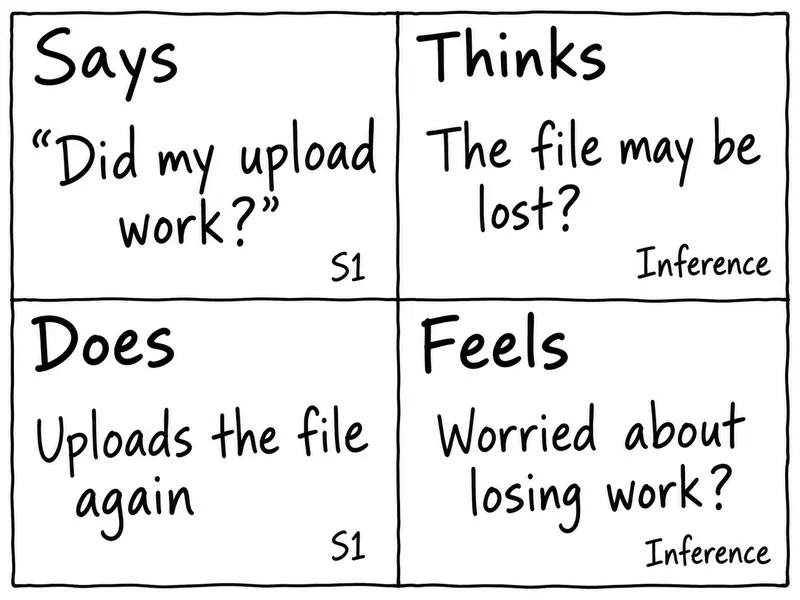
The repeated upload is an action. Fear of losing work is only one possible explanation: the person might instead be replacing the file or following an instruction. Keep that interpretation as a question. Ask what they expected after the first upload and check what the interface showed at that moment.
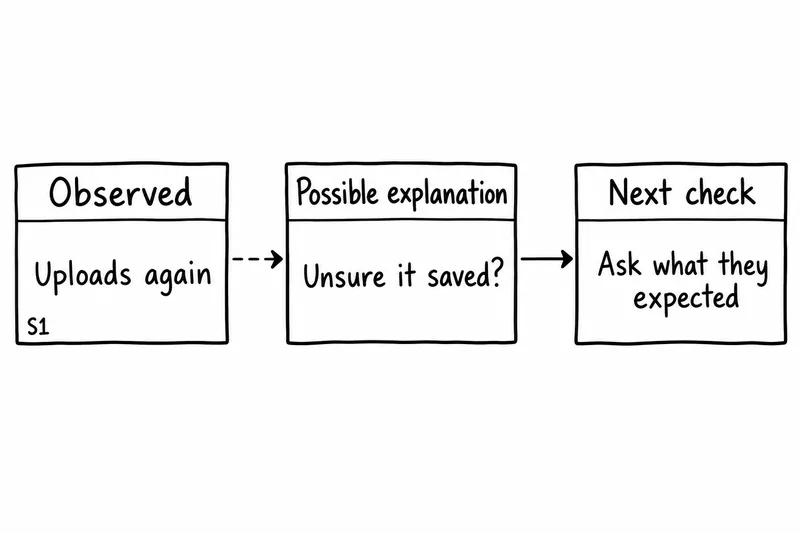
The second drawing follows the same example from observation to a checkable interpretation. If further evidence points to unclear feedback, investigate the confirmation experience; the map alone does not prove the cause or validate a redesign. Prepare a Customer Interview when the next step requires understanding the person’s context.
Choose the right map
An empathy map examines a perspective within a situation. Journey Mapping follows an experience over time. A Prototype Persona describes a provisional user profile; it is not interchangeable with research about a particular task.
Use Behavioral Empathy Mapping when you want to extend the discussion to behavioral barriers and enablers. Standard empathy mapping already includes thoughts and feelings; a behavioral framework offers additional prompts, not access to a person’s unspoken mind.
A useful output is a sourced map plus a decision about what to learn next. It does not measure how common a need is or establish demand for a product. Keep research references anonymized, revisit uncertain notes as evidence arrives, and retain exceptions that could change your decision.
Instructions for running this play
- Set the scope. Spend 5 minutes choosing one user and situation, or one clearly defined research group with a shared goal. Write the goal and context above a four-quadrant board: Says, Thinks, Does and Feels.
- Read the evidence. Spend 5 minutes reviewing anonymized interview extracts, observation notes or support conversations collected before the workshop. Give each source an ID; distinguish a participant’s reported action from behavior you actually observed.
- Map individually. Run 8 minutes of Silent Storming. Put one quote, action or interpretation on each note, attach its source ID, and mark every inference or unsupported assumption explicitly.
- Share and group. Use 10 minutes of Playback to explain notes and their evidence. Combine duplicates, retain conflicting accounts and keep different participants identifiable; do not settle uncertainty by majority vote.
- Find the important gap. Spend 10 minutes comparing the quadrants. Choose one contradiction or uncertain interpretation that could change a product decision, and write an open research question rather than jumping to a feature.
- Assign the next check. Use 7 minutes to choose how to investigate that question and record an owner and date in a Who / What / When Matrix. Agree what evidence would change your interpretation and when to update the map.
Tips to perfect this play
Master and adapt the play to fit your context and needs.
Tip: Leave honest gaps
An empty quadrant is a research question. Do not invent a quote or emotion to make the board look finished.
Tip: Keep differences visible
Use separate maps for materially different goals or situations. A combined map should retain source IDs and exceptions rather than invent an average person.
Tip: Work remotely
Share anonymized research extracts beforehand. Use the same source labels on a shared board and reserve silent time before discussing interpretations.
Trigger Questions
- Can we make an empathy map without research? Yes, as an explicitly labeled assumption map for planning research. It does not establish what customers actually think or feel.
- What if Says and Does contradict each other? Keep both entries with their context and sources, then investigate the difference rather than choosing the more convenient account.
- Should every quadrant have the same number of notes? No. Missing evidence is useful to see; equal note counts are not a success measure.
Use Discovery Patterns to choose research methods before turning team assumptions into statements about customers.
$129 · Printed deck + digital edition
Explore Discovery Patterns- Updated Empathy Map Canvas by Dave Gray
- Empathy Mapping: The First Step in Design Thinking by Rachel Krause and Sarah Gibbons