Workshop Exercises: Understand
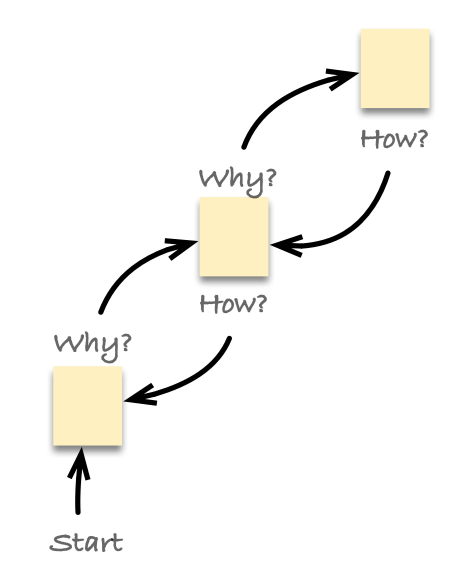
Why-How Laddering
Challenge the level and focus of an initial design question

Why: Allow for an thorough understanding of the problem space by identifying needs, constraints, and opportunities
When: Useful to go beyond surface-level solutions and instead explore the underlying drivers and intricacies of user needs
Instructions for running this play
- Prepare a problem statement or user need to explore before the meeting.
- Step up the ladder from the problem or need, asking “why?”, considering options broader than the initial one.
- Continue until you feel you have reached a root cause or common abstract need. This is the top of the ladder..
- Climb back down the ladder, asking “how?”, considering options narrower than where you came from. This will provide ideas for how to address the needs.
- Consider continuing the exercise with How Might We…
Tips to perfect this play
Master and adapt the play to fit your context and needs.
Tip: Reverse Laddering
Start with a lower-level "how" mechanism and ladder up to uncover the higher-level "why" motivations, providing a different perspective on the problem.
Tip: Parallel Laddering
Divide participants into smaller groups, each focusing on a specific aspect of the design question, and explore the "why" and "how" dimensions simultaneously.

Every card deck includes workshop patterns, so your team can put the methods to work in your next session.
Running behavioral design workshops? The Persuasive Patterns Workshop Playbook (PDF) shows you how to design and run them.
Browse the card decksRelated plays
- Why-How-Laddering: Define the right challenge by Philipp Munzert
- Why-How Laddering by PD Methods
- Using Abstraction Laddering: How to Build the Right Question and Stick to it by Daniel Stillman
- What is Why-How Laddering?
- Abstraction Laddering by LUMA Institute
- Laddering Technique: A method to discover what people value by B2B International