
Why: Help teams shift from focusing on problems to exploring possibilities and brainstorming creative solutions
When: Useful for reframing challenges and generating ideas in ideation- or problem-solving sessions
Instructions for running this play
- Break down a larger design challenge into smaller insights or problems to solve.
- Explain how to write a How Might We… (HMW) question: by rephrasing a problem or insight as a question asking one or more solutions.
Example:
- Problem: Users complete the wrong tax form
- Question: HMW make users feel confident they are filing their taxes correctly?
- Try rephrasing each problem or insight as questions by adding “How Might We…” at the beginning, writing only one HMW idea or opportunity per sticky note
- Consider sorting and prioritizing HMW notes with Affinity Mapping and Dot Voting.
- Use ideation exercises such as Crazy Eightss/workshop-exercise/crazy-eights”>Crazy Eights</a>, **Round Robin, Figure Storming, or even Reverse Brainstorming (convert back to problems) to generate ideas for solving your problems.
Tips to perfect this play
Master and adapt the play to fit your context and needs.
Tip: Broaden your search
Ask yourself whether your "How Might We"-question allows for a variety of solutions. If it doesn't, broaden it.
Tip: Quantity is good
If your insights or problems suggest several How Might We... questions, that is great.
Tip: HMW... is short for...
Instead of writing out "How Might We" on every generated sticky note, use the acronym HMW
Tip
Aim for quantity over perfection
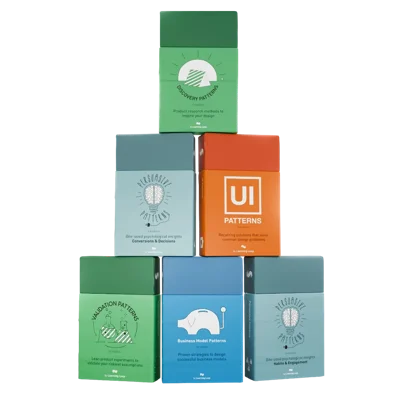
Every card deck includes workshop patterns, so your team can put the methods to work in your next session.
Running behavioral design workshops? The Persuasive Patterns Workshop Playbook (PDF) shows you how to design and run them.
Browse the card decks