Design that adapts just-in-time
Turning Product Psychology into Product Mechanics
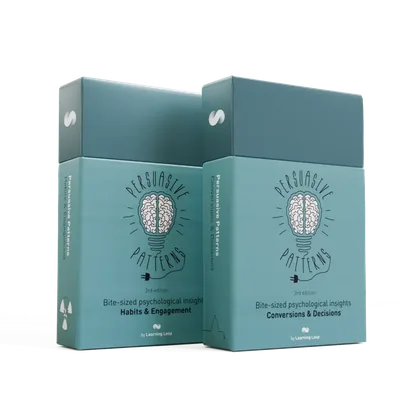
Design for behavior change with the Persuasive Patterns card decks
Apply psychological principles to influence decisions, increase engagement, and optimize user experience.
Get your deck!Imagine a fitness app that notices you haven’t gone for a run in a week. Just as you’re debating whether to hit snooze instead of exercising, your phone buzzes with a personal message: a reminder of how far you’ve progressed and how great you’ll feel after a run.
That nudge arrives at the perfect moment – exactly when your motivation is waning – and it rekindles your commitment to your goal. This is the power of Just-in-Time Adaptive Interventions (JITAIs) in action: delivering the right support precisely when the user needs a push, turning a theoretical insight from behavioral science into a practical product feature.
What are just-in-time adaptive influence strategies? And why should you care?
Within health research, there’s a concept called “Just-in-Time Adaptive Interventions” (JITAIs) that aims to provide the right type and amount of support, at the right time, by adapting to an individual’s changing internal state and context.
For product design, we could call it “Just-in-Time Adaptive Influence” (JITAI) - the same concept, just applied to product design.
Instead of static, one-size-fits-all messages or features, a JITAI-powered product dynamically adjusts when and how it intervenes based on what each user is doing or feeling in the moment. The goal is to maximize effectiveness by only intervening when it will have impact (and only when needed).
Adapting JITAI to general product design, it would mean that we would look to adjust or implement these key components in our product:
- Decision Points. Moments in the user’s journey when the system should consider influencing the user’s decision (e.g. when a user opens a cancel page, or has been inactive for 7 days). These are the “windows of opportunity” or kairos moments.
- Influence strategies. The menu of actions or messages the system can deliver (e.g. a prompt, a discount offer, a motivational quote, an educational tip). This includes the content, format, and even intensity of the intervention.
- Tailoring variables. Data about the user’s current context or state that inform the decision (e.g. time of day, user’s past behavior, their reason for canceling). Modern apps gather this via analytics, sensors, or user input to gauge when and what help is needed.
- Decision rules. The logic that matches a situation to an influence strategy (e.g. “If user has not logged in for 1 week and has <50% of onboarding complete, then send an encouraging email with progress stats”). Essentially, rules (potentially learned via AI) decide which intervention to deliver at which decision point for which user.
Don’t nudge all users all the time. Nudge the right user at the right moment.
Rather than bombarding every user with the same prompt (“Don’t forget to come back!”) at arbitrary times, a JITAI-driven approach might wait until the user hits a critical moment, the moment of truth, and then deliver a tailored nudge.
Well-timed adaptive nudges can dramatically improve outcomes in activation, retention, learning, and habit loops.
Features that drive action without annoying the user target users with precision. They seek that Kairos moment, the opportune instant, when a user is most likely to be receptive to a prompt rather than relying on brute-force techniques (endless notifications or emails).
Turning Behavioral Theory into Product Opportunities
Looking at product design from the lens of JITAIs opens up exciting opportunities.
Seek to make your product “sense” when a user is struggling, coasting, or about to give up, and respond accordingly. For example, a learning app might detect when a learner’s practice frequency drops and then at that very moment unlock a fun new challenge or send an encouraging message. This is personalization not just of content, but of context. It’s the next level beyond simple segmentation: it’s adaptivity at the individual level (the Persuasive Pattern of Tailoring, adapting to each user’s needs and abilities).
By intervening only at pivotal moments it feels like the product “just gets me.” The user might even thank you for the timely assist, instead of reaching for the unsubscribe button. In academic terms, a well-designed system is “contextually aware” and “anticipatory,” looking out for critical decision points and intervening judiciously without derailing the user’s flow. In plain terms: the app knows when to speak up and when to stay silent.
The JITAI approach can be seen as a delivery method for all sorts of persuasive design patterns you might already know, but delivered just-in-time. For instance, one powerful bias is Loss Aversion: our fear of losing something is often stronger than the lure of gaining something equivalent. Products can tap into this by timing messages to highlight what the user stands to lose by not acting. A classic example is Duolingo’s use of streaks. As a user’s streak grows, the app strategically sends urgent notifications like “⚠️ Your streak is in danger!” late in the day, playing on the user’s aversion to losing their hard-earned progress
It’s no coincidence those prompts hit when the clock is ticking – the timing makes the emotional hook (loss of streak) far more compelling. Similarly, Social Proof messages are most persuasive at decision moments; for example, a prompt saying “5 of your team members completed this step today” is most effective right when the user is hesitating to complete that step themselves. By combining timing with principles like Scarcity (“Only 2 days left to redeem your reward!”), Commitment (“Remember, you pledged to do this”), or Curiosity (“A surprise awaits if you continue…”), a just-in-time intervention can dramatically increase the chance of action. The key is that the mechanic (e.g., a pop-up, notification, or UI prompt) is driven by user context, and the message leverages a motivational bias.
Real world examples
To ground this in reality, let’s look at how in-built just-in-time adaptive influence is already being used (or could be used) as product mechanics:
Juttu’s cancel flow intercept
Subscription businesses often treat a cancellation click as the end of the road. Juttu (a churn-prevention SaaS) shows how a JITAI approach can turn this “moment of truth” into an opportunity. The moment a user hits the “Cancel” button, Juttu springs into action, intercepting the flow to ask why they’re leaving and then instantly presenting a personalized offer based on their reason (for example, a discount if cost is an issue, or a pause plan if they’re just needing a break). In essence, it adapts the intervention (the offer) to the user’s context (their cancellation reason) right at the pivotal time when the user’s decision can be influenced. This just-in-time strategy has been shown to reduce cancellations significantly. Juttu reports up to 30% reduction in churn. The brilliance here is timing a generic “win-back” email days later is far less effective because the user’s mindset has moved on. By acting in the moment, the product turns a likely loss into a chance to retain the user.
Duolingo’s Adaptive Reminders
Duolingo, the language-learning app, is famous for its gamified habit-forming techniques. One reason it’s so effective is the adaptive timing of its reminders. Duolingo doesn’t send the same push notification to every user at 2 PM. Instead, it observes your behavior and times its “nagging” strategically. For instance, if you usually practice in the evenings, it might send a gentle reminder after dinner, then escalate to an urgent “Your streak is in danger!” message as midnight (your streak reset time) approaches.
This is a JITAI in disguise: the app learns when you’re most likely to lapse and intervenes before you do. It taps into your commitment and fear of breaking consistency (Commitment & Consistency bias and FOMO) at the moment those feelings will be most salient. Duolingo’s approach shows that even simple triggers like push notifications can be made far more effective by adaptive timing and personalization.
Many onboarding flows can borrow this idea: for example, a new user who stops midway through setup might receive a prompt the next time they open the app, specifically addressing the step they left incomplete (leveraging the Zeigarnik Effect; our tendency to remember and want to complete unfinished tasks). The influence strategy is delivered just as they return, making it feel like a contextual helper rather than a random annoyance.
Any In-App Guidance and Support, really
Consider a complex SaaS product where new users often get stuck using a particular feature. A JITAI-inspired design might instrument the UI to detect frustration or stalling (say, spending too long on one screen without progressing) and in that moment offer help. It could be through a tooltip, a chatbot message, or an invitation to a quick tutorial. This is akin to the old Clippy (“It looks like you’re writing a letter, need help?”) but far more context-aware and subtle.
Modern apps can use triggers like repeated failed attempts, unusual hovers, or idle time as signals for when to step in. The intervention could be tailored: e.g., if user has attempted X three times with no success, then pop up a micro-help dialog or offer to auto-fix the issue. The timing ensures the help is relevant (the user is experiencing the problem now). This approach aligns with Appropriate Challenges (ensuring the user isn’t overwhelmed by adjusting difficulty/support on the fly) and Feedback Loops (immediately responding to user actions with guidance).
A nice side-effect is fewer support tickets and smoother UX as you’re proactively helping users at the moment of need.
Products like these leverage Triggers and Tailoring deeply:
- the cue is embedded in the user’s life (location, activity, mood)
- the content is adapted to their goal (e.g., staying smoke-free).
While not every product has access to such rich data, even simple context (time of day, user’s recent actions) can be used creatively to approximate this. The key lesson is to find the “Kairos” in your user’s journey, those opportune moments for change, and be ready to intervene in a helpful, personalized way.
Getting Started: How to Design a JITAI-style Product
Enthused by the possibilities? Bringing JITAI concepts into your product doesn’t necessarily require complex algorithms. You just need a clearer map of where decisions wobble and why.
1. Spot the high-leverage moments
Start by mapping where people are most likely to drift, hesitate, or abandon. Your best candidates are typically:
- onboarding stalls
- upgrade and checkout moments
- “I’m about to leave” actions
- moments after a win (where drop-off often happens)
- recurring routines that need consistency
A practical way to uncover these is to run Behavioral Journey Mapping. Use this exercise to identify friction, goals, emotions, and bias hotspots across the journey, then zoom in on the moments with the biggest behavioral upside.
2. Turn moments into decision points and influence hypotheses
Once you’ve identified the hotspots, define:
- the specific decision you want to influence
- the current default behavior
- the desired behavior
- the likely bias behind the gap
This is where JITAI becomes a concrete product mechanic: you’re not “adding nudges.” You’re designing small, timed interventions around known behavioral risks.
Use the Persuasive Patterns Deck for Inspiration
If you have access to a library or deck of behavioral design patterns (like the one from Learning Loop), use it to refine your influence strategy ideas. Each pattern is a lens on human psychology.
- JITAI = timing logic + tailored content.
- Persuasive patterns = your influence strategy menu
For example, flipping through the deck might prompt you to consider a Trigger placement you missed (“Can we put a visual cue at the point of sale to remind users of something?”) or a Framing Effect tweak (“Should our just-in-time message frame this as an opportunity rather than a loss?”). The deck’s cards on biases can also help ensure your content hits the right note: e.g., using an Authority Bias angle (“An expert tip: …”) if appropriate, or a Social Proof angle (“Join 80% of your team who’ve already …”) can increase credibility and impact of the nudge. When designing the mechanics, the Tailoring card reminds us to personalize; the Timing (Kairos) card underscores choosing the moment carefully; the Trigger card itself is all about placing cues in the user’s path, which is exactly what you’re doing with JITAI. By combining these patterns with real-time context, you create interventions that not only reach the user, but actually resonate.
It’s all about experimentation
Treat your just-in-time influence strategies as hypotheses. Your goal is to figure out which moments and messages actually move the needle for your users?
Use A/B testing and other experiments to compare behavior with and without the intervention.
You might find, for example, that sending a push at the exact moment of abandonment is too intrusive, but sending it 30 minutes later yields better re-engagement - or vice versa. Iterate on the timing, wording, and logic.
In academic research, JITAIs often use micro-randomized trials to continuously learn the optimal strategy. In the product world, you can borrow this ethos by continuously monitoring performance and adjusting. Over time, you might even get more sophisticated, using predictive analytics to identify who needs an intervention before a problem happens (e.g., predicting who is likely to churn and preemptively offering help).
User trust and ethics are vital
Like all powerful tools, they can be used for both bad and good. With great power comes great responsibility (and perhaps reputation effects on your product).
Always align influence strategies with a focus on helping the user achieve their goals. Aim to create win-win scenarios (user succeeds, business benefits). If a strategy feels too manipulative or only business-serving, rethink it. For instance, inducing FOMO and anxiety (as some apps do) can backfire if it causes user stress.
Aim for strategies that encourage rather than guilt-trip whenever possible. And give users some control. It could be allowing them to snooze reminders or opt out of certain prompts. An ethical, user-centric approach will ensure your adaptive strategies are seen as delightful features and not dark or deceptive patterns.
Just-in-time adaptive influence helps bridge the gap between behavioral theory and real product outcomes. It reminds us that when you ask is just as important as what you ask.
The method is simple: identify high-leverage decision points, read lightweight context signals, and deploy tailored influence strategies using proven persuasive patterns.
The challenge is even simpler: pick one journey this week, choose two decision moments, and ship one just-in-time rule for each. Then test the timing, refine the message, and let your product earn the right to nudge less often by nudging better.
- Mirai: A Wearable Proactive AI “Inner-Voice” for Contextual Nudging by Fang, Samaradivakara, Maes & Nanayakkara
- Leveraging NeuroUX for Powerful Just-In-Time Adaptive Interventions by NeuroUX
- Duolingo’s Streak Feature: Masterclass in Behavioral Design by Yusuf Muhammed
- The Art of Duolingo Notifications: The Subtle Manipulation of Language Learners by WebDesigner Depot
- Juttu by Juttu