Idea Validation
Validation Strategy System
Start with any playbook below. These questions help reveal gaps in evidence; they are not launch approval or a required order of testing.

⬇

⬇
⬇

⬇
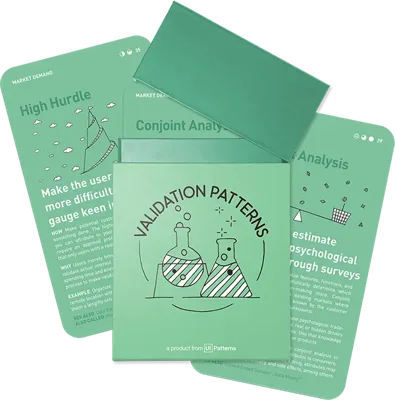
Use Validation Patterns to compare practical experiments and choose a method for the evidence your next decision needs.
$129 · Printed deck + digital edition
Explore Validation Patterns
Use Validation Patterns to compare practical experiments and choose a method for the evidence your next decision needs.
$129 · Printed deck + digital edition
Explore Validation PatternsTesting business ideas means gathering evidence about assumptions that could make an idea succeed or fail. Validation Patterns organizes practical methods around four useful questions: the problem, reachable demand, the proposed product and willingness to pay.
Use the playbooks and methods above to choose where to investigate. They are routes into the work, not four certificates you must earn in order. A new finding can send you back to an earlier question or expose delivery and cost risks that need additional investigation.
Choose the question that matters next
| What is uncertain? | Start here | What a positive result still leaves open |
|---|---|---|
| Does a specific group face an important problem? | Validate the problem | Whether the proposed solution is wanted or useful |
| Can we reach buyers who act on this offer? | Validate the market | Repeat demand, costs and the product experience |
| Does the proposed experience help people achieve their goal? | Validate the product | Whether enough buyers will adopt and pay |
| Will buyers accept this price and these terms? | Validate willingness to pay | Maximum price, renewal and viable delivery economics |
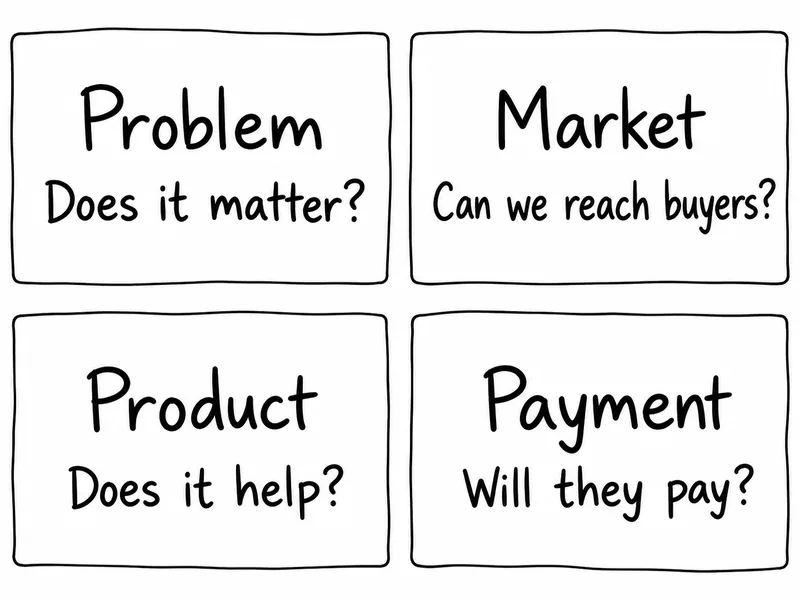
For example, a team considering a stock-report service for independent shops might investigate a recent stock shortage, test an offer through a recruiting channel, observe an owner making an ordering decision, or offer a paid pilot. Choose among those activities based on the consequential uncertainty, not because one method is fashionable. This is a hypothetical example, not a report of customer results.
Match the evidence to the claim
In Testing Business Ideas, David J. Bland and Alexander Osterwalder connect business assumptions to practical experiments. The scope includes desirability, feasibility and viability, rather than only interface quality.
An interview can illuminate a problem without proving demand. A landing-page click can show interest without establishing payment. A usable prototype can expose interaction problems without demonstrating a profitable service. A paid pilot can show acceptance of an offer while leaving delivery costs and renewal unresolved.
Consider the people recruited, the actual offer and conditions, what happened and the explanations the design cannot rule out. Strong evidence is evidence appropriate to the claim; there is no single ranking that makes payments the answer to every research question.
Plan a bounded next test
Write the assumption, audience, method, observations or measures, decision criterion and constraints before starting. Choose a test that can inform the next commitment at a reasonable cost. Preserve existing evidence instead of assuming you always need new data.
The Product Experimentation guide explains the learning process, including a paid-pilot example where revenue does not cover delivery cost. The Experiment Sheet helps record a plan; individual plays explain execution. The guide and method descriptions remain readable without buying or subscribing.
Use the result to choose a next action
Decide whether to continue with a bounded investment, revise the offer or test, investigate a contradiction, or stop an approach. Record what remains uncertain and who owns the next action. A favorable test supports a particular decision under particular conditions, not a guarantee that the whole business will work.
Revisit questions as the audience, product, offer or market changes. Keep customer outcomes, payments, delivery capability and economics connected when deciding how much confidence the next investment requires.
- Testing Business Ideas by David J. Bland and Alexander Osterwalder
- How to test your idea: start with the most critical hypotheses by Alex Osterwalder