Product management, User research, Ux design, Product discovery, Experimentation, Ai
Synthetic User Research
A research practice that uses AI-generated users, personas, or participants to simulate how real people might respond to product ideas, interfaces, surveys, interviews, or user journeys
Synthetic User Research at a glance
- Type
- Research Method
- Also called
- Synthetic Users, AI-generated Research Participants, Simulated Users, Synthetic Personas, AI Participants, Virtual Users, Synthetic Customers, Digital Twins, and Silicon Participants
- See also
- A/B TestingProduct MetricsA/B TestingBusiness IntelligenceDual Track AgileProduct DiscoveryDesign ThinkingHEART FrameworkJob Story (JTBD)Jobs-To-Be-Done Framework (JTBD)Sean Ellis ScoreSelf-Determination TheoryProduct/Market FitNudgingProduct ExperimentationKano Model
- Metrics
-
11 relevant metrics to track
- Directional agreement between synthetic-user findings and real-user research
- Calibration gap between synthetic predictions and observed user behavior
- Use-case reliability across different research and product questions
- Stability of synthetic-user output over time
- False-positive rate of synthetic-user findings
- False-negative rate of synthetic-user findings
- Hypothesis validation rate from real-user research
- Real-user confirmation rate of synthetic-user insights
- Time to insight
- Cost per research question
- Percentage of synthetic findings later confirmed by interviews, usability tests, analytics, or A/B tests
Synthetic user research is the practice of using AI-generated users, personas, or participants to simulate how real people might respond to product ideas, interfaces, surveys, interviews, or user journeys.
It is also called synthetic users, AI-generated research participants, simulated users, synthetic personas, AI participants, virtual users, synthetic customers, digital twins, and silicon participants.
Synthetic user research is useful because it lets teams explore assumptions quickly. It can help product managers, designers, researchers, and founders test rough ideas, improve research questions, identify likely objections, and prepare better real-user studies.
It is not a replacement for real user research.
Synthetic users do not have lived experience. They do not feel frustration, urgency, trust, fear, confusion, or social pressure in the way real people do. They do not pay for products, abandon workflows, misunderstand onboarding in context, or make trade-offs under real constraints. They generate likely responses based on patterns in data.
Used well, synthetic user research helps teams ask better questions. Used poorly, it gives teams false confidence.
What is synthetic user research?
Synthetic user research uses AI-generated representations of users to simulate responses to research questions, product concepts, interface designs, surveys, or user scenarios.
A product team might use synthetic user research to ask:
- How might a first-time user understand this onboarding flow?
- What objections might a buyer have to this product concept?
- Which part of this landing page is unclear?
- What would a skeptical user ask before signing up?
- Which assumptions should we validate with real users?
- How might different customer segments react to the same feature?
The output can look like interview transcripts, survey responses, persona feedback, usability critique, concept reactions, journey feedback, or product objections.
A simple definition:
Synthetic user research is the use of AI-generated users, personas, or participants to simulate user-like responses so teams can explore assumptions before validating with real people.
The important word is simulate. Synthetic users simulate user-like responses. They do not provide real user evidence.
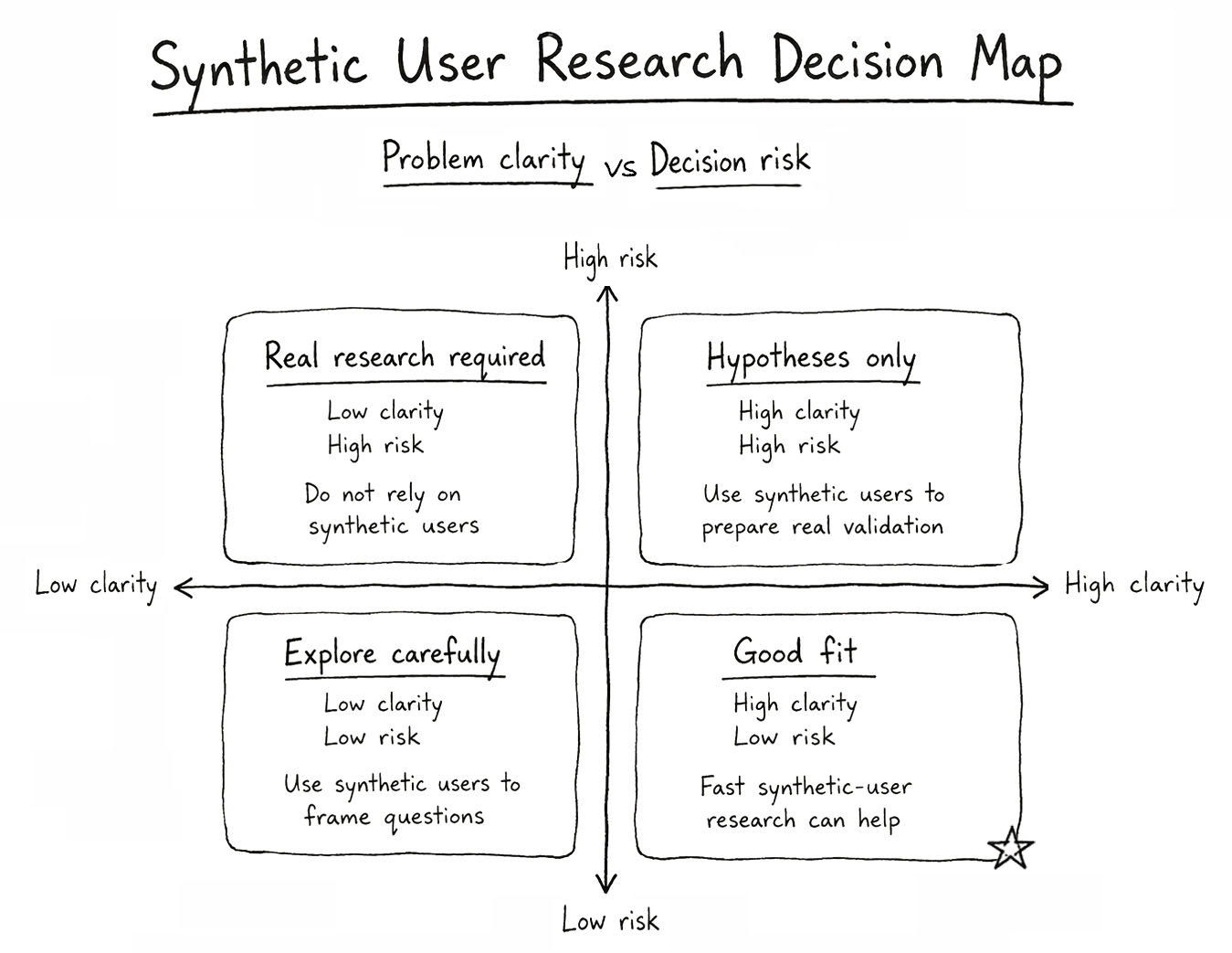
Synthetic user research is most useful when decision risk is low or when the team needs hypotheses. As decision risk increases, teams should rely more on real user research, behavioral data, and experiments.
What are synthetic users?
Synthetic users are AI-generated representations of user behavior, preferences, or decision-making. They are usually produced by large language models or agent-based systems that simulate how specific user types might respond in a given context.
For example, a team could create synthetic users representing:
- A first-time buyer
- A skeptical enterprise admin
- A non-technical user
- A power user
- A user switching from a competitor
- A budget owner
- A support-heavy customer
- A user with low domain knowledge
Each synthetic user can then be asked to review a concept, answer interview questions, react to a prototype, or compare alternatives.
Synthetic users are closely related to personas, but they are not the same thing. A persona is usually a static description of a user group. A synthetic user is interactive. You can ask it questions, give it scenarios, and generate new responses.
Why are teams using synthetic user research?
Product teams are under pressure to make decisions faster. Real user research remains essential, but it can be slow, expensive, or difficult to schedule early in the product process. Synthetic user research has become popular because it gives teams a fast way to explore early uncertainty before investing in real studies.
Teams use synthetic user research because it offers:
- Speed. Synthetic users can generate responses in minutes or hours. This is useful when a team needs to compare early ideas, review copy, test a rough concept, or prepare for interviews.
- Low marginal cost. Once a team has set up the synthetic user profiles, it is inexpensive to generate more responses, compare more scenarios, or run the same question across multiple simulated users.
- Early exploration. Synthetic user research can be used before a team has traffic, customers, or a finished product. It can help teams move from vague assumptions to clearer hypotheses.
- Access to difficult segments. Some user groups are hard to recruit. Synthetic users may help teams prepare for real research with these groups by identifying likely topics, vocabulary, and objections.
- Better real-user research. Synthetic users can help researchers improve interview guides, test survey questions, and identify where real-user research should focus.
The best use of synthetic user research is not to avoid real research. It is to make real research more focused.
Key definitions and related terms
The conversation around synthetic user research is messy because many terms are used interchangeably.
- Synthetic users. The broadest and most useful umbrella term. Synthetic users are AI-generated representations of users that simulate responses, needs, objections, or behaviors.
- Synthetic user research. The research practice of using synthetic users, AI participants, or synthetic personas to explore assumptions and generate hypotheses.
- Synthetic personas. AI-generated persona profiles. These are often static or semi-static descriptions used to guide simulations.
- Simulated users. A broader term that can include AI agents, rule-based models, scripted users, or behavioral simulations.
- Digital twins. A more established term in engineering, operations, and systems modeling. In user research, a digital twin usually refers to an AI model that attempts to represent a real person, segment, or behavior pattern. NN/g notes that digital twins and synthetic users are related but distinct: digital twins often aim to model individuals, while synthetic users more often mimic broader user groups.
- Silicon participants. A term used more often in academic contexts to describe AI-generated research participants.
- Synthetic customers. A business-oriented term for synthetic users who simulate buyers, customers, or market segments.
Which term should teams use?
The term synthetic user research is useful when describing the method. The term synthetic users is useful when describing the AI-generated participants themselves.
A quick search done in the summer of 2026 tried to compare related terms and found much higher search-result volume for “digital twins” than for more research-specific terms:
| Term | Approximate search results |
|---|---|
| Digital Twins | 11.790k |
| Simulated Users | 45k |
| Synthetic Personas | 46k |
| Synthetic Users | 24k |
| Silicon Participants | 930 |
The cheatsheet’s assessment is a good framing:
- Synthetic users works best as the umbrella term.
- Digital twins is established in other contexts.
- Silicon participants is used mostly in academia.
For a product and UX audience, synthetic user research is the clearest name for the practice, while synthetic users remains the most natural term for the participants.
What can synthetic user research be used for?
Synthetic user research works best when the goal is exploration, not proof.
1. Synthetic A/B testing at pull request scale
Teams can simulate control-versus-variant workflows to get early directional signals before rollout.
For example, a team might compare two versions of an onboarding flow, a checkout step, a product page, or a pricing explanation. Synthetic users can flag possible clarity issues before the team runs a real experiment.
This should not replace live A/B testing. It can help teams decide which variants are worth testing with real users.
2. Automated synthetic UX studies
Synthetic users can evaluate usability and comprehension without recruiting participants.
A team can ask simulated users to react to a prototype, interface, product tour, landing page, or signup flow. The goal is to surface likely confusion, missing information, unclear labels, and possible objections.
NN/g warns that synthetic-user responses are often shallower than real-user responses, so this should be treated as desk research or hypothesis generation rather than final UX evidence.
3. Virtual surveys and feedback loops
Teams can generate synthetic survey responses to explore likely preferences, objections, and friction points.
This can be useful for question testing and early pattern discovery. Qualz.ai suggests synthetic users can help test interview guides, identify confusing language, refine probing logic, and generate starting hypotheses. However, synthetic survey data should not be used as market sizing, demand validation, or final evidence of user preference.
4. Cost-efficient validation for under-served teams
Small teams often do little or no research because they lack budget, time, or access to participants. Synthetic user research can give these teams a starting point. It can help them identify assumptions, write better interview questions, and avoid testing poorly framed ideas with real users.
The risk is that teams treat synthetic data as a cheap replacement for research. That is where the method becomes dangerous.
5. Context-aware hypothesis exploration
Synthetic users can use product context, user profiles, market information, or known customer data to generate possible explanations.
For example:
- Why might users abandon this flow?
- Why might a buyer hesitate?
- What language might confuse new users?
- How might a novice and an expert interpret this feature differently?
- What assumptions should we test first?
These answers should become hypotheses for validation.
6. Automated design-review augmentation
Synthetic users can act as an additional review layer before a design critique or usability test.
They can help identify:
- Unclear labels
- Inconsistent terminology
- Missing states
- Confusing instructions
- Weak value propositions
- Likely objections
- Accessibility considerations
- Gaps in onboarding
This works best as a preparation step. Human review and real-user testing are still needed.
When should you use synthetic user research?
Synthetic user research is most useful when the decision is reversible and the cost of being wrong is low.
The cheatsheet frames this through two dimensions: problem clarity and decision risk.
| Problem clarity | Decision risk | Recommendation |
|---|---|---|
| High | Low | Helpful for quick exploration or early prototyping |
| High | High | Helpful for hypothesis generation, but validate with real users |
| Low | Low | Helpful to surface patterns, but use only directionally |
| Low | High | End-to-end research required; simulation is insufficient |
A simpler rule:
Use synthetic user research when you need direction. Use real user research when you need evidence.
When should you avoid synthetic user research?
Synthetic user research should not be used as the final input for high-risk decisions.
Avoid relying on synthetic users for:
- Final validation. Do not make go/no-go decisions based only on synthetic data. Qualz.ai explicitly warns against using synthetic users for final validation.
- Pricing research. Real willingness to pay requires real people making real trade-offs. Synthetic users can suggest possible pricing objections, but they cannot prove demand.
- Emotional research. AI cannot authentically experience emotional responses. Qualz.ai names emotional research as an inappropriate use case for synthetic users.
- Regulatory or compliance research. Studies that require human-subject validation cannot be replaced with synthetic users.
- High-stakes product decisions. If a decision affects safety, finances, health, legal rights, access, or other serious outcomes, synthetic user research should not be the primary evidence.
- Claims about real behavior. Synthetic users can simulate answers. They cannot prove what real people will do.
Synthetic user research vs. real user research
Synthetic user research and real user research answer different kinds of questions.
| Method | Best for | Weak for |
|---|---|---|
| Synthetic user research | Hypothesis generation, early exploration, interview preparation, copy critique, concept screening | Final validation, behavioral proof, emotional truth, high-risk decisions |
| Real user research | Understanding lived experience, behavior, context, trade-offs, usability, needs, decision-making | Fast large-scale early exploration when no participants are available |
Traditional research studies real people through interviews, usability tests, field studies, surveys, analytics, support analysis, or experiments.
Synthetic user research studies simulated responses.
Synthetic users can complement real research, especially for desk research and hypothesis generation, but they should not replace real-user research or be presented as real-user findings.
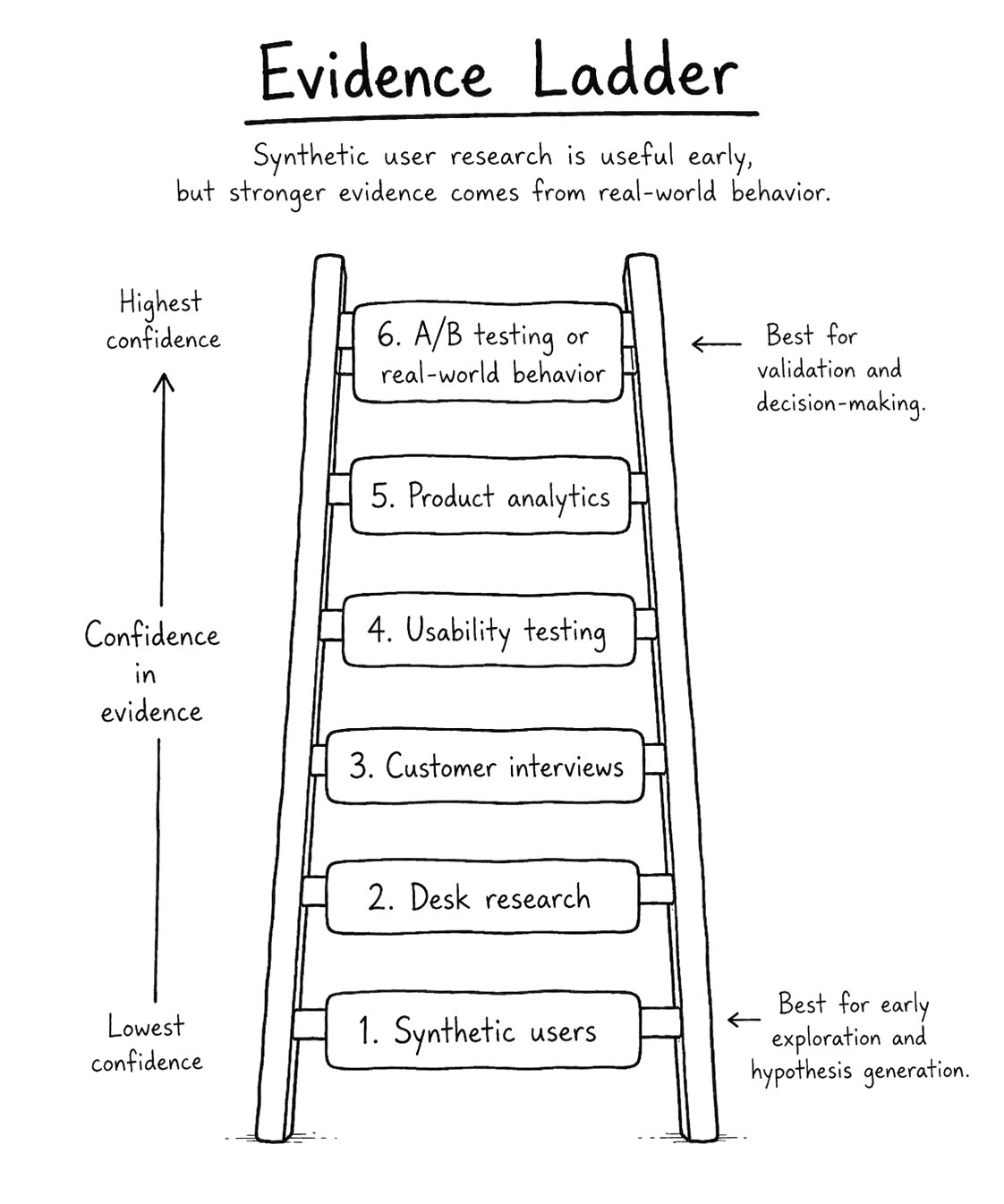
Synthetic user research sits near the bottom of the evidence ladder. It is useful for early exploration and hypothesis generation, but confidence should increase as teams move toward real customer interviews, usability testing, analytics, and observed behavior.
Synthetic user research vs. synthetic monitoring
Synthetic user research is often confused with synthetic monitoring.
They are related in name, but they solve different problems.
| Concept | Main field | What it simulates | Primary purpose |
|---|---|---|---|
| Synthetic user research | Product, UX, research | User responses, objections, preferences, and research participants | Explore product assumptions and prepare real research |
| Synthetic monitoring | Engineering, reliability, observability | User journeys, HTTP checks, transactions, page loads, and service calls | Detect technical issues before real users are affected |
Synthetic monitoring uses automated checks to simulate user journeys or requests at regular intervals. Dash0 describes synthetic checks as scripted tests that verify website and API availability and performance, helping teams catch outages, latency spikes, and regressions before real users are affected.
Cursion describes synthetic monitoring as scripts that mimic user behavior such as clicking through pages, completing forms, and making purchases. These checks can help teams detect slow pages, performance issues, third-party service failures, and feature problems before launch.
Synthetic user research asks, “What might users think, need, misunderstand, or object to?”
Synthetic monitoring asks, “Is the system working for users right now?”
How to apply synthetic user research
Synthetic user research works best when it is used inside a disciplined discovery process.
Step 1: Define the decision
Start by naming the decision the team is trying to make.
Examples:
- Should we change the onboarding flow?
- Should we test this new product concept?
- Should we simplify the dashboard?
- Should we prioritize this feature?
- Should we change the pricing page?
- Should we run real interviews with this segment?
Synthetic user research is more useful when the decision is specific.
Step 2: Define the user group
Avoid vague profiles like “busy professional” or “young user.”
Define the synthetic user with enough context to produce useful variation:
- Role
- Goal
- Situation
- Existing alternatives
- Level of domain knowledge
- Motivation
- Frustrations
- Constraints
- Buying context
- Technical comfort
- Product familiarity
Qualz.ai recommends defining background, goals, frustrations, technology comfort, and domain experience before running synthetic research.
Step 3: Ask specific questions
Weak prompt:
Will users like this feature?
Better prompts:
What would make this feature unclear to a first-time user?
What objections would a skeptical buyer raise before approving this purchase?
What would this user expect to happen after clicking this button?
Which parts of this onboarding flow require more explanation?
What assumptions should we validate with real users?
Specific questions produce more useful hypotheses.
Step 4: Compare different synthetic users
Run the same scenario across several profiles.
For example:
- New user
- Power user
- Skeptical buyer
- Budget owner
- Non-technical user
- Admin user
- User switching from a competitor
- User with accessibility needs
The value is often in the differences between profiles, not in one average answer.
Step 5: Separate observations from assumptions
Ask the synthetic users to structure their output into:
- Possible observations
- Assumptions
- Objections
- Questions
- Risks
- Unknowns
- Suggested validation steps
- Confidence level
This makes it harder to mistake synthetic output for evidence.
Step 6: Turn findings into hypotheses
A synthetic finding should become a testable statement.
Example:
Synthetic users repeatedly misunderstood the difference between “workspace” and “project.”
This becomes:
We believe first-time users may not understand the difference between “workspace” and “project” during onboarding. We will test this in usability sessions with real users.
Step 7: Validate with real users
Compare synthetic-user findings with real evidence:
- Interviews
- Usability tests
- Product analytics
- Support tickets
- Sales calls
- Surveys
- A/B tests
- Session recordings
- Customer success notes
It’s recommended to alibrate synthetic responses against known real-user data and validating top hypotheses with real users.
Step 8: Track what was right and wrong
Synthetic user research becomes more useful when teams keep score.
| Synthetic finding | Real-world validation | Match? | Notes |
|---|---|---|---|
| Users may miss the primary CTA | Usability test | Yes | 4 of 6 users hesitated |
| Buyers will prefer annual pricing | Sales interviews | No | Buyers wanted monthly pilots |
| Onboarding copy is too technical | Support tickets | Partial | Mostly true for SMB customers |
| Admin users need more role controls | Customer interviews | Yes | Strong pattern in enterprise accounts |
This helps the team learn where synthetic user research is reliable and where it is weak.
Metrics and validation
Synthetic user research should be measured by how well it helps teams make better research and product decisions.
The cheatsheet highlights four useful validation lenses.
Directional agreement
Ask:
Do synthetic-user insights lead to the same directional outcome as real studies or A/B tests?
For example, if synthetic users prefer version B and real users also perform better with version B, there is directional agreement.
The exact magnitude does not need to match.
Examples
Onboarding copy review
A product team redesigns onboarding for a B2B SaaS product. Before recruiting real users, they create synthetic users representing a first-time admin, a skeptical buyer, a non-technical team member, and a power user switching from a competitor. The synthetic users flag unclear terms such as workspace, project, and role. The team turns those findings into hypotheses and validates them in a real usability test.
Product concept screening
A startup has five possible product concepts. Instead of testing all five with customers immediately, the team uses synthetic users to surface likely objections, missing context, and unclear value propositions. The team does not treat the output as proof. It uses the findings to decide which concepts deserve real customer interviews first.
Interview preparation
A researcher entering a new domain uses synthetic users to simulate interviews with different buyer and user roles. The synthetic responses surface likely topics such as budget constraints, switching costs, compliance concerns, reporting needs, and integration complexity. These topics become prompts for real interviews.
Synthetic monitoring
An engineering team uses synthetic monitoring to run a scripted checkout flow at regular intervals from different locations. This catches payment failures and latency issues before customers report them. This is related to synthetic user research, but it is focused on technical reliability rather than research insight.
-
What is synthetic user research?
Hint Synthetic user research is the practice of using AI-generated users, personas, or participants to simulate how real people might respond to product ideas, interfaces, surveys, interviews, or user journeys. It is useful for early exploration and hypothesis generation, but it should not be treated as real-user evidence. -
What are synthetic users?
Hint Synthetic users are AI-generated representations of users, customers, or research participants. They can simulate responses, objections, preferences, and possible behaviors, but they do not replace the lived experience or real-world behavior of actual users. -
How is synthetic user research different from traditional user research?
Hint Traditional user research studies real people through interviews, usability tests, surveys, analytics, and experiments. Synthetic user research uses AI-generated participants to explore assumptions and prepare research. It can help teams move faster, but findings should be validated with real users. -
Can synthetic user research replace real user research?
Hint No. Synthetic user research can support research planning, early exploration, and hypothesis generation, but it cannot replace real user research. Synthetic users do not experience real emotions, constraints, trade-offs, habits, or consequences. -
When should product teams use synthetic users?
Hint Synthetic users are most useful when problem clarity is high and decision risk is low. They can help with early prototyping, copy review, onboarding critique, interview-guide preparation, survey design, concept exploration, and identifying what to validate next. -
When should product teams avoid synthetic user research?
Hint Product teams should avoid relying on synthetic user research for high-risk decisions, final validation, pricing research, emotional research, regulatory decisions, or any product decision where real-world consequences matter. -
Are synthetic users reliable?
Hint Synthetic users can be useful directionally, but their reliability depends on the use case, model, prompt quality, available context, and calibration against real-user evidence. Teams should track where synthetic findings are confirmed or contradicted by real research. -
What is the biggest risk of synthetic user research?
Hint The biggest risk is false confidence. Synthetic-user output can sound clear and convincing even when it is generic, biased, incomplete, or wrong. Teams should treat synthetic findings as hypotheses, not validated insights. -
How do you validate synthetic-user findings?
Hint Validate synthetic-user findings by comparing them with interviews, usability tests, product analytics, support tickets, sales calls, surveys, and A/B test results. Useful validation metrics include directional agreement, calibration gap, use-case reliability, and stability over time. -
What is the difference between synthetic users and synthetic personas?
Hint Synthetic personas are AI-generated persona profiles. Synthetic users are broader and may include interactive AI-generated participants that respond to questions, evaluate interfaces, simulate objections, or act within a product scenario. -
What is the difference between synthetic user research and synthetic monitoring?
Hint Synthetic user research simulates user responses, preferences, objections, and research participants. Synthetic monitoring simulates technical user journeys, such as logging in, completing checkout, or checking uptime, to detect system issues before real users are affected. -
How should synthetic-user findings be documented?
Hint Synthetic-user findings should be clearly labeled as synthetic-user hypotheses for validation. Teams should document prompts, assumptions, model context, confidence levels, and the real-user evidence needed before acting on the findings. -
What decisions can synthetic user research support?
Hint Synthetic user research can support low-risk exploratory decisions, such as improving research questions, identifying likely objections, reviewing copy, finding possible usability issues, and prioritizing what to test with real users. -
What decisions should not be made with synthetic users alone?
Hint Teams should not use synthetic users alone to make launch decisions, roadmap commitments, pricing decisions, market-sizing claims, safety decisions, compliance decisions, or other high-risk choices. -
How can synthetic users be used in product discovery?
Hint In product discovery, synthetic users can help teams explore assumptions, compare concepts, simulate objections, improve interview guides, and turn vague ideas into testable hypotheses for real-user research. -
How can teams prevent synthetic users from biasing the roadmap?
Hint Teams can prevent bias by labeling synthetic findings clearly, separating hypotheses from evidence, requiring real-user validation for high-risk decisions, and tracking whether synthetic predictions match observed behavior.
You might also be interested in reading up on:
- Testing With Synthetic Users by Anders Toxboe (2025)
- Synthetic Users: If, When, and How to Use AI-Generated Research Participants by Nielsen Norman Group (2024)
- Synthetic Users for Early-Stage Validation by Qualz.ai (2025)
- Synthetic Monitoring by Dash0 (2025)
- How to Use Synthetic Monitoring to Predict User Issues by Cursion (2025)
- Testing With Synthetic Users by Anders Toxboe at UI-Patterns
- Synthetic Users: If, When, and How to Use AI-Generated Research Participants by Nielsen Norman Group at Nielsen Norman Group
- Synthetic Users for Early-Stage Validation by Qualz.ai at Qualz.ai
- Synthetic Monitoring by Dash0 at Dash0
- How to Use Synthetic Monitoring to Predict User Issues by Cursion at Cursion
- Synthetic Users Cheatsheet by Nils Stotz
Product Weekly · Curated by Anders Toxboe
Sign up for the Product Weekly newsletter.
Join 40,000+ product people who get a weekly selection of useful reads on building digital products, plus new Learning Loop resources and occasional product updates.
What will I receive?Takes 10 seconds. Free to subscribe, unsubscribe at any time. Privacy policy.