Skip to content
Practical guide · Behavioral design

How to learn behavioral design

Choose how to learn, master the core skills and practice on a real product challenge. A practical guide for UX designers, product managers and teams.

By Anders Toxboe · Learning Loop

You don't need to start with a certification to learn behavioral design. You can build a foundation through behavioral science research, frameworks and books, then develop your skills by diagnosing and testing real product problems.

Start with a specific behavior, understand what shapes it, explore possible changes and test the outcome. Behavioral design complements—not replaces—user research, accessibility and good product fundamentals.

From behavioral science to better product decisions A hand-drawn five-step process: understand behavior, diagnose barriers, explore ideas, test solutions, and learn and improve. From behavioral science to better product decisions 1. Understandbehavior 2. Diagnosebarriers 3. Exploreideas 4. Testsolutions 5. Learn &improve
A practical process: understand behavior, diagnose barriers, explore ideas, test solutions and learn from results.

What is behavioral design?

Behavioral design applies evidence about human behavior to products, services and environments. It considers motivation, capability, attention, habits, social context and how choices are presented.

In product work, this can help you investigate questions such as:

  • Onboarding: Why don't new users complete their first meaningful action?
  • Decision-making: Which parts of a choice are confusing or overwhelming?
  • Conversion: What prevents people from completing an action they intended to take?
  • Retention: What helps people return because a product continues to deliver value?
  • Behavior change: How can an experience help people follow through on their own goals?

Related terms: Behavioral science studies behavior; behavioral economics studies decisions, often in economic contexts; product psychology applies psychological knowledge to product experiences; persuasive design focuses on influencing attitudes and actions. These fields overlap but are not identical.

The five skills that matter

1. Understand how people make decisions

Start with attention, memory, motivation, social influence, cognitive biases and decision context. Familiar concepts include social proof, anchoring, defaults and loss aversion. Learning the names is a beginning, not evidence that a particular effect will work in your product.

2. Diagnose behavior before proposing interventions

Translate an objective such as “improve onboarding” into an observable behavior, such as “help new users complete their first project setup.” Explore whether the barrier concerns ability, opportunity or motivation. The COM-B model and Behaviour Change Wheel provide a useful starting framework.

3. Generate alternative design hypotheses

After understanding the problem, investigate whether clearer sequencing, reduced complexity, better feedback or different presentation of choices might help. Pattern libraries can prompt ideas. The free Persuasive Patterns playbook contains 80 patterns to explore, but a pattern is a hypothesis generator—not a guaranteed fix.

4. Test interventions

Use research and suitable evaluation methods: interviews, usability sessions, prototypes, controlled experiments or analytics. Define the expected user benefit and measure unintended effects as well as business results. The OECD BASIC toolkit offers a structured approach.

5. Apply psychology responsibly

A better conversion rate does not always mean a better product. Ask whether users understand their options, benefit from the intervention, and remain free to decline or reverse a decision. Avoid deceptive design and unwanted dependency.
Choose your format

Compare ways to learn behavioral design

A course can teach theory. A book can deepen understanding. A workshop provides guidance. Pattern cards help you apply ideas as you work. You may benefit from more than one format.

Learning goal Books & podcasts Courses Workshops & consulting Learning Loop
Pattern cards
Relative cost $–$$ $–$$$ $$$ $$
Time commitment ◷Flexible ◷◷◷Structured ◷◷Scheduled ◷On demand
Depth of theory ●●● ●●● ●● ●
Guided feedback — ◐ ✓ —
Workshop-friendly ◐ ◐ ✓ ✓

Illustrative comparisons, not measured ratings. $ = lower typical cost; more symbols indicate greater relative cost, time or theory depth. ✓ = generally well suited; ◐ = depends on format; — = typically not included. Hover or focus on cells for details.

Books & podcasts

Best for independent exploration and foundational ideas.

Cost
$–$$
Time
◷ Flexible
Theory
●●● High (books vary)
Feedback
— Typically none
Team use
◐ Adaptable

Courses

Best for a structured curriculum and, sometimes, instructor feedback.

Cost
$–$$$ Varies
Time
◷◷◷ Structured
Theory
●●● Often deep
Feedback
◐ Depends on course
Team use
◐ Depends on format

Workshops & consulting

Best for facilitated practice or guidance on a specific problem.

Cost
$$$ Often higher
Time
◷◷ Scheduled
Theory
●● Varies
Feedback
✓ Often direct
Team use
✓ Strong fit

Symbols summarize typical tradeoffs and are not measured ratings. $ indicates relative cost; ◷ indicates time; ● indicates depth; ✓ and ◐ indicate general or conditional suitability.

Choose resources by what you need

Build your foundation with books

  • Thinking, Fast and Slow — Daniel Kahneman. A starting point for judgment and decision-making; some findings have since been challenged or revised.
  • Nudge — Richard Thaler and Cass Sunstein. An introduction to choice architecture.
  • Tiny Habits — BJ Fogg. Practical approaches to behavior change.
  • Designing for Behavior Change — Stephen Wendel. Behavioral science applied to product development.

Take a course when you need structure

Choose a course if you want a curriculum, instructor feedback or a credential. Look for courses that cover diagnosis, research methods, ethics, intervention design and evaluation—not only lists of biases. Check the instructor's qualifications and whether projects are part of the curriculum.

Use frameworks to diagnose behavior

Start with COM-B, the Fogg Behavior Model, or the OECD BASIC toolkit. Learn one framework thoroughly before collecting more.

Use pattern libraries to generate and compare ideas

When you already work on products, a pattern library can help you recall principles, compare possible approaches and discuss interventions with colleagues. The Learning Loop Persuasive Patterns playbook is freely available.

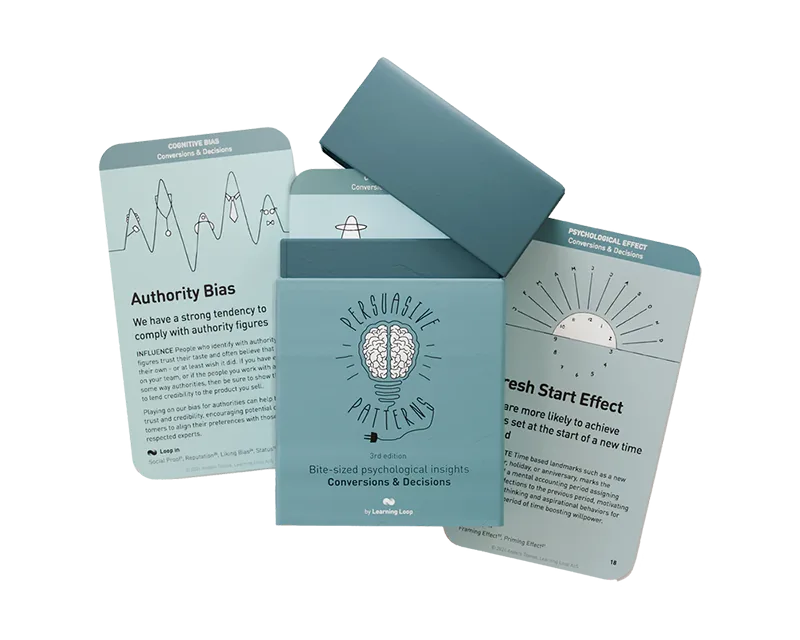
Learning Loop Persuasive Patterns: Conversions & Decisions card deck

Learning Loop's Persuasive Patterns

Conversions & Decisions covers behavioral principles for choices and barriers to action. Habits & Engagement explores engagement, repeat use and habit formation. The decks are available in printed and digital formats and include exercises for practical application.

Use the cards as reusable references and prompts for discussing competing design ideas. They do not diagnose a behavioral problem for you, establish causal evidence or replace a course. For deeper theory, pair them with research or structured learning.

Explore Persuasive Patterns

Use workshops or consulting for guided practice

Workshops support shared learning and guided practice. Consulting can help with complicated, high-stakes problems. Both are useful when you need dedicated expertise or a team learning experience; neither automatically builds a lasting internal capability.

Learn behavioral design in four weeks

This is a starting plan for practitioners who can invest a few hours per week. It builds practical familiarity, not expert status.

Week 1

Learn the basics

Read about attention, motivation, defaults and decision context. Examine a product you use and record five possible behavioral influences.

Outcome: Five observations and questions.

Week 2

Diagnose a behavior

Select a measurable product behavior, review available evidence and use COM-B to explore capability, opportunity and motivation.

Outcome: A problem statement and hypotheses.

Week 3

Explore interventions

Use research, frameworks or a pattern library to develop three different responses to the problem, including possible downsides.

Outcome: Three testable design ideas.

Week 4

Test and reflect

Choose an appropriate evaluation method, define user and business outcomes, then run an initial test where practical.

Outcome: A test plan and learnings.

How product teams can learn together

Teams don't need everyone to become a behavioral scientist. Instead, build a shared vocabulary and a habit of examining evidence. Three low-friction approaches:

  1. Monthly pattern discussion: Review one psychological principle, its evidence and where it might or might not apply.
  2. Behavioral questions in design reviews: Ask what action users want to take, what's preventing it and what evidence is missing.
  3. Structured ideation workshops: Explore several relevant patterns, propose alternatives and decide how to evaluate them.

Physical cards can make principles easy to spread across a table and discuss. Digital resources may work better for distributed teams. Either way, start with the users' goals, not the technique.

Common mistakes to avoid

  • Memorizing biases without understanding research: Context and research quality matter.
  • Assuming every problem requires persuasion: Sometimes usability, accessibility or product value is the real issue.
  • Treating a principle as a guaranteed result: Test interventions with the people affected.
  • Optimizing only conversion or engagement: Include user well-being, understanding and control.
  • Reading without practicing: Apply concepts to real problems, reflect and refine.

Frequently asked questions

Can I learn behavioral design on my own?

Yes. Books, free research, frameworks and practical exercises can give you a strong start. Feedback from instructors or experienced practitioners helps when you need deeper methodological skills.

Do I need a psychology degree?

Not necessarily for applying behavioral principles as a product practitioner. Specialized research roles may require more formal training.

What's the difference between behavioral design and persuasive design?

Behavioral design considers how environments and experiences shape behavior, including removing barriers and building capability. Persuasive design focuses more directly on influencing choices and actions.

Can behavioral design cards replace a course?

Not if you need a comprehensive education, instructor feedback or certification. Cards are useful for referencing principles and discussing practical ideas during product work.

What's the best way to learn product psychology?

Combine foundational reading, one diagnostic framework and an actual product problem. Use a structured course for deeper instruction and a pattern library for regular application.

How long does it take to learn behavioral design?

You can begin applying a few core concepts within weeks. Competence in diagnosis, research methods and experimentation takes sustained practice, feedback and attention to evidence.

Start with one real problem

Investigate a behavior, generate alternative explanations and test what helps. Start with the free playbook, or explore the card decks if you want a reusable tool for individual and team practice.