Charm Pricing
When to end a price in .99, .95 or a round number
Turn small pricing changes into revenue with The Psychology of Pricing
A practical collection of 100+ research-backed pricing tactics for digital products, SaaS and e-commerce.
$49 · PDF book
Get the book!$19.99 and $20.00 are, for any practical purpose, the same price. One cent apart. Yet customers don’t read them as the same price, and the reason isn’t that they can’t do the math. It’s that they’ve usually made up their mind about a price before they’ve finished reading it.
That makes price endings one of the cheapest experiments a product team can run. You don’t need to change your packaging, your plans or your positioning. You only need to decide how your prices end, and to know when the usual advice to “end everything in .99” stops working. Because sometimes it backfires.
What is charm pricing?
Charm pricing is the practice of ending prices just below a round number, usually with a 9, .99 or .95, so that the price is perceived as lower than it is. It is the most widely used form of psychological pricing and is also called odd pricing or just-below pricing.
The effect is small per customer, but it is consistent. In one field experiment with a women’s clothing catalog, versions of the catalog using 99-ending prices outsold versions with 00-endings (Schindler & Kibarian, 1996).
Why prices ending in 9 work
There are two separate mechanisms behind charm pricing, and it helps to keep them apart because they point to different design decisions.
1. The left-digit effect
We read numbers from left to right, and we start forming an impression of the size of a number before we have finished reading it. Once we’ve seen the first digit, the rest of the number gets less attention.
That is why $2.99 is encoded closer to “two-something” than to “three”. Thomas and Morwitz showed that this left-digit effect only happens when the leftmost digit changes: $2.99 vs. $3.00 is perceived as a meaningful difference, but $4.59 vs. $4.60 is not (Thomas & Morwitz, 2005).
The practical implication: a 9-ending only helps when it moves the leftmost digit. Going from $40 to $39 can matter. Going from $45 to $44.99 is mostly noise.
The aha: Charm pricing isn’t about the cent you save customers. It’s about the digit they read first. If the first digit doesn’t change, neither does the impression.
2. The 9 as a signal
The second mechanism has nothing to do with arithmetic. Customers have learned that 9-endings appear on sale tags and in discount stores. So a 99-ending doesn’t only make the price feel smaller, it also tells customers that this is a low-price offer (Schindler, 2006).
That signal is a double-edged sword. It helps when you compete on price. It hurts when you compete on quality. Stiving found that brands are more likely to use round prices when their prices are meant to signal quality (Stiving, 2000). A $1,999 consulting retainer can make the offer feel like a discount bin item. $2,000 feels confident.
The signal is closely related to the framing effect: The same amount can be framed as a bargain or as a premium choice depending on how it’s presented. Retailers use the same trick without changing prices at all: sale-style signs and stickers can lift sales just by looking like a discount.
.99 vs .95: which ending should you use?
This is where the common advice gets too simple. Studies comparing 99- and 95-endings have found that customers often prefer .99 for low-priced items, but .95 for higher-priced items (Gendall, 1998). Researchers haven’t fully agreed on why.
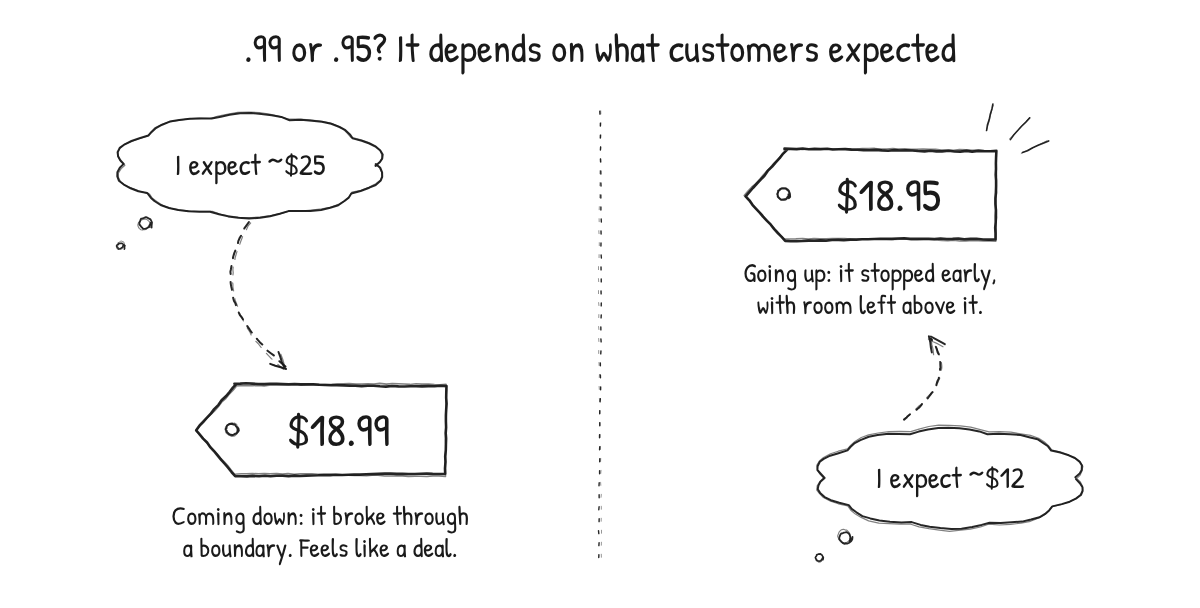
Nick Kolenda has proposed an explanation that is useful for product teams: What matters isn’t the size of the price, but the price customers expected. In a pilot study he ran, people imagined buying flip flops while he varied both the expected and the final price:
- When people expected to pay $25, they preferred $18.99.
- When people expected to pay $12, they preferred $18.95.
The idea is that customers evaluate a price by “traveling” from their expectation to the actual number:
- Coming down from a higher expectation, $18.99 feels good. It has pushed through a boundary, and it is clearly below the next round number.
- Going up from a lower expectation, $18.99 feels like the price has been pushed to the very top of its bracket. $18.95 stopped earlier, and there’s still “room” above it.
This is a hypothesis from a single pilot, not established science. But it explains why the same ending can feel like a bargain in one context and like a stretch in another, and it gives you a better rule of thumb than “low prices get .99, high prices get .95”:
| Customer expectation | Example | Try ending in |
|---|---|---|
| Customers expect to pay more than your price | A deal, a sale, or a cheaper alternative to a known competitor | .99 or 9 |
| Customers expect to pay less than your price | A premium tier, a price increase, a new category | .95, or a round number |
| You compete on quality or trust | B2B, services, luxury, high-ticket items | Round numbers ($2,000) |
The aha: There’s no universally best price ending. The right ending depends on the number customers had in mind before they saw yours.
If you don’t know what customers expect, you have your first research question. A few customer interviews or a short closed-ended survey will tell you whether you’re above or below their reference price. That expected price works like an anchor, which is the topic of our next guide, price anchoring.
When round prices beat charm prices
Round numbers aren’t just the absence of charm pricing. They do something of their own: They are easier to process, and easy-to-process information “feels right”. It’s the same processing fluency that makes easy-to-pronounce names seem safer.
Wadhwa and Zhang found that round prices work better for products bought on feelings, while precise prices work better for products bought after careful thought (Wadhwa & Zhang, 2015). A bottle of champagne for a celebration did better at $40.00; a calculator did better at $39.72 or $40.29. When the way a price is processed matches the way the product is bought, customers mistake that ease for liking the product.
Kolenda extends this idea into a broader principle: the adjectives that describe your product should also describe your price. A sharp, precise analytics tool could carry a precise price. A simple, solid hammer could carry a round one. In one of his pilots, participants preferred a $10 hammer over a $9.37 hammer, even though the second option was cheaper. It’s a conceptual metaphor at work: We borrow qualities from one domain (the product) and look for them in another (the number).
Treat this with some caution. A replication of the precise-price effect failed to find it (Harms et al., 2018), and Kolenda reports that his own attempt to make a kitchen scale seem more accurate with a precise price didn’t work either. Matching your price to your product is a good hypothesis to test, not a law to apply.
Make the price look as big or small as you want it to feel
The digits are only half of how a price is perceived. The other half is how the price looks.
Customers partly judge the size of a number by its visual size. Coulter and Coulter showed that sale prices are perceived as a larger discount when the sale price is written in a smaller font than the regular price (Coulter & Coulter, 2005). Small looks small.
Kolenda adds a caveat from more recent research: Large fonts can also signal confidence. So a price in a big, bold font can work if your price is genuinely a good deal and you want customers to notice it. If it isn’t, keep the price visually quiet and give the benefits the space.
A few other visual details are worth testing on your pricing table:
- Drop the cents when you can. “$49” is shorter and quieter than “$49.00”, and many SaaS pricing pages already show headline prices without cents.
- Give “what you get” more room than “what you pay”. Make the benefits the largest part of the page and keep the payment details compact. Kolenda noticed Walmart redesigning its product pages exactly this way.
- Avoid repeated digits on your own site. Similar shapes group together, so clusters of repeated digits stand out. Nick Kolenda points to research on prices such as $2,111 (Dogerlioglu-Demir et al., 2022), where heatmaps showed that repeated digits (8999) drew more attention than unique digits (6875) in online listings. That’s useful when you’re one listing among hundreds on Amazon, eBay or an app store. On your own pricing page, you usually want attention on benefits, not on the cost.
How to apply charm pricing in your product
Here’s a checklist you can use the next time you set or revisit your prices:
- Find the reference price. What do customers compare you to: a competitor, your old price, a free alternative, or nothing at all? Your price endings should depend on whether you are above or below that number.
- Only use a 9-ending when it changes the left digit. $49 vs. $50 is worth testing. $47 vs. $46.99 isn’t.
- Decide what you want the price to signal. If you compete on price, use 9s. If you compete on quality, expertise or trust, use round numbers.
- Match the price to how the product is bought. Emotional and simple purchases suit round prices. Analytical, utility-driven purchases can carry precise prices.
- Design the price, not only the number. Font size, weight, currency symbols and position all change how big a price feels.
- Keep it consistent across tiers. Mixing $19, $49.99 and $100 on the same pricing page makes customers notice the endings instead of the plans.
Test it before you roll it out
Price endings are a near-perfect candidate for an A/B test: The change is tiny, the cost of implementing it is close to zero, and the outcome (conversion and revenue per visitor) is easy to measure.
A few things to keep in mind:
- Measure revenue, not only conversion. A 9-ending might increase conversion while a round price brings in more revenue per customer, or the other way around.
- Segment by plan. The best ending for your entry plan may be different from the best ending for your enterprise plan, because customers arrive with different expectations.
- Watch the signal over time. If a charm price lifts conversion but also lifts churn or refund requests, it may be attracting customers who only came for the deal.
And as with every persuasive technique, stay on the right side of the line between persuasion and manipulation. Charm pricing changes how a fair price is perceived. It shouldn’t be used to hide what something actually costs.
Go deeper into the psychology of pricing
Price endings are only one of the levers that shape how customers read a price. If you want to see how they fit together with price anchoring, prospect theory, the decoy effect and the ways you can raise prices without losing customers, the Psychology of Pricing PDF book collects 100+ behavioral pricing tactics for pricing pages, plans and promotions, including the psychology behind each one, when to use it and how to test it.
Thanks to Nick Kolenda, whose newsletter on the psychology of marketing inspired this article. The pilot studies mentioned above are his.
- Thomas, M., & Morwitz, V. (2005). Penny wise and pound foolish: The left-digit effect in price cognition. Journal of Consumer Research, 32(1), 54-64.
- Schindler, R. M., & Kibarian, T. M. (1996). Increased consumer sales response though use of 99-ending prices. Journal of Retailing, 72(2), 187-199.
- Schindler, R. M. (2006). The 99 price ending as a signal of a low-price appeal. Journal of Retailing, 82(1), 71-77.
- Gendall, P. (1998). Estimating the effect of odd pricing. Journal of Product & Brand Management, 7(5), 421-432.
- Stiving, M. (2000). Price-endings when prices signal quality. Management Science, 46(12), 1617-1629.
- Wadhwa, M., & Zhang, K. (2015). This number just feels right: The impact of roundedness of price numbers on product evaluations. Journal of Consumer Research, 41(5), 1172-1185.
- Harms, C., Genau, H. A., Meschede, C., & Beauducel, A. (2018). Does it actually feel right? A replication attempt of the rounded price effect. Royal Society Open Science, 5(4), 171127.
- Coulter, K. S., & Coulter, R. A. (2005). Size does matter: The effects of magnitude representation congruency on price perceptions and purchase likelihood. Journal of Consumer Psychology, 15(1), 64-76.
- Dogerlioglu-Demir, K., Akpinar, E., Gurhan-Canli, Z., & Koçaş, C. (2022). Are 1-endings the new 9-endings? An alternative for generating price discount perceptions. Journal of Retailing and Consumer Services, 66, 102912.
- Charge High Prices With 95-Endings by Nick Kolenda
- Align Product Type With Digit Type by Nick Kolenda
- Show Repeated Digits in External Marketplaces by Nick Kolenda
- Add an Expensive Product to Catalogs by Nick Kolenda