Product Management, Leadership
Lean Canvas
A one-page business model template for new ideas that turns problems, customers and solution into assumptions you can test
Lean Canvas at a glance
- Type
- Tool
The Lean Canvas is a one-page business model template, created by Ash Maurya in 2010, that captures a new idea’s problem, customers, solution and economics in nine boxes so you can see which assumptions to test first. Maurya adapted it from Alexander Osterwalder’s Business Model Canvas for startups and new products working under a lot of uncertainty.
A business plan for a new idea is mostly guesses written as if they were facts. The Lean Canvas makes the guesses visible on one page, short enough to fill in within an hour and change after every conversation with a customer.
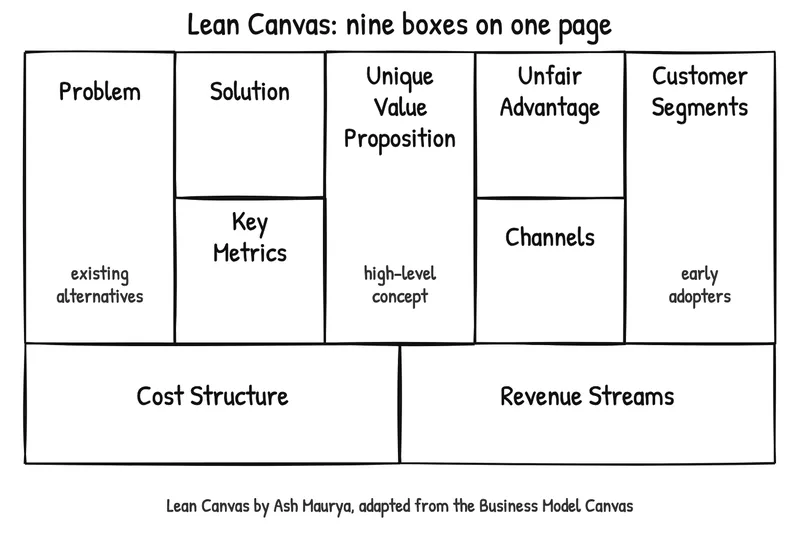
How the Lean Canvas works
The canvas has nine boxes. Each one asks a question about the idea:
| Box | The question it answers |
|---|---|
| Customer Segments | Who has the problem, and who will pay? Note the early adopters you would target first. |
| Problem | What are the top one to three problems these customers have? Note the existing alternatives they use today. |
| Unique Value Proposition | What single, clear message says why you are different and worth attention? A high-level concept, such as “X for Y”, can help. |
| Solution | What are the top features that address each problem? |
| Channels | How will you reach these customers? |
| Revenue Streams | How will you make money, and at what price? |
| Cost Structure | What will it cost to build, reach customers and run the business? |
| Key Metrics | Which few numbers tell you whether the business is working? |
| Unfair Advantage | What do you have that can’t easily be copied or bought? |
The boxes are connected. A problem only matters if a specific customer segment has it. The unique value proposition should follow from the problem and the existing alternatives, not from the solution’s features. Revenue and costs together show whether the idea could ever be a business.
We suggest starting with Customer Segments and Problem, because every other box depends on them, and leaving Unfair Advantage for last. Writing “none yet” there is normal for a new idea.
A worked example: a booking tool for dog groomers
This example is hypothetical. The idea and every entry are invented to show the reasoning, not taken from a real company.
A two-person team wants to build online booking for independent dog groomers. Their first canvas takes an hour:
| Box | First guess |
|---|---|
| Customer Segments | Independent groomers with one or two staff. Early adopters: mobile groomers who drive to clients. |
| Problem | Bookings arrive by phone and text while their hands are full; no-shows cost them income. Existing alternatives: paper diary, a generic calendar app. |
| Unique Value Proposition | “Clients book and confirm themselves, so you can keep grooming.” |
| Solution | Self-service booking page, automatic reminders, deposit at booking. |
| Channels | Groomer Facebook groups, grooming-supply wholesalers. |
| Revenue Streams | €19 a month per groomer. |
| Cost Structure | Two developers’ time, SMS reminders, hosting. |
| Key Metrics | Groomers who take their first online booking; share of bookings made without a phone call; no-show rate. |
| Unfair Advantage | None yet. |
Pick the riskiest assumption first. The whole canvas rests on the problem: if groomers don’t lose real time or money to phone bookings, nothing else matters. The second-riskiest is the €19 price. The channels and the solution’s features can wait.
Choose a test for each risky box.
- Problem: customer interviews with 10 groomers about their last week of bookings and no-shows.
- Solution: a concierge test, taking bookings for three groomers by hand for a month before building anything.
- Revenue: ask the concierge groomers to pre-order a year at a launch price.
After the interviews, the team updates the canvas. If mobile groomers turn out to lose far more to no-shows than to phone calls, the Problem, Unique Value Proposition and Key Metrics boxes change, and so does the next test. That rewrite is the point of the canvas, not a failure of it.
How to use the Lean Canvas
- Fill it in quickly. Aim for a first version in under an hour. Short bullet points are enough; vague entries show you where you know least.
- Make one canvas per customer segment when segments have different problems or would pay differently.
- Mark each entry as a guess or as evidence. Most boxes in a first canvas are guesses.
- Rank the risks. Ask which box would sink the idea if it were wrong. That is usually Problem, Customer Segments or Revenue Streams.
- Design a test for the top risk. Use product experimentation to pick a method that could prove the guess wrong cheaply.
- Update the canvas after every test, and keep old versions. They show how the idea has changed and why, which helps when you consider a pivot.
For a team exercise that turns rough ideas into assumptions you can test, see Write Down Your Concept.
Lean Canvas vs Business Model Canvas
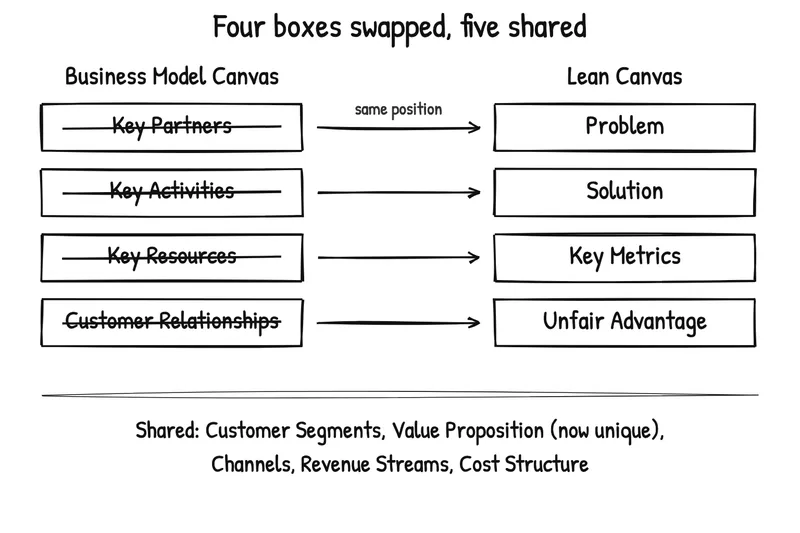
Maurya kept five boxes from the Business Model Canvas and replaced four. The replacements sit in the same positions on the canvas:
| Business Model Canvas box | Lean Canvas replacement | Why the swap suits a new idea |
|---|---|---|
| Key Partners | Problem | Before partners matter, you need to know the problem is real. |
| Key Activities | Solution | Early on, the solution is still a hypothesis to test, not a set of routine activities. |
| Key Resources | Key Metrics | A few numbers show whether the idea is working; resources can be planned later. |
| Customer Relationships | Unfair Advantage | Makes you ask what would protect the idea once it works. |
LeanStack explains the first swap directly: early-stage ventures need to understand their problem deeply before worrying about key partners. The reasons given for the other three are our reading of how the boxes are used.
The five shared boxes are Customer Segments, Value Proposition (on the Lean Canvas, the Unique Value Proposition), Channels, Revenue Streams and Cost Structure.
| Lean Canvas | Business Model Canvas | |
|---|---|---|
| Best for | New ideas and early products with an unproven problem | Describing or redesigning how an established business creates, delivers and captures value |
| Starting point | The customer’s problem | The value proposition and the operations behind it |
| Main question | Is this worth building, and what should we test first? | How do all the parts of this business fit together? |
| Creator | Ash Maurya (2010) | Alexander Osterwalder, popularized in Business Model Generation |
The two are not rivals. Many teams start with a Lean Canvas while the problem is unproven, then move to a Business Model Canvas once partners, activities and resources become real decisions. To map an existing business model as a team, use the Business Model Mapping workshop. To work on the promise to customers in more depth, see value proposition.
Limitations and common mistakes
- A filled-in canvas isn’t evidence. Every box starts as a guess. The canvas is useful only if it leads to tests.
- Starting with the solution. Teams often fill the Solution box first and then invent a problem to fit it. Start with Customer Segments and Problem instead.
- Treating features as an unfair advantage. Features can usually be copied. A blank box is more honest than a weak claim.
- Vague customer segments. “Small businesses” is too broad to test. Name the early adopters you could reach this month.
- Freezing the canvas. A canvas that hasn’t changed after several tests probably isn’t being used to make decisions.
- It doesn’t replace a plan for an established business. Once the problem and solution are proven, partners, operations and customer relationships need more attention than the Lean Canvas gives them.
-
Who created the Lean Canvas?
Hint Ash Maurya, in 2010. He adapted Alexander Osterwalder's Business Model Canvas for early-stage ideas and describes the method in his book Running Lean. -
What is the difference between the Lean Canvas and the Business Model Canvas?
Hint The Lean Canvas replaces Key Partners, Key Activities, Key Resources and Customer Relationships with Problem, Solution, Key Metrics and Unfair Advantage. It focuses on whether a new idea is worth pursuing; the Business Model Canvas describes how a business creates, delivers and captures value. -
Is a filled-in Lean Canvas a validated business model?
Hint No. Every box is a guess until you have evidence. The canvas helps you see which guess is riskiest so you can test it first. -
Which box is your riskiest assumption, and what is the cheapest test that could prove it wrong?
Hint Usually it is the problem or the customer segment. Start with interviews or a small manual test before building anything. -
Do you need a separate canvas for each customer segment?
Hint It helps when segments have different problems or would pay differently. Mixing them on one canvas hides which assumptions belong to whom. -
What should you write in Unfair Advantage if you don't have one yet?
Hint Leave it empty or write "none yet". An honest blank is more useful than calling a feature or hard work an unfair advantage.
You might also be interested in reading up on:
- What is a Lean Canvas? by Ash Maurya, LEANSTACK
- How to Document Your Business Model On 1 Page (archived) by Ash Maurya
- Running Lean: Iterate from Plan A to a Plan That Works (3rd ed.) by Ash Maurya
- The Business Model Canvas by Strategyzer
Product Weekly · Curated by Anders Toxboe
Sign up for the Product Weekly newsletter.
Join 40,000+ product people who get a weekly selection of useful reads on building digital products, plus new Learning Loop resources and occasional product updates.
What will I receive?Takes 10 seconds. Free to subscribe, unsubscribe at any time. Privacy policy.