Self-Perception Theory
Users decide how they feel by watching what they do
Turn insights into action with the Persuasive Patterns card decks
Master the science behind user motivation and create products that drive behavior.
Get your deck!Ask someone whether they like a podcast, and they’ll often have to think about it. Then they remember that they’ve listened to the last twelve episodes, and the answer becomes obvious: “I guess I really like it.”
That small moment of inference is what self-perception theory describes. We don’t always have direct access to our own attitudes. Often, we work them out the same way we would for anyone else: by looking at what we do.
For product teams, this flips a common assumption. We usually think that attitudes drive behavior: people who love a product use it. Self-perception theory says the arrow also points the other way. The behaviors users see themselves performing in your product shape how they feel about it.
What is self-perception theory?
Self-perception theory states that people infer their own attitudes and feelings by observing their own behavior and the situation it happened in, especially when their internal feelings are weak or unclear. It was proposed by psychologist Daryl Bem (Bem, 1972).
Two conditions make the effect stronger:
- The attitude is weak or new. Users have no strong opinion yet, as with a product they just signed up for.
- The behavior doesn’t have an obvious outside cause. If someone was paid or forced to do something, they attribute the behavior to that. If they chose it freely, they attribute it to themselves.
That second condition is why the details of how you ask for a behavior matter so much.
The aha: A behavior a user chose says something about them. A behavior they were pushed into says something about you. Only the first one builds an attitude in your favor.
Self-perception theory vs. cognitive dissonance
Self-perception theory started as a challenge to cognitive dissonance, and the two are easy to confuse.
In Festinger and Carlsmith’s famous experiment, participants did a boring task and were then paid either $1 or $20 to tell the next participant it was fun. Afterwards, the people paid $1 rated the task as more enjoyable than those paid $20 (Festinger & Carlsmith, 1959).
- Cognitive dissonance explains this as an uncomfortable tension: “I said it was fun for only $1, so I must have actually enjoyed it”. People change their attitude to reduce that discomfort.
- Self-perception theory explains it without any discomfort: “Someone who says a task is fun for $1 probably found it fun.” People simply read their own behavior, the way an observer would (Bem, 1967).
Today, both are seen as valid in different situations. Dissonance applies when a behavior clearly conflicts with an attitude someone already holds strongly. Self-perception applies when the attitude is still forming. For most products, especially in onboarding and early use, users are in that second situation. They haven’t decided what they think of you yet. Their own behavior is going to help them decide.
How self-perception shapes behavior in products
Self-perception is also one of the explanations behind the commitment and consistency principle (see also the UI pattern).
In Freedman and Fraser’s classic foot-in-the-door study, homeowners who first agreed to put a small “Be a safe driver” sign in their window were far more likely to later accept a large, ugly sign on their lawn (Freedman & Fraser, 1966). Agreeing to the small request changed how they saw themselves: as the kind of person who supports causes like this.
This gives product teams a practical lens. Every behavior in your product is also a message users send themselves about who they are and how they feel about you. Here are research-backed ways to design that message.
1. Make every rating option a positive one
Rating systems ask users to observe and label their own reactions. That label sticks. (The format of a rating also changes how other users read it, as we covered in how a simple rating can make or break your product.)
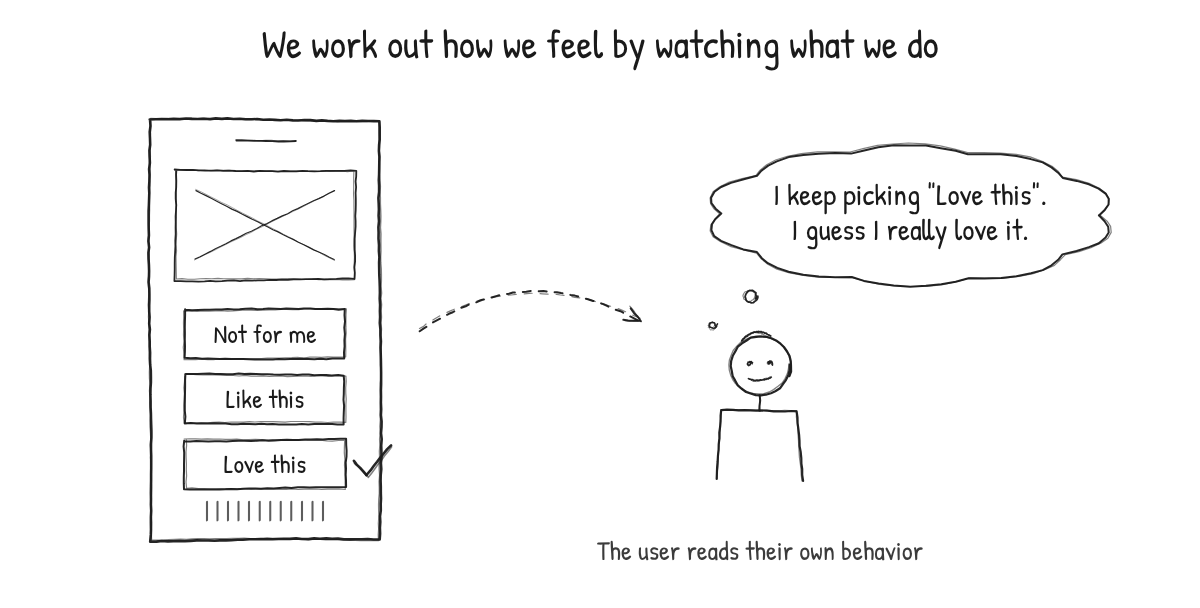
Netflix’s rating options are “Not for me”, “Like this” and “Love this”. There’s no “Dislike”. A user who regularly clicks “Dislike” is also regularly telling themselves that they dislike much of what the service offers, which invites an awkward question: why am I still paying for this?
“Not for me” lets users reject a title without rejecting the product. The judgment is about fit, not quality.
Try it: Review the feedback options in your product. Do any of them invite users to repeatedly label your product negatively, when a more specific or neutral option would capture the same information?
2. Say “thank you”, not “sorry”
When something goes wrong, the words you choose decide what users conclude about their own role.
You and colleagues tested this across a range of service failures. Saying “thank you for your patience” restored satisfaction better than saying “sorry for the wait”. An apology focuses attention on the provider’s failure. A thank-you puts the spotlight on the customer’s contribution, which makes them feel better about themselves, and in turn, about the service (You et al., 2020).
Try it: Look at your error messages, loading states and support macros. “Thanks for waiting while we set up your workspace” tells users they’re patient. “Sorry, this is taking a while” tells them they’ve been inconvenienced.
3. Let users claim an identity, not only a behavior
Labels that describe who someone is are stronger than labels that describe what they do.
Bryan and colleagues asked people about an upcoming election in two ways: “How important is it to you to vote?” or “How important is it to you to be a voter?” The identity framing increased actual turnout (Bryan et al., 2011).
Kolenda describes a similar case from conversion optimization agency WiderFunnel: A nonprofit asked visitors to pick what kind of donor they were: “regular donor”, “occasional donor” or “first-time donor”. New visitors who selected “first-time donor” affirmed an identity that makes the next step natural. An option such as “I’ve never donated” would have reinforced their inaction instead.
Try it: In onboarding surveys and segmentation questions, phrase options as identities that point forward: “I’m new to analytics”, not “I’ve never used analytics tools”. These also make great hooks for role-playing and self-expression later in the product.
4. Don’t let users practice saying no
“It doesn’t hurt to ask” isn’t quite true. Every time users decline an offer, they observe themselves declining.
Gvili and Levy studied what happens when people reject an incentive to share a brand’s message on social media. Reflecting on their own refusal led them to perceive manipulative intent and trust the message less afterwards (Gvili & Levy, 2025). The act of saying no became evidence against the brand.
This doesn’t mean you should never ask. It means you should ask when users are likely to say yes, and you should be careful about repeated asks that train users to ignore you. When users do skip something, give them a reason that doesn’t involve disliking you. Kolenda suggests that if someone scrolls to the end of a catalog without clicking anything, you could offer a product quiz. That frames their inaction as indecision, not disinterest.
Try it: Map every upgrade prompt, rating request and share prompt in your product. How often does an average user decline one per week? Each of those is a small self-perception moment.
5. Ask for “now” before you offer “later”
How you structure a choice also tells users what kind of choice it is.
Reiff and colleagues ran a field experiment with more than 5,000 employees. Offering the option to increase retirement savings now or later on the same screen reduced savings. Offering “now” first, and only showing “later” to those who declined, worked better. Showing both options at once signalled that acting wasn’t urgent (Reiff et al., 2023).
Try it: If you ask users to enable a feature, invite a colleague or set up an integration, ask for “now” first. Offer “remind me later” as a follow-up step, not as an equal alternative next to the main action. Users who choose “later” should still be making a decision, not skipping one.
6. Make loyal behavior visible
Users feel more loyal when they can see themselves behaving loyally.
Streaks, usage summaries and year-in-review features work partly because they hold up a mirror, a pattern known as self-monitoring: “You’ve listened to 4,200 minutes this year.” Users look at that evidence and draw the obvious conclusion. Kolenda adds a less obvious tactic from sales: Making customers aware of a competitor’s offer they’re not taking can reinforce their sense of being loyal to you.
Try it: Find a behavior that already signals commitment, such as returning every week, customizing settings or building up content, and reflect it back to users. Combined with the endowed progress effect and the IKEA effect, this turns usage into a sense of ownership.
Why onboarding is where self-perception matters most
Self-perception is strongest when attitudes are weakest, and users never know less about how they feel about your product than in their first days with it. That makes onboarding the moment when the behaviors you design have the most influence.
Every early action is evidence users collect about themselves: completing a profile, importing their own data, reaching the moment it clicks, coming back the next day. Design those first steps so that users succeed at things they chose, and the conclusion they draw (“I’m someone who uses this”) becomes the foundation for the shift from repeat use to habit.
The aha: Users don’t just form habits by repeating behaviors. They also form an identity by watching themselves repeat them, and that identity helps keep them coming back.
Self-perception is not a license to trick users
Self-perception works best when the behavior is freely chosen. That’s also its ethical boundary. If you trap users into actions they wouldn’t otherwise take, through pre-checked boxes, confirmshaming or hidden opt-outs, they’ll attribute the behavior to your design, not to themselves. That’s when persuasion turns into manipulation, and it often ends in reactance instead.
The goal is to help users notice the genuine value they already get from your product, and to avoid designs that make them rehearse reasons to leave.
Explore more persuasive patterns
Self-perception connects many persuasive patterns, from commitment and consistency to cognitive dissonance and the default effect. The Persuasive Patterns card decks give your team these patterns as cards, with examples and workshop formats, so you can use them in your next design session.
- Bem, D. J. (1972). Self-perception theory. Advances in Experimental Social Psychology, 6, 1-62.
- Bem, D. J. (1967). Self-perception: An alternative interpretation of cognitive dissonance phenomena. Psychological Review, 74(3), 183-200.
- Festinger, L., & Carlsmith, J. M. (1959). Cognitive consequences of forced compliance. The Journal of Abnormal and Social Psychology, 58(2), 203-210.
- Freedman, J. L., & Fraser, S. C. (1966). Compliance without pressure: The foot-in-the-door technique. Journal of Personality and Social Psychology, 4(2), 195-202.
- Bryan, C. J., Walton, G. M., Rogers, T., & Dweck, C. S. (2011). Motivating voter turnout by invoking the self. Proceedings of the National Academy of Sciences, 108(31), 12653-12656.
- You, Y., Yang, X., Wang, L., & Deng, X. (2020). When and why saying “thank you” is better than saying “sorry” in redressing service failures: The role of self-esteem. Journal of Marketing, 84(2), 133-150.
- Gvili, Y., & Levy, S. (2025). Vive la résistance: A boomerang effect of resisting incentivized eWOM on consumer trust. International Journal of Advertising, 44(1), 24-46.
- Reiff, J., Dai, H., Beshears, J., Milkman, K. L., & Benartzi, S. (2023). Save more today or tomorrow: The role of urgency in precommitment design. Journal of Marketing Research, 60(6), 1095-1113.
- Reinforce a Desired Attitude by Nick Kolenda