A successful behavioral design workshop is more than brainstorming with psychology cards. It builds a shared understanding of the behavior, focuses the problem, explores interventions, and ends with a decision about what to test next.
This guide introduces the approach from The Persuasive Patterns Workshop Playbook. The book contains the complete workshop recipes, exercise instructions, facilitation techniques, and ethical-design guidance. This public article is a starting point, not a reproduction of the full PDF.
Start with the Persuasive Workshop Framework
The book combines the Double Diamond's four phases—Discover, Define, Develop, Deliver—with the Facilitation Canvas for planning the people, inputs, agenda, environment, outcomes, outputs, and pitfalls. The workshop needs both: a way to move the problem forward and a way to plan the session itself.
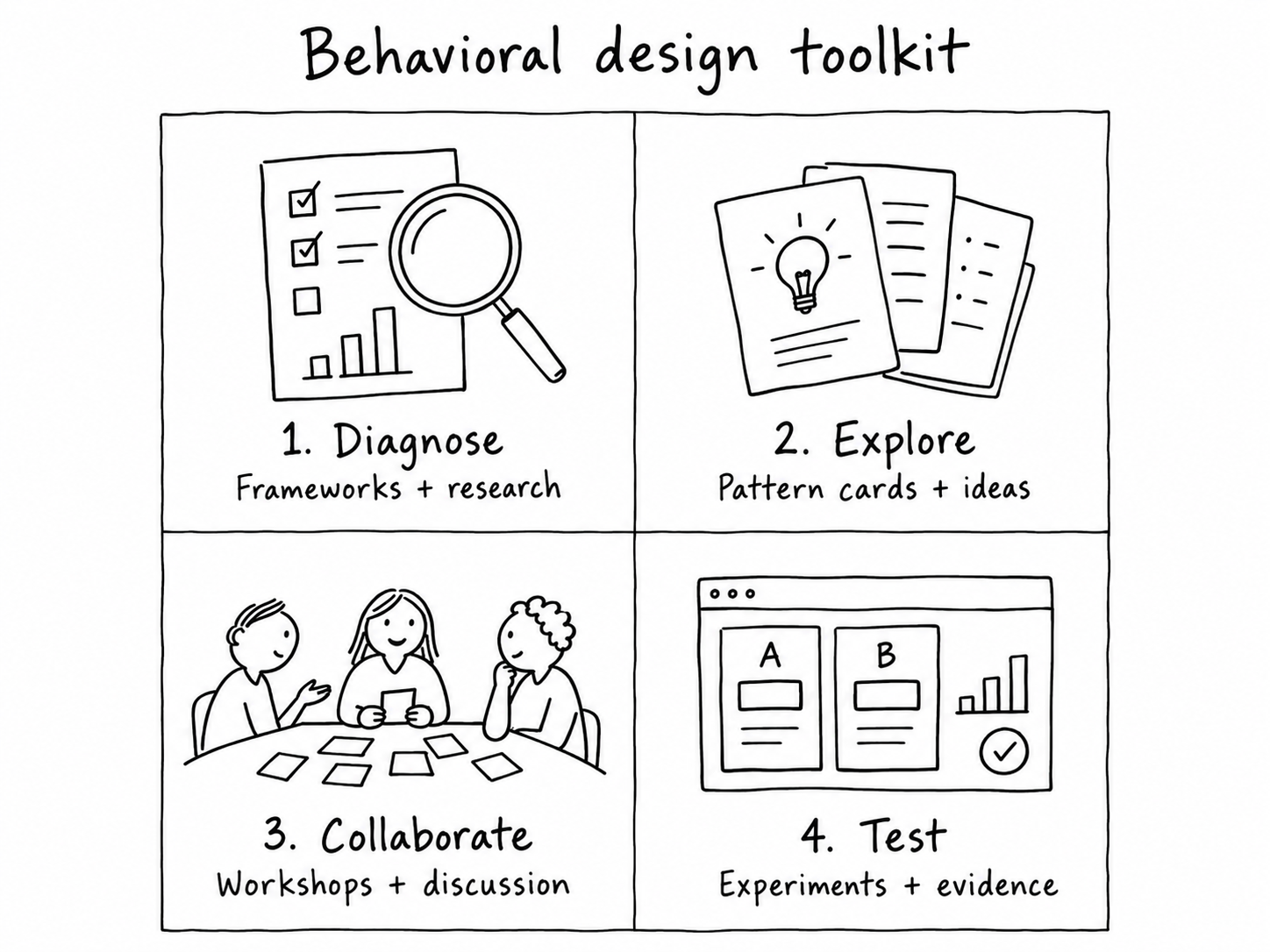
For selecting exercises, the book introduces a complementary Workshop Design System with six categories: Purpose, Understand, Define, Ideas, Decide, Commit. If the team cannot agree on the target behavior, return to Purpose. If the problem is not understood, return to Understand. Do not jump straight into card-based ideation.
Prepare for a decision, not just a discussion
Before inviting people, write down the behavioral outcome you're trying to influence: who should do what, in which context, and why it matters to them. Bring actual observations or research rather than relying only on assumptions. Then sketch your facilitation plan.
- Purpose: What concrete decision or behavioral question should this session resolve?
- People: Who understands the users, who can act on the output, and who will facilitate?
- Inputs: What research, journey insights, product metrics, or prototypes should everyone see?
- Agenda and environment: Which exercises fit the available time, group size, and setting?
- Outcomes and outputs: What decisions and artifacts will exist at the end?
- Pitfalls: What could derail participation, ethics, focus, or follow-through?
Prepare sticky notes, markers, voting dots, a visible timer, and a shared place to capture decisions. Cards are optional during early diagnosis; introduce them deliberately when they help exploration.
Example: a 90-minute behavioral design workshop
This is an illustrative short-form agenda adapted from the book's stages, not a verbatim recipe from the book. A complex challenge or deep research synthesis will require a longer session.
| Time | Activity | Output |
|---|---|---|
| 0–10 min | Open / Purpose: Agree on the audience, target behavior, and desired outcome. | Shared behavioral goal |
| 10–30 min | Discover / Understand: Surface research, map barriers and enablers, and flag unanswered questions. | Visible evidence and behavior map |
| 30–40 min | Define: Select one important barrier or opportunity to address. | Focused problem statement |
| 40–65 min | Develop / Ideas: Generate ideas independently first, then use psychological patterns as prompts. | Several intervention hypotheses |
| 65–80 min | Decide: Discuss impact, feasibility, user value, and potential harm; select candidates to test. | Prioritized test ideas |
| 80–90 min | Deliver / Commit: Assign an owner, next action, and review date for each selected test. | Named commitments |
Example: A team discovers that new users intend to complete onboarding but hesitate when asked for information they don't yet have. Rather than immediately choosing a persuasion tactic, the group examines the barrier, creates alternative ways to complete the step, and decides what to prototype and validate.
Select exercises based on where the team is stuck
The book contains full exercises and ready-made recipes for intervention design, habit creation, habit change, persuasive experiences, and ethical design. You can also combine individual exercises. These examples illustrate the categories without replacing the full facilitation instructions.
| Need | Exercise from the book |
|---|---|
| Clarify the objective | Define Target Behaviors |
| Understand friction and motivation | Behavioral Journey Mapping or Drag & Drive Mapping |
| Focus the challenge | Focus Mapping |
| Translate barriers and enablers into ideas | Painkillers and Vitamins |
| Go beyond the obvious card selection | Forced Fit or Ideas first, Patterns later |
| Choose where to invest | Priority Mapping or PIE Scoring |
| Make accountability visible | Who / What / When Matrix |
For a broader comparison of frameworks, card decks, and methods, see the behavioral design tools guide.
Use Persuasive Patterns cards at the right moment
Psychology cards turn abstract principles into tangible prompts for discussion, but the book also warns that cards can narrow thinking. Participants may overvalue the apparent authority of a card, gravitate toward familiar patterns, or spend too long choosing from a large deck.
Start with evidence and unguided ideas. Once the team understands the problem, introduce a small selection of Persuasive Patterns cards to challenge or extend its thinking. Consider the book's Forced Fit exercise to explore patterns that do not seem immediately relevant. Treat every card-inspired idea as a hypothesis to evaluate and test, not a proven solution for your users.
Build in ethical checkpoints
The workshop should help users as well as the business. The book emphasizes transparency, user autonomy, manageable cognitive load, and the need to question negative consequences. Before selecting an intervention, ask:
- Does this solve a real user problem, or merely pressure someone into an action?
- Can people understand and reject the proposed choice?
- Who might be disadvantaged or excluded?
- Could it create unwanted habits, anxiety, or long-term harm?
The book includes Dark Reality and Evil by Design exercises for deliberate ethical reflection.
After the workshop: make it real
End with a visible record of the target behavior, key evidence, the chosen intervention hypotheses, their risks, the experiment or prototype to run, and the person responsible. Set a date to review what was learned. A good workshop isn't measured by the number of sticky notes it produces; its usefulness depends on what the team actually validates and improves.
Go deeper: The Persuasive Patterns Workshop Playbook
Anders Toxboe's PDF book explains the Persuasive Workshop Framework and Facilitation Canvas in detail, with workshop recipes, exercise instructions, facilitation techniques, and practical guidance for using Persuasive Patterns cards.
Explore the PDF workshop book →