A card deck might teach you how people think, help you run a better meeting, or give your product team a concrete method to research needs, explore design alternatives and test ideas. These are different jobs—and the best deck depends on which one you need.
Disclosure: This guide is published by Learning Loop, which creates and sells the Learning Loop card decks discussed below. Competitor descriptions are based on publicly available product information, not an independent hands-on laboratory test. Our recommendations explain when another deck may be a better fit.
The short answer: match the deck to the job
| You want to… | Start with… | Why |
|---|---|---|
| Discover customer needs and opportunities | Discovery Patterns | Research methods and product-discovery exercises |
| Test risky assumptions before investing | Validation Patterns | Lean experiments and evidence-led decisions |
| Explore viable ways to create and capture value | Business Model Patterns | Business-model strategies and structured conversations |
| Help people understand options and make decisions | Persuasive Patterns: Conversions & Decisions | Psychological patterns applied to product decisions |
| Support sustained use and valuable habits | Persuasive Patterns: Habits & Engagement | Behavioral patterns for longer-term product experiences |
| Design clearer screens and interaction flows | UI Patterns | Common interface solutions and alternatives |
| Facilitate many kinds of meetings and workshops | Pip Decks: Workshop Tactics | General-purpose workshop methods and facilitation instructions |
| Spot bias in your own decisions or team discussions | Insight Decks: Cognitive Bias | Recognize common thinking traps and apply bias checks |
These aren't mutually exclusive choices. An experienced facilitator might use Workshop Tactics to design a session and Learning Loop cards to supply product-specific content and exercises inside it.
Learning Loop vs. Pip Decks vs. Insight Decks
All three can be useful to people who work in products. Their main emphasis differs.
| Consideration | Learning Loop | Pip Decks Workshop Tactics | Insight Decks Cognitive Bias |
|---|---|---|---|
| Primary question | What product problem should we solve, and how? | Which activity will help us work together effectively? | Which bias might distort this decision? |
| Core material | Specialized discovery, validation, business, psychology and interface patterns | Workshop activities, frameworks and facilitation instructions | Cognitive biases, examples and practical checks |
| Team use | Product-oriented methods paired with relevant collaborative exercises | Facilitation across meetings, workshops and product/service problems | Bias awareness and discussion during individual or group decisions |
| Best first choice when | You need domain-specific tools to design, research or validate a product | You need a versatile activity library to lead a workshop | You want to improve how you evaluate beliefs and decisions |
Learning Loop
Primary question: What product problem should we solve, and how?
Core material: Specialized discovery, validation, business, psychology and interface patterns.
Team use: Product-oriented methods paired with tailored collaborative exercises.
Choose it when: You need domain-specific tools to research, design or validate a product.
Pip Decks: Workshop Tactics
Primary question: Which activity will help us work together effectively?
Core material: Workshop activities, frameworks and facilitation instructions.
Team use: Facilitating meetings, workshops and product/service problems.
Choose it when: You need a versatile activity library to lead a workshop.
Insight Decks: Cognitive Bias
Primary question: Which bias might distort this decision?
Core material: Cognitive biases, examples and practical checks.
Team use: Bias awareness in individual or group decisions.
Choose it when: You want to improve how you evaluate beliefs and decisions.
An important nuance: Pip Decks' Workshop Tactics also includes activities relevant to product design, including assumption mapping, and its vendor describes it as useful for building products and services. Insight Decks' Cognitive Bias cards also support workplace decisions and group discussions. The distinction is one of emphasis, not exclusivity.
Product information: Pip Decks Workshop Tactics, Insight Decks Cognitive Bias, and Learning Loop's full collection. Features and availability may change.
See the six Learning Loop card decks
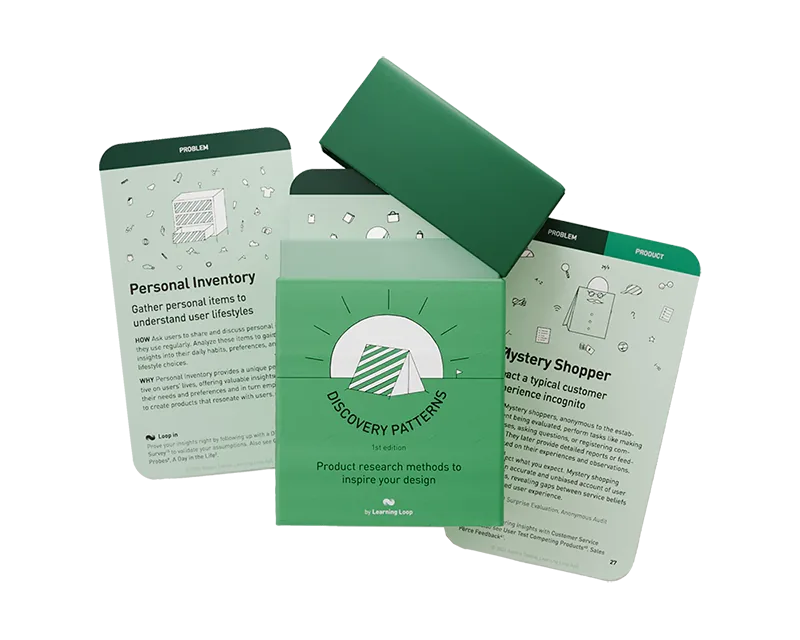
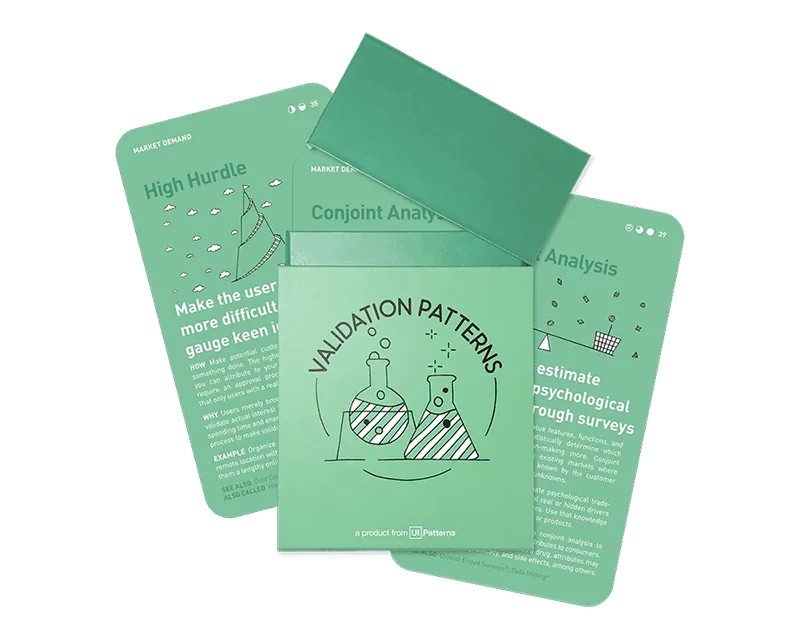
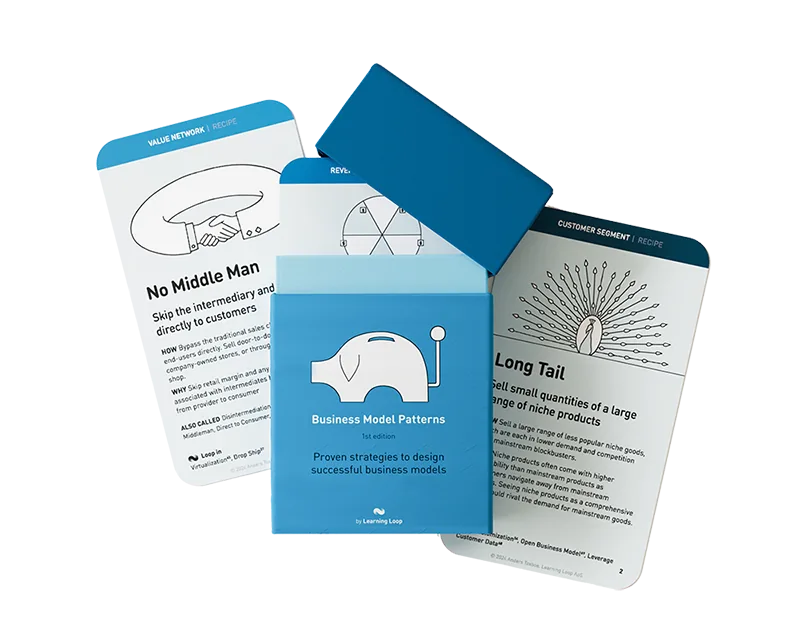
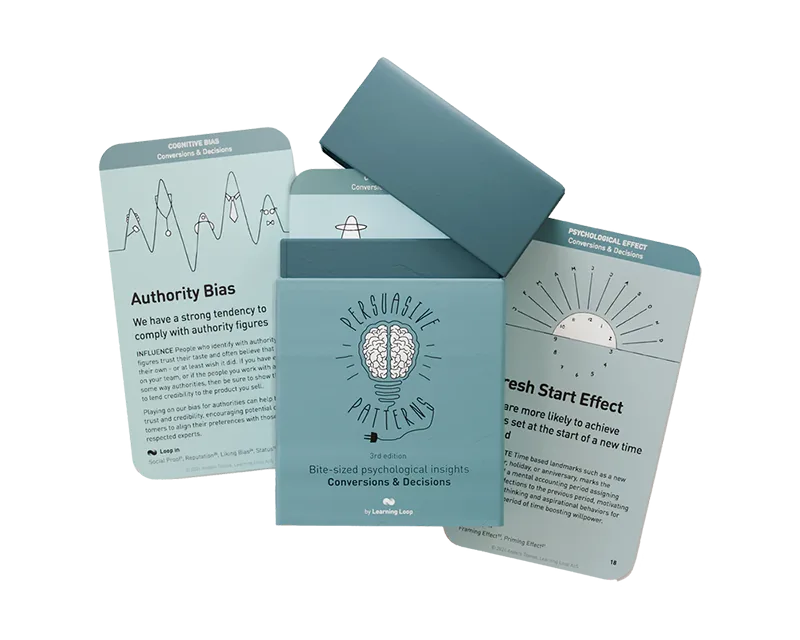
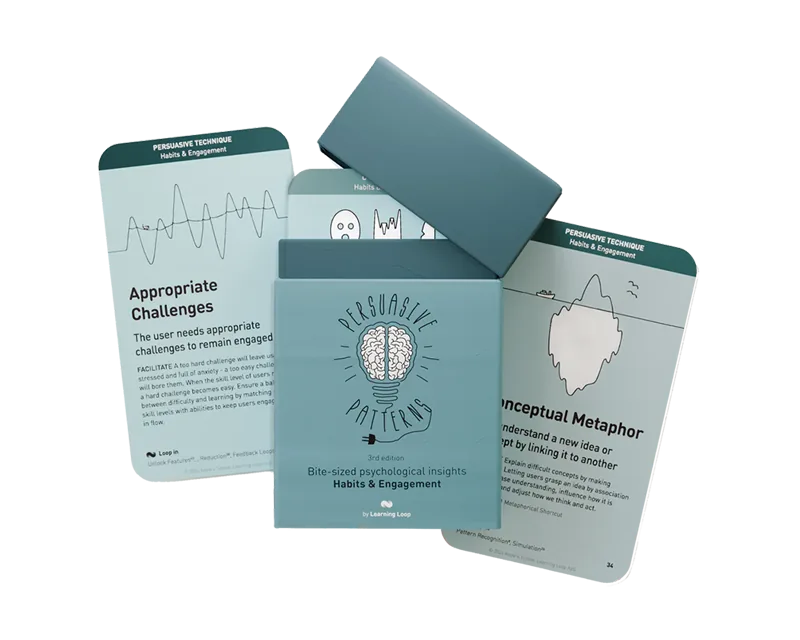
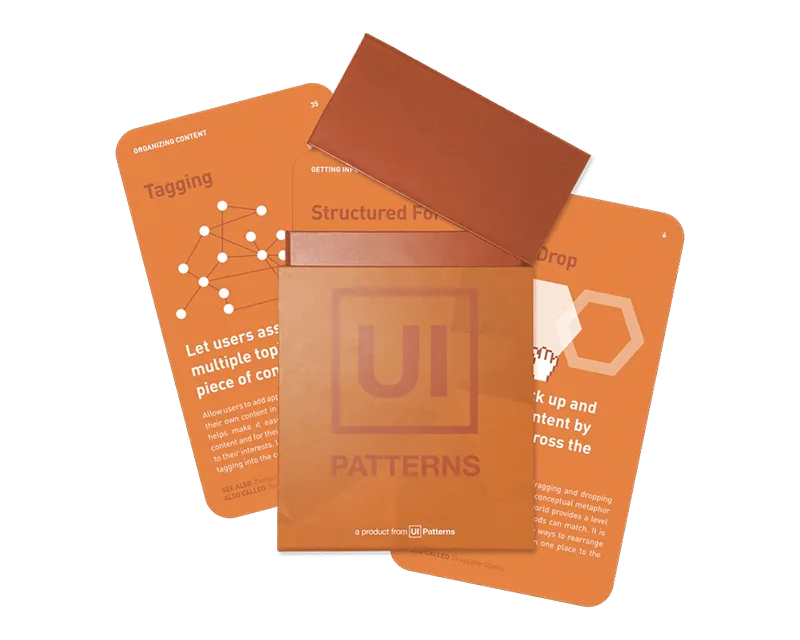
These are the actual product images from the Learning Loop shop. Choose a deck based on the challenge your team faces, then explore its methods and practical exercises.
Why method cards and workshop exercise cards belong together
Learning Loop's central design idea is that a product team needs both ideas about what to do and a structured way to do it together. Its decks combine cards introducing domain-specific patterns, methods or experiments with tailored exercises to apply them in a team setting. The precise mix of card types and exercises differs by deck.
1. Understand the method
Use a pattern, research method, experiment or interface reference to expand the team's choices and establish a shared vocabulary.
2. Apply it together
Use a tailored exercise to turn the reference into an actual map, decision, hypothesis, design alternative or next test.
Worked example: from an onboarding assumption to a test
Scenario: A team thinks users abandon onboarding because the setup feels too long. That is a hypothesis, not a finding.
Choose a suitable way to learn
Use the Discovery Patterns methods as prompts to investigate the setup journey and gather direct user evidence. The cards help the team consider research approaches instead of guessing at a solution.
Make assumptions visible together
Run an Assumptions Mapping exercise to list beliefs about the onboarding problem, separate evidence from speculation, and agree which uncertainty to investigate first.
What the team takes away: An assumption map, one prioritized uncertainty, and a next research or validation step—not merely a list of inspirational ideas. Once evidence is gathered, Validation Patterns can help select an appropriate experiment.
Illustrative scenario, not a claim about a measured customer result or a verbatim exercise card.
For instance, an Assumptions Mapping activity helps a team identify what it believes and what it needs to learn next. Behavioral Journey Mapping encourages a team to consider the context, barriers and enablers around a behavior before jumping to interventions. A card suggesting a useful principle and an exercise that helps apply it solve different parts of the same problem.
See the tailored workshop exercises
These illustrations come from Learning Loop's existing exercise library. They're previews of the activities, not photos of the printed exercise card faces. Each exercise gives a product team a concrete way to work with the relevant methods and patterns.

That doesn't make general facilitation decks redundant: broad workshop tactics may help a team start, participate and make decisions, while the product-specific deck keeps the work anchored in the actual design challenge.
Which Learning Loop deck should you choose?
Discovery Patterns — find the right problem
Choose it when: Your team has feature ideas but insufficient evidence about customer needs. The deck brings product research methods and exercises such as Opportunity Solution Tree Mapping into everyday product discussions.
Typical output: A clearer opportunity, prioritized uncertainties and a plan for gathering customer insights. Explore Discovery Patterns →
Validation Patterns — test before you build
Choose it when: You've identified a possible solution but don't yet know whether customers will understand, want or use it. Its lean product experiments help teams choose an appropriate way to collect evidence.
Typical output: An explicit assumption, a test approach and criteria for deciding what the results mean. Explore Validation Patterns →
Business Model Patterns — explore strategic alternatives
Choose it when: You need to rethink how a product or service delivers value, earns revenue, or fits into a sustainable business. Its business model patterns make possible strategies visible and discussable.
Typical output: Several plausible business-model options and assumptions to investigate. Explore Business Model Patterns →
Persuasive Patterns: Conversions & Decisions — improve choice moments
Choose it when: People struggle to understand options or follow through on an intended action, such as onboarding or checkout. Behavioral principles can inspire hypotheses for reducing friction and improving clarity—but should never replace user research.
Typical output: Alternative experience ideas tied to a defined decision or behavior, ready to test. Explore Conversions & Decisions →
Persuasive Patterns: Habits & Engagement — design for sustained value
Choose it when: You're designing repeated use, a helpful routine or a better long-term relationship with a product. Prioritize whether ongoing engagement benefits the person using the product, not simply whether usage increases.
Typical output: Hypotheses about triggers, routines, motivation and sustained value to validate with users. Explore Habits & Engagement →
UI Patterns — make interface decisions with a shared vocabulary
Choose it when: Your team is designing screens and flows, comparing established interaction patterns, or discussing design alternatives. Use the cards to make trade-offs visible rather than reinventing familiar conventions without cause.
Typical output: Clearer interface options to prototype and usability-test. Explore UI Patterns →
Working across several stages? The Learning Loop Ultimate Bundle combines all six deck families. If you only have one immediate problem, a focused deck may be a better starting point than buying the full library.
A practical exercise for each product challenge
The deck is only useful if it changes what your team does next. Here are six concrete examples using exercises and techniques documented in Learning Loop's public library. These exercises are included in the respective Learning Loop card decks, alongside their specialized method and pattern cards. Check the product listing for edition and format details.
Discovery Patterns
Product problem: Your team has feature ideas but lacks a clear picture of customer needs.
Relevant workshop method: Opportunity Solution Tree Mapping — Organize observed opportunities and potential solutions around an outcome.
Team output: A research-informed opportunity map and questions to investigate.
Validation Patterns
Product problem: Your team needs to test whether an important product assumption holds.
Relevant workshop method: Assumptions Mapping — Identify uncertain, important beliefs before selecting a validation experiment.
Team output: A prioritized assumption and a testable learning objective.
Business Model Patterns
Product problem: The team is unsure how the product creates, delivers or captures value.
Relevant workshop method: Business Model Mapping — Map customers, value propositions and the components of a possible business model.
Team output: A shared model and gaps to explore.
Persuasive Patterns: Conversions & Decisions
Product problem: Users struggle to move from intention to an important action.
Relevant workshop method: Behavioral Journey Mapping — Explore the context, barriers and enablers across the experience.
Team output: A journey map that pinpoints hypotheses for better decisions.
Persuasive Patterns: Habits & Engagement
Product problem: People struggle to integrate a beneficial repeated action into their routines.
Relevant workshop method: Habit Stacking — Explore ways a useful new action could connect to a routine people already have.
Team output: A candidate habit sequence to prototype and validate.
UI Patterns
Product problem: The team needs to decide whether an interface option is understandable.
Relevant workshop method: First Click Testing — Test whether people can identify where to begin a task in a prototype.
Team output: Evidence about first-step clarity and a concrete usability improvement to test.
Notice the progression: explore the opportunity, make assumptions explicit, map the business, diagnose behavior, develop helpful habits and test the interface. You wouldn't use all six every time; pick the smallest method that answers your current question.
When a competitor may be the better choice
Choose Pip Decks Workshop Tactics if your main challenge is facilitating a wide range of workshops and meetings with confidence. Its cards include step-by-step instructions, exercise suggestions and a workshop strategy system. It is relevant to product teams too; what distinguishes Learning Loop is its specialized collections of product-development content coupled with relevant workshop exercises.
Choose Insight Decks Cognitive Bias if your immediate goal is to notice thinking traps, improve judgment or run bias checks during decisions. Its cards describe biases, real-world examples and practical checks. If the next step is designing a product experience using behavioral science, Persuasive Patterns provides a more directly product-oriented collection.
Use them together when useful: a facilitator might pick an activity from Workshop Tactics, use a bias check before prioritizing, and then bring in Discovery, Validation or Persuasive Patterns cards for the product-specific substance of the session.
Physical or digital card decks?
Printed decks work well when people gather around a table, sort approaches, compare ideas and make decisions together. Digital cards can be easier to use in distributed sessions and digital whiteboards. Check the actual format options for the specific deck before buying; the availability of downloadable files or printed cards differs by product and provider.
Cards are not evidence. Use research and real user feedback to decide which patterns, experiments or workshop ideas are appropriate. When applying psychology to product experiences, preserve user autonomy and avoid manipulative tactics.
Frequently asked questions
What is the best card deck for a UX designer?
It depends on the work. UI Patterns is a natural starting point for interface design; Discovery Patterns for customer research; Persuasive Patterns for behavioral questions; and Validation Patterns for testing uncertain product ideas.
Are Learning Loop decks only workshop exercise cards?
No. They combine specialized reference content—such as methods, patterns or experiments—with relevant exercises or application guidance. A team can use the reference material for individual work and the exercises when collaborating.
Are Pip Decks and Learning Loop direct substitutes?
Sometimes, but not always. Workshop Tactics helps a facilitator select and run effective activities across many contexts, including product work. Learning Loop's collections concentrate on the specific content of product discovery, validation, psychology, business modeling and interface design.
How do Insight Decks Cognitive Bias and Persuasive Patterns differ?
Insight Decks focuses on recognizing and checking biases in people's judgments. Persuasive Patterns focuses on using behavioral concepts as inputs to product experience design and experimentation. Both require thoughtful application and can complement one another.
Can cards replace customer interviews and usability tests?
No. They organize team thinking and suggest approaches. Product decisions still need real customer evidence and evaluation of actual outcomes.
Start with the challenge, not the deck
Identify whether your immediate need is customer discovery, a business-model decision, improved behavior and experience, interface design, or validation. Then select the deck that gives you both the appropriate methods and a practical way to apply them.
Product comparisons are based on published information from Learning Loop, Pip Decks and Insight Decks, reviewed in October 2026. This guide is authored by Learning Loop and is not an independent ranking or a claim that any deck guarantees a particular result.