Free Trial vs. Paid Trial
When free is the wrong price
Great products need great business models. Get the Business Model Patterns card deck
Discover tested strategies to build a sustainable business model that works.
$129 · Printed deck + digital edition
Get your deck!“Start your free trial” is so common on SaaS websites that it barely registers as a decision anymore. Free is the lowest possible price, so it must be the strongest possible offer. Right?
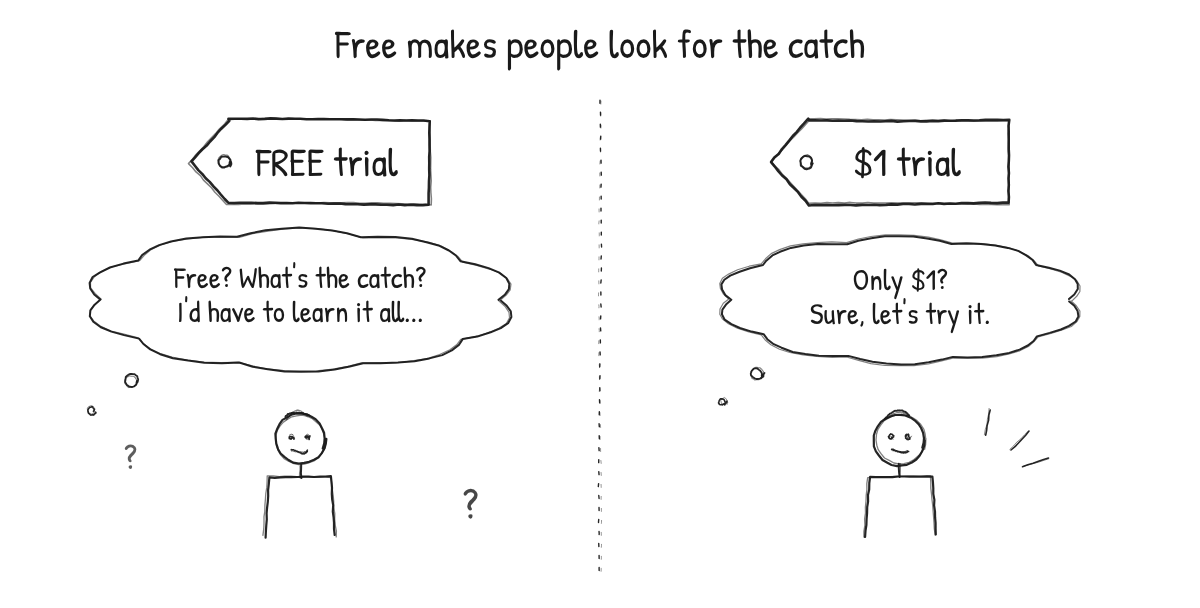
Not always. Research on how people react to a price of zero shows that free does two things at once. It makes an offer more attractive, and it makes people look harder for the catch. When the catch is real, for example when the product takes effort to learn, a small price can convert better than no price at all.
This article covers when to offer a free trial, when to charge for one, how long a trial should be, and which business model patterns give you alternatives to the standard 14-day trial.
Free trial vs. paid trial: the short answer
- Offer a free trial when the product is easy to try: fast setup, little learning, and value customers can see in the first session.
- Consider a paid trial (for example $1 for the first month) when trying the product costs customers something else: time, effort, learning, data migration or perceived risk.
- Consider freemium when the free version can deliver real value on its own, and upgrades are driven by growing usage.
- Stay free when free is the norm. If every competitor offers a free trial, charging even $1 makes you the exception, and customers will judge you against that norm.
The rest of this article explains why.
The big distance between free and $1
The core thesis from behavioral economics is simple: the step from free to $1 is much bigger than the step from $1 to $2. Customers don’t experience prices on an even scale. Zero is a category of its own.
Venture capitalist Josh Kopelman called this the penny gap: “The biggest gap in any venture is that between a service that is free and one that costs a penny” (Kopelman, 2007). His point was that founders wrongly assume getting customers from free to $1 a month is as easy as getting them from $1 to $2.
The research backs this up. In a field experiment at MIT, Shampanier, Mazar and Ariely set up a booth selling Lindt truffles and Hershey’s Kisses. With the truffle at 15 cents and the Kiss at 1 cent, 73% of the people who took a chocolate chose the truffle. Then they lowered both prices by exactly one cent, to 14 cents and free. Now only 31% chose the truffle, and 69% took the free Kiss (Shampanier et al., 2007).
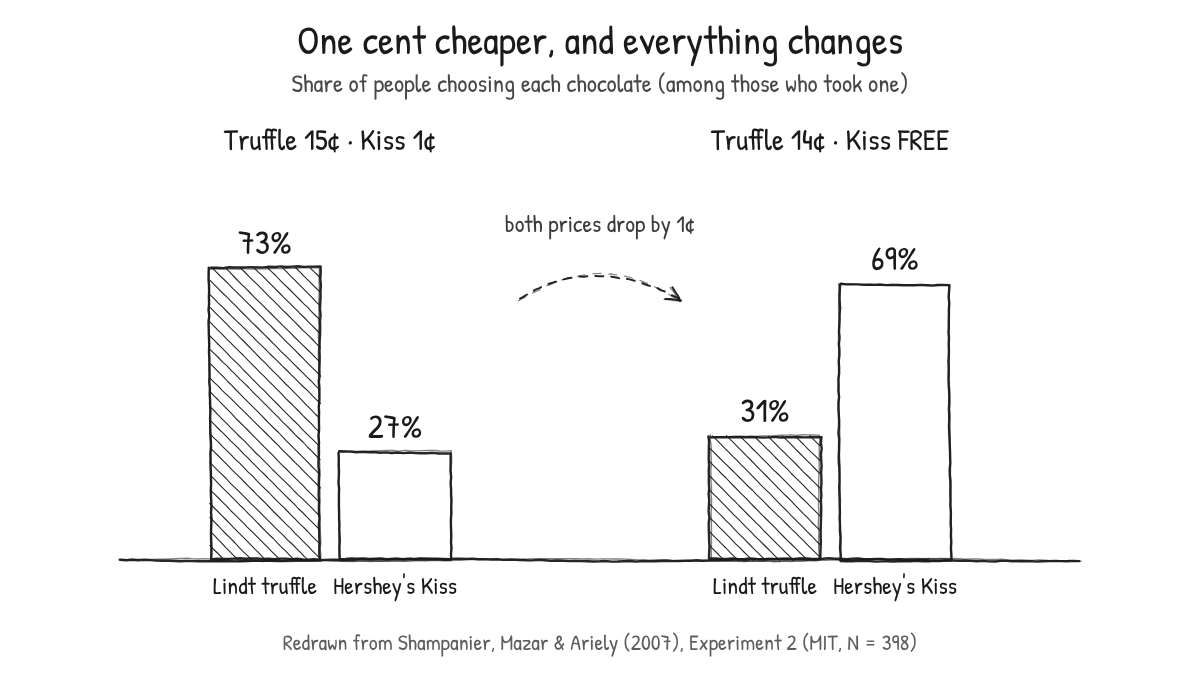
The price difference between the two chocolates was the same in both cases: 14 cents. According to standard economics, nothing should have changed. Even lowering the truffle to 10 cents, a far bigger discount, didn’t win people back from the free Kiss.
The aha: Free isn’t just the lowest price on the scale. It’s a different kind of offer. That’s why going from free to $1 loses far more customers than going from $1 to $2, and why one cent can matter more than cutting a competing price by a third.
The researchers’ explanation is that people don’t treat zero as just a lower price. Free doesn’t only remove the cost. It adds a positive feeling that makes the product itself seem more valuable. This zero price effect is a big part of why free trials and freemium models work, and why asking for the first dollar is the hardest part of pricing.
When free backfires
Fan, Cai and Bodenhausen found the limit of the zero price effect. Across five studies, a price of zero raised demand when the offer came with few other costs, but lowered demand compared to a small price when it came with high “incidental costs”, such as the time it takes to travel to an in-person class or the perceived risk of a new vaccine (Fan et al., 2022).
The reason is that free triggers two reactions at once:
- A positive feeling: “Free, nice.”
- Scrutiny: “Free? So what’s the catch?”
When the catch is small, the good feeling wins. When the catch is big, scrutiny wins, and people talk themselves out of it. A small price changes the inner dialogue. Instead of searching for a reason to say no, customers fixate on the low cost: “Only $1? Sign me up.”
In Kolenda’s summary of the research, an education company found that a small fee converted better than free for in-person courses (which require travel), while free converted better for online courses (which don’t).
What counts as an incidental cost in a digital product?
Your product might be free to try, but it isn’t free to start. Look for the costs users pay in effort and risk:
- Learning: Complex tools with a long time to first value, such as analytics, design or developer tools.
- Setup and migration: Importing data, connecting integrations, inviting a team.
- Switching: Leaving a tool they already use, which status quo bias and loss aversion make feel bigger than it is.
- Risk: Sharing sensitive data, or the fear of a surprise charge when the trial ends.
The more of these your product has, the more a free offer invites scrutiny, and the more a small price might help. You can also flip it around: Reducing those costs (pre-filled templates, imports, guided setup) makes a free offer work better.
When free is the norm, the norm wins
There’s an important limit to all of this. The experiments above compare offers in isolation. Your customers don’t see your trial in isolation. They see it next to every other product in your category.
Customers judge prices against a reference price: what they expect to pay, based on what they’ve seen before. Prices above that reference feel like a loss, and customers react more strongly to losses than to equivalent gains (Kalyanaram & Winer, 1995). That’s loss aversion at work.
In many SaaS categories, the free trial has become a business model pattern customers simply expect. Their reference price for trying a product is zero. In that context, a $1 trial isn’t read as “only $1”. It’s read as “the one that charges for a trial”, and the same penny gap that makes free powerful now works against you. Add the friction of entering card details instead of letting people in first, and a small fee can easily cost more conversions than it gains.
So the behavioral economics points in two directions at once:
- The zero price effect says the distance from free to $1 is huge, so free attracts far more people.
- The incidental cost effect says free makes people scrutinize everything else the offer costs them, so a small price can convert better when trying is hard.
The aha: Whether free or $1 wins isn’t decided by your price alone. It’s decided by what customers expect in your category.
When free trials are the norm, deviating from them is costly, and you’ll usually do better by reducing incidental costs (templates, guided setup, imports) than by adding a price. A paid trial is most likely to work when free isn’t the expected default in your market, when you can make the small fee clearly worth it (for example by including onboarding or setup help), or when you deliberately want fewer, more committed trial users. A small fee has one more effect worth considering: Users who chose to pay, even a little, have seen themselves act like customers. As we explain in our article on self-perception theory, that kind of self-observed commitment shapes how people feel about a product afterwards.
How long should a free trial be?
Longer feels more generous, but it isn’t necessarily better.
Yoganarasimhan and colleagues ran a large field experiment with a SaaS company, testing different trial lengths. On average, the shorter trial produced the most subscriptions, retention and profit. Long stretches of inactivity near the end of a trial were associated with fewer conversions. Experienced users benefited from longer trials, while beginners did better with shorter ones (Yoganarasimhan et al., 2023).
This fits the idea of incidental costs. A short trial adds a little urgency and keeps beginners from drifting away before they reach the moment it clicks. A long trial gives experts time to evaluate the product properly. Either way, a visible trial countdown helps users plan their evaluation instead of being surprised when it ends.
Try it: Match the offer to the user’s level of effort. Kolenda suggests the same logic for a gym: beginner classes could start with a $1 trial to distract newcomers from the effort of getting started, while advanced classes could be free for experienced members who don’t feel those costs.
Alternatives to the free trial from the Business Model Patterns playbook
A free trial is only one way to lower the barrier to a first purchase. Several business model patterns solve the same problem differently, each with its own trade-offs:
| Pattern | How it lowers the barrier | Best when |
|---|---|---|
| Freemium | A basic version is free forever; premium features, limits or storage cost extra. | The free version delivers real value, and upgrades follow naturally from growing usage. |
| Subscription with a paid trial | A low first-period price ($1 for the first month) before the regular subscription. | The product requires effort to try, and you want committed trial users. |
| Pay per use | No upfront commitment; customers pay for what they actually use. | Usage varies a lot between customers, and small customers should be able to start small. |
| Credits | Starter credits let customers try the product for real, and they buy more as they go. | Value is delivered in clear units (exports, generations, downloads). |
| Bait and hook | A cheap or free core product, with revenue from consumables or follow-on purchases (also known as captive product pricing). | The core product creates ongoing demand for something else. |
| Add-on | An attractive base price, with extras customers can add. | Customers have different needs, and most will want at least some extras. |
| Flat rate | One simple price for everything. | Simplicity is a selling point in a complicated market. |
These patterns aren’t mutually exclusive. A freemium product can also sell credits. A subscription can have add-ons. The useful question is: Which barrier stops customers from starting, and which pattern removes it at the lowest cost to you?
Freemium has a pricing problem of its own
The challenge with freemium isn’t getting users. It’s getting them to pay when a good free version exists. Good onboarding is a big part of the answer (see onboarding as a product-led growth multiplier), but so is how you price the premium version.
Gu, Kannan and Ma ran a field experiment with a content provider that offered books as free PDFs and sold paperbacks. Adding a second premium version, an e-book or a hardcover, increased sales of the paperback. The extra option made the paperback the middle choice and gave customers something to compare it to (Gu et al., 2018).
In other words, the free version anchors the bottom of the range. If you only have one paid plan, every customer compares it to free. Adding another tier changes the comparison, the same effect we cover in our guide to price anchoring and the decoy effect.
Instead of discounting, let customers win
If your trial or first purchase comes with a discount, how you give it matters as much as how big it is.
- Probabilistic discounts sell more than certain ones. In Mazar, Shampanier and Ariely’s experiments, a chance to get a purchase for free made people more likely to buy, and to buy more, than a guaranteed discount of the same expected value (Mazar et al., 2017).
- Winning a discount changes how people feel about the store. Hock, Bagchi and Anderson found across seven studies that winning a discount in a promotional game increased conversion and spending compared to an equivalent straight discount, through feelings of luck and a warmer attitude toward the store (Hock et al., 2020). According to Kolenda’s summary, in one of their studies even a lucky 10% discount sold more than a guaranteed 20%.
- Gambled discounts protect your regular price. Regular discounts teach customers to expect lower prices. Alavi and colleagues found that gambled discounts avoid this: customers’ internal reference price didn’t drop the way it did with regular discounts (Alavi et al., 2015).
It’s the same psychology behind variable rewards and rewards in general: an uncertain outcome is more exciting than a fixed one. For a SaaS product, this could be a spin-to-win offer at the end of a trial, a chance to get the first year free, or a scratch card in an onboarding email. Keep the game about luck, not skill, so customers feel fortunate rather than tested. And be careful with B2B and high-ticket products, where a playful promotion can cheapen the offer.
How to decide: questions to test
Pricing a trial is a hypothesis, not a fact. Before you change yours, work through these questions with your team:
- What does it cost a user to try the product, apart from money? List the learning, setup, switching and risk costs.
- What’s the norm in your category? If every competitor offers a free trial, the burden of proof is on any alternative.
- Who is trying it? Beginners and experienced users may need different offers and different trial lengths.
- What does a successful trial look like? Define the activation event that predicts conversion, and design the trial around reaching it.
- Which pattern removes the biggest barrier? Free trial, paid trial, freemium, credits or pay per use.
- What will you measure? Trial starts are easy to increase. Measure paid conversion, retention and revenue per visitor too.
Then test it, ideally before you build any billing changes. A fake door test can show whether a “$1 for your first month” offer gets more clicks than “Start your free trial”, and an A/B test can confirm the effect on paying customers.
Go deeper into business models and pricing
The Business Model Patterns card deck gives your team the patterns in this article, and many more, as cards you can use to explore alternatives in a strategy workshop. If you want to go further into the psychology of the price itself, the Psychology of Pricing PDF book collects 100+ behavioral pricing tactics for pricing pages, plans and promotions.
- Shampanier, K., Mazar, N., & Ariely, D. (2007). Zero as a special price: The true value of free products. Marketing Science, 26(6), 742-757.
- Fan, X., Cai, F. C., & Bodenhausen, G. V. (2022). The boomerang effect of zero pricing: when and why a zero price is less effective than a low price for enhancing consumer demand. Journal of the Academy of Marketing Science, 50(3), 521-537.
- Kalyanaram, G., & Winer, R. S. (1995). Empirical generalizations from reference price research. Marketing Science, 14(3), G161-G169.
- The Penny Gap by Josh Kopelman
- Yoganarasimhan, H., Barzegary, E., & Pani, A. (2023). Design and evaluation of optimal free trials. Management Science, 69(6), 3220-3240.
- Gu, X., Kannan, P. K., & Ma, L. (2018). Selling the premium in freemium. Journal of Marketing, 82(6), 10-27.
- Mazar, N., Shampanier, K., & Ariely, D. (2017). When retailing and Las Vegas meet: Probabilistic free price promotions. Management Science, 63(1), 250-266.
- Hock, S. J., Bagchi, R., & Anderson, T. M. (2020). Promotional games increase consumer conversion rates and spending. Journal of Consumer Research, 47(1), 79-99.
- Alavi, S., Bornemann, T., & Wieseke, J. (2015). Gambled price discounts: A remedy to the negative side effects of regular price discounts. Journal of Marketing, 79(2), 62-78.
- Charge for Product Trials That Require Effort by Nick Kolenda
- Let Customers Win Their Discount by Nick Kolenda
- Business Model Patterns by Anders Toxboe